



The lovely Stephen Follows recently published a piece called Hollywood gives men second chances it doesn’t give women. While the piece was good, and well-argued, something bothered me in it that I couldn’t fully articulate. I kept drafting comments and then deleting them until I finally decided it was worth its own piece.
The second chances idea had already come up for me while researching my epic essay on #OscarsSoWhite, specifically the trajectory of Ava DuVernay, a trained publicist who masterfully spun a missed Academy screener deadline into a heroic #OscarsSoWhite narrative on Selma.
Selma was a $20m prestige drama. Her next fiction feature, A Wrinkle In Time, a roughly $125m fantasy epic, made her the first Black woman in history to direct a film with a $100m+ budget.
While researching that film, I realized that A Wrinkle In Time was a colossal financial failure. It added DuVernay to a more infamous list, as a director of one of the 25 biggest bombs of all time, which I am calling a megabomb. The film ultimately lost Disney an estimated $164m.
A Wrinkle in Time was supposed to be proof that Hollywood’s old white boys’ club was finally changing. Instead, through its failure, it became proof of how the “boys’ club” was actually an elaborate, hyper-competitive talent pipeline that couldn’t be easily tweaked for activist sensibilities.

DuVernay went from directing a $20 million prestige drama to directing a $125m+ fantasy epic without any intermediate project, either in genre or scale. She had no proof that she could deliver a grand scale, broadly successful commercial entertainment. A mid budget attempt at such would have been far less costly to both the studio and DuVernay herself.
When A Wrinkle in Time failed, she had no bomb shelter: no commercial franchise she had created, no previous tentpole success to prove she deserved another shot. While she has continued to direct, including NETFLIX’s excellent tv series When They See Us and NEON’s Origin, DuVernay has not directed a film with a blockbuster budget, defined here as $100m+, since.
After seeing this, I became curious to investigate how the directors of the 25 biggest bombs got their jobs, and whether they were allowed to work at that same level again. I also wanted to investigate whether there was gender bias at work, as Follows showed on a broader range of films, and as folk wisdom has told us for years.
So do women actually get fewer second chances?
Yes. But not just because of their gender. A director who has already made a blockbuster has something enormously valuable to fall back on if the next one bombs: proof that they can make a successful high budget film.
I call this “the banked-hit effect.” And it turns out to be a much better predictor of who survives a bomb than gender.
A Brief History of Megabombs

Megabombs are as old as blockbusters, and they’ve never been far apart. D.W. Griffith met the racism charges against Birth of a Nation — Hollywood’s first blockbuster — with defiance. He then blew a fortune rebuking his critics with Intolerance, and delivered one of cinema’s first iconic megabombs.
Intolerance was an extraordinary financial failure. Griffith reportedly spent as much as $2.5 million on it—roughly $74 million today—and the film’s failure left him financially ruined.
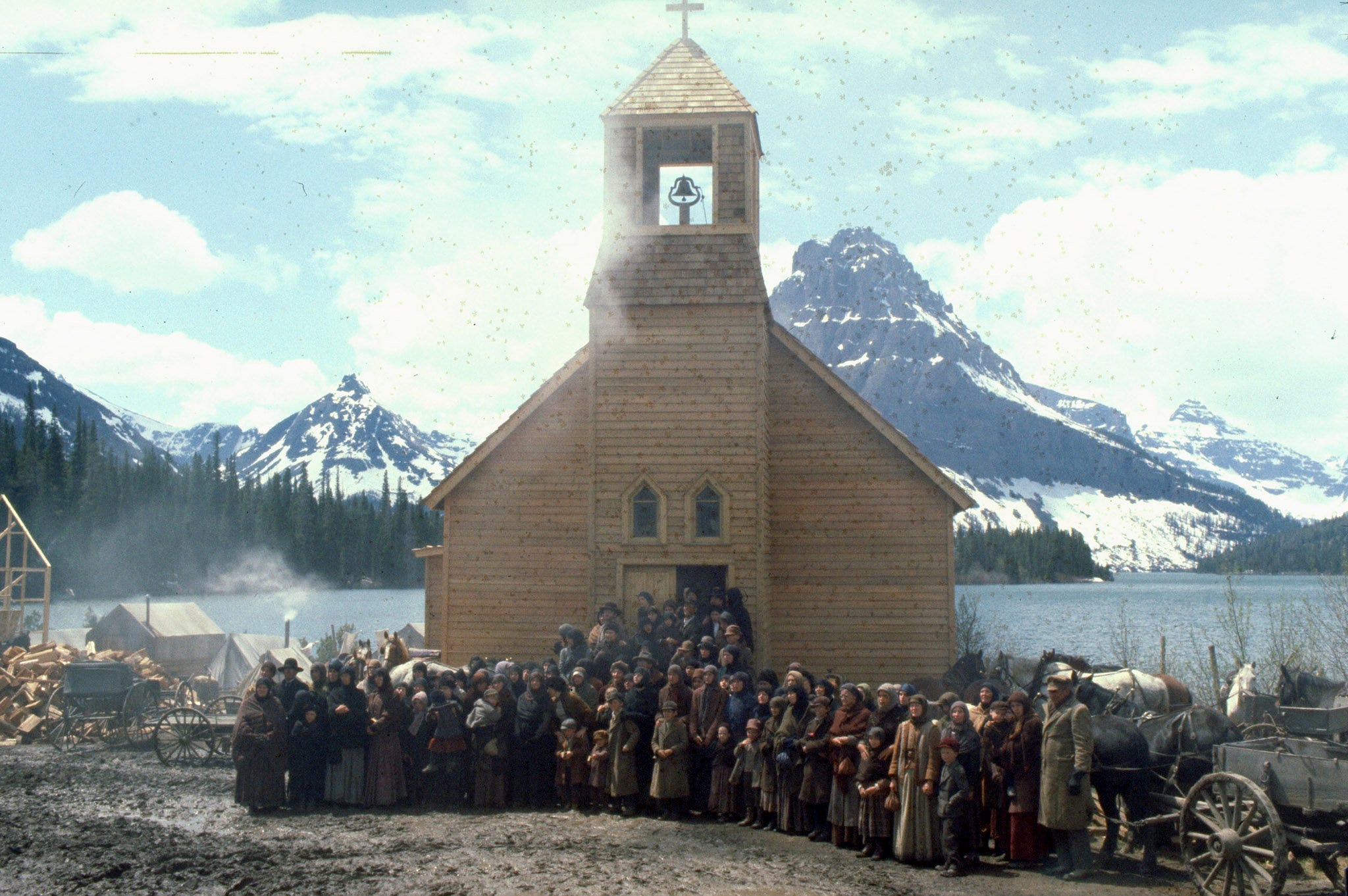
Michael Cimino’s 1980 Heaven’s Gate lost the inflation-adjusted equivalent of $158m. It famously tanked United Artists and ended the new cinema of the 1970s.
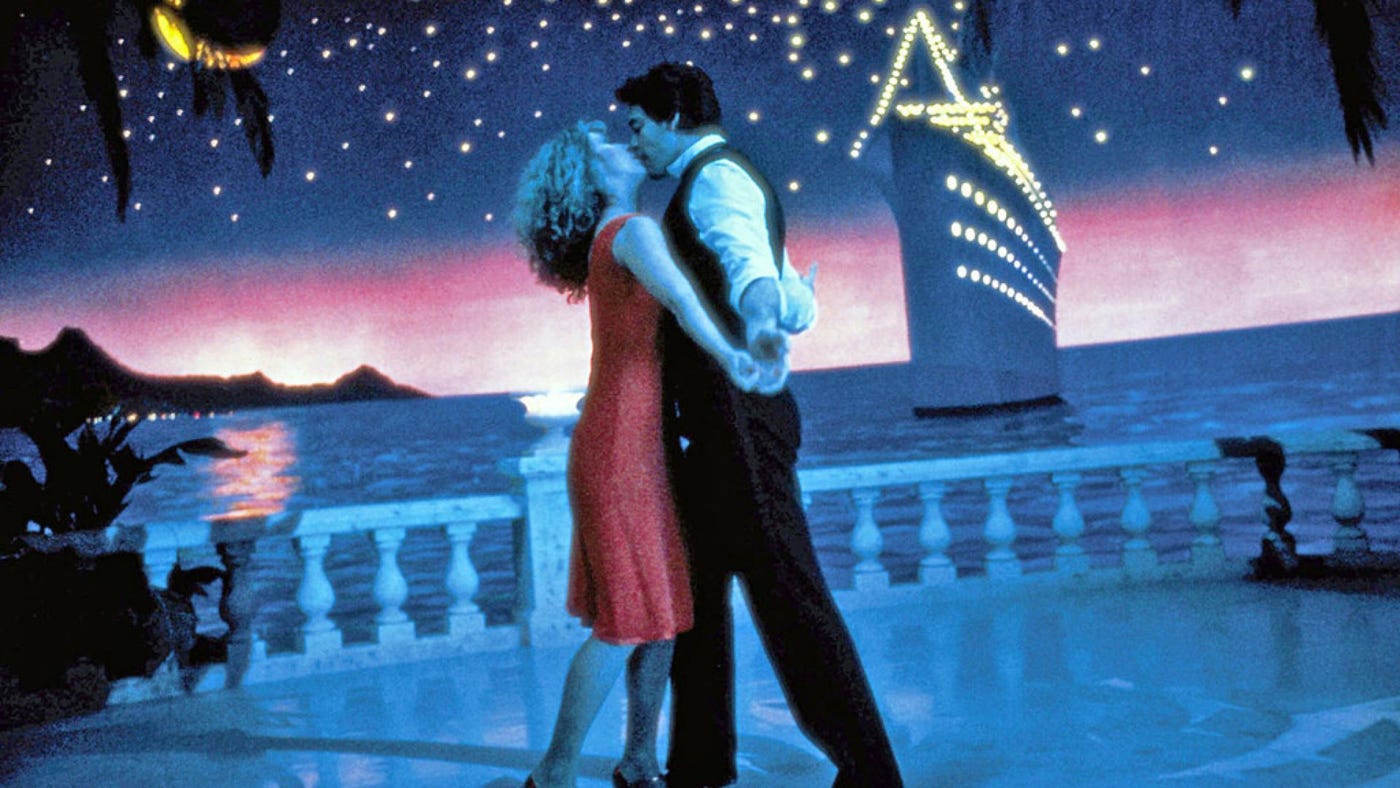
It’s not always just studios that blow themselves up. Like Griffith, after putting his own assets on the line to fund his 1981 bomb One From the Heart, Francis Ford Coppola was forced to mortgage his properties, including his Napa Valley land.
His financial problems brought us the much-maligned 1990 sequel The Godfather Part 3, which he had previously refused to make. While it was critically savaged, it did manage to turn a profit. Soon he was able to make his 1992 smash-hit Bram Stoker’s Dracula, which allowed him to finally pull himself out of the hole.
Coppola soon blew his wine/Dracula fortune on yet another movie. In 2021 he folded the Francis Ford Coppola Winery into Delicato, in a deal reportedly worth north of $500m. He kept an equity stake, which became the collateral for a roughly $200m loan. Coppola poured about $120m of that into Megalopolis, an epic he'd been chasing since the '80s. That movie bombed too — earning just $14m in worldwide box office against a $120m budget — and is now the subject of the lovely making-of doc Megadoc.
To prepare for this piece, I constructed a database of 515 blockbusters with $100m+ budgets. Megalopolis has the lowest ROI of any film among wide theatrical releases, measuring just .12, which meant that the film returned only a tenth of its production budget.
To "keep the ship afloat," Coppola began auctioning off rare watches, one of which earned him almost $11m — roughly $4m more than Megalopolis earned at the US box office.

Coppola is far from the only iconic filmmaker with several huge bombs under his belt. Scorsese almost died after New York, New York flopped. The aftermath drove him into a cocaine spiral and eventually the hospital, where De Niro famously pitched him Raging Bull. Hugo, his first $150m budget, lost about $130m.
But none of these iconic bombs even made it into the top 25. To make it to megabomb status, you have to lose even more money than that.
What Counts as a Bomb?
To be a true bomb, a movie first of all has to be very expensive. The first film with a confirmed production budget at or above $100m (unadjusted for inflation) was James Cameron’s 1994 blockbuster True Lies.
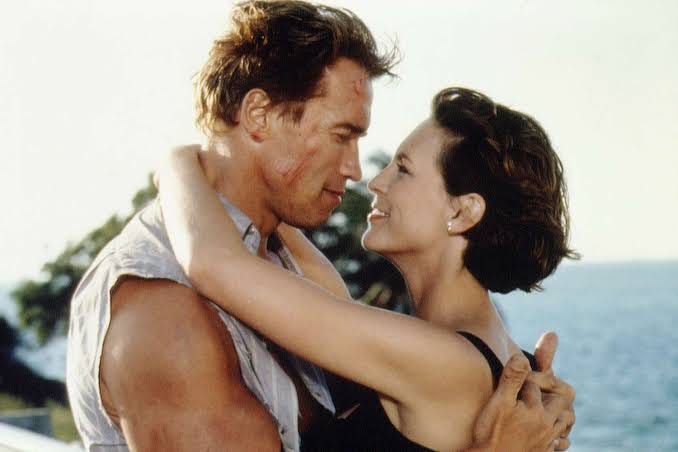
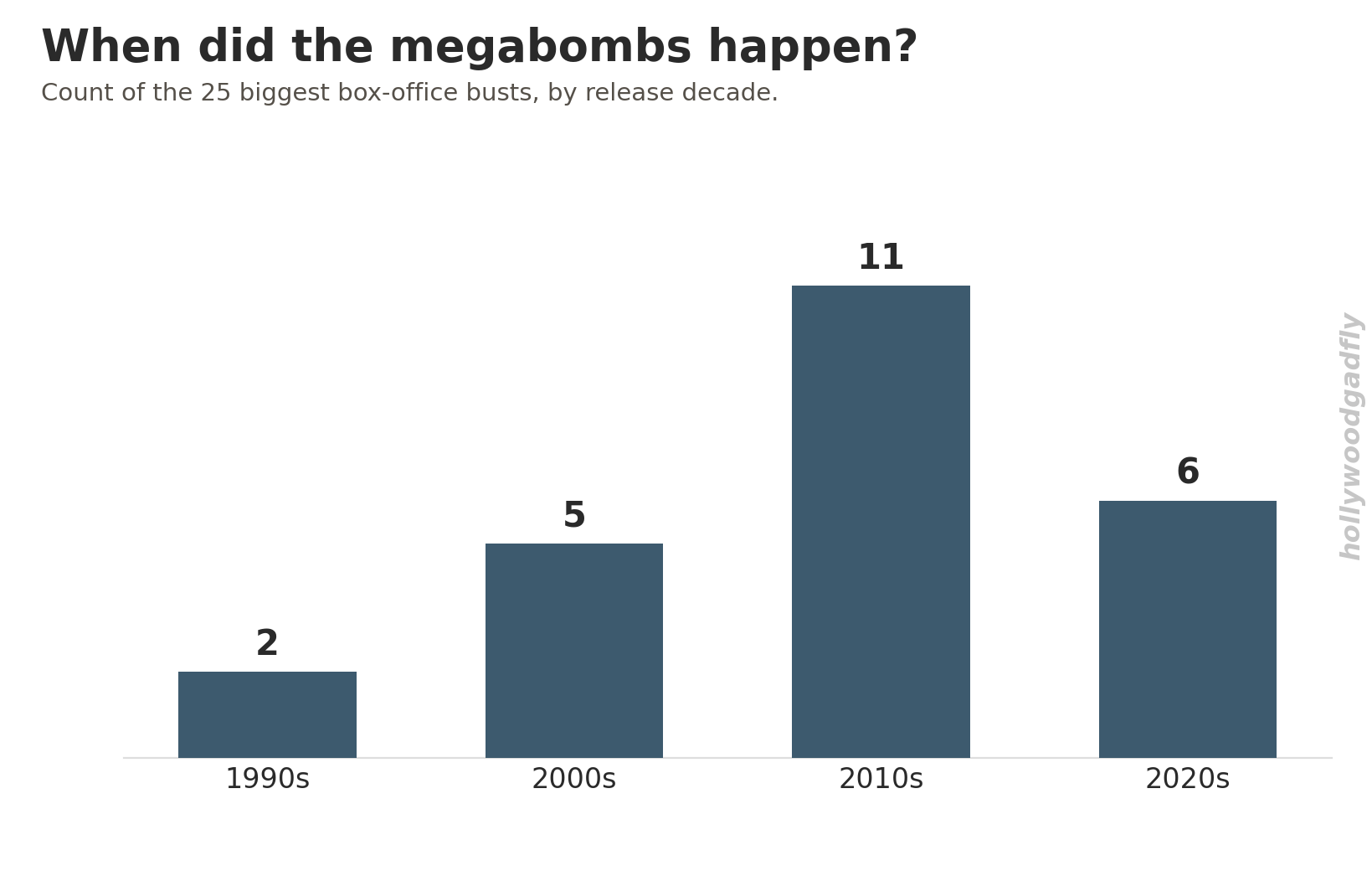
The number of $100m+ budget films rapidly expanded as the 90s (and inflation) continued. Today there have been over five hundred $100m+ films.
The number of megabombs also increased, tracking their blockbuster siblings, and Hollywood’s overall trend toward fewer, bigger movies.
A brief note on Methodology:
The 25 biggest bombs presented here are the upper bound, inflation-adjusted losses based on the box office release including marketing. These figures are drawn from Wikipedia’s list of the biggest box office bombs of all time, which in turn draws from Box Office Mojo, the Numbers, and a variety of other sources. Wikipedia’s floor for inclusion is a $110m loss. I independently verified the numbers myself.
Loss figures are adjusted for inflation using the CPI. In one or two instances I had to correct wikipedia’s numbers, I have not corrected the actual page. Sources for each film at the end of the article.
I explicitly did not include films that did not have theatrical releases in at least 1,500 theaters, which excluded several pandemic-era straight to streaming titles listed elsewhere. It did not feel fair to compare pandemic era straight to streaming releases to films that were released wide in theaters.
Meet the Megabombs
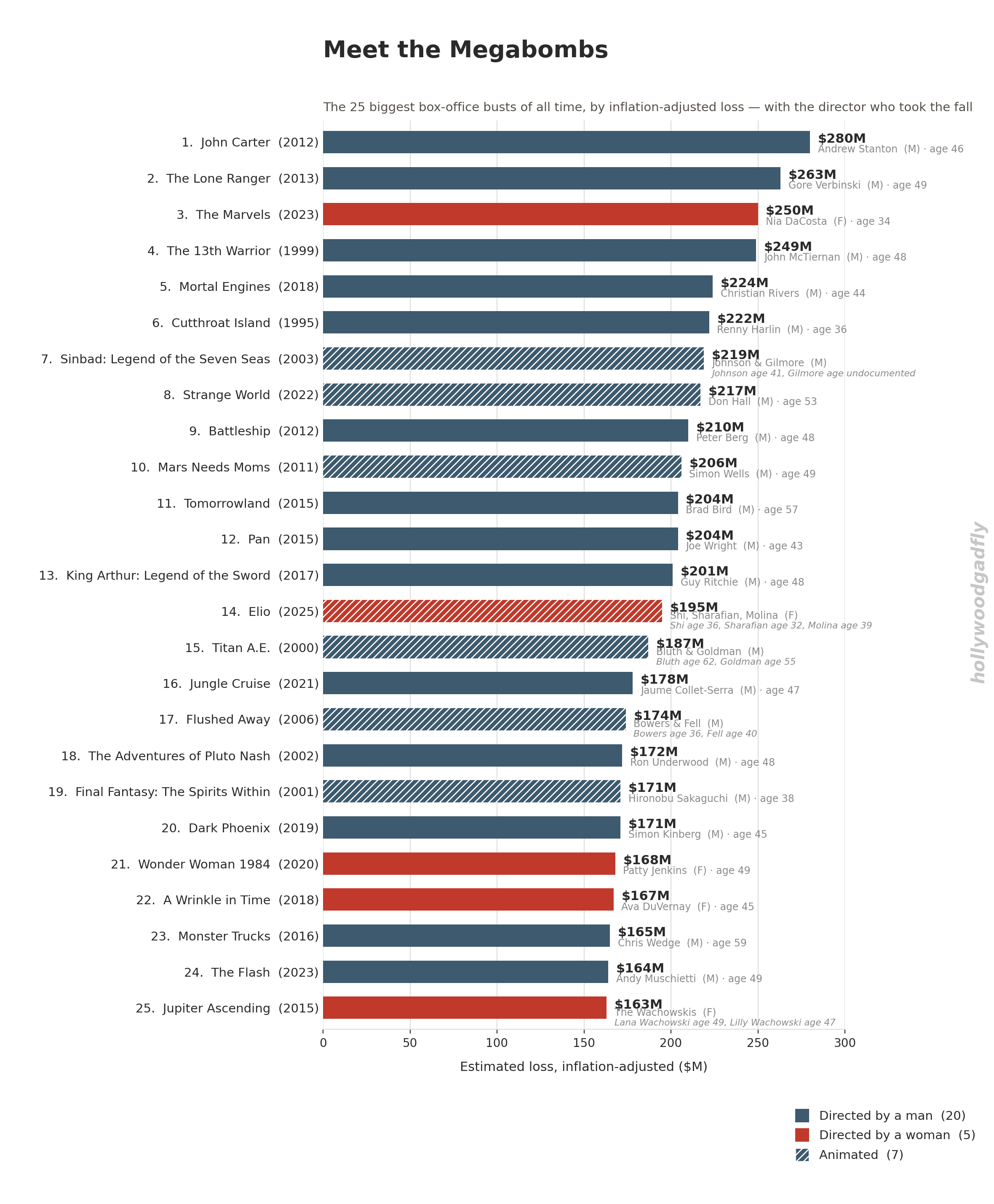
Here are the biggest bombs of all time, with the genders broken out by color, animation in bars, and the directors’ names and ages at the time of the film below the loss figure.
Some Basics:
The 25 megabombs were directed by 28 individual directors: 21 men (75%) and 7 women (25%).
Their average age is 46, and the median is 48.
The youngest director is 34 (Nia DaCosta) and the oldest is 62 (Don Bluth).
There are seven animation films (28%) and eighteen live action films (72%).
Breaking In
The first clue to the megabomb is how few of these directors had actually proven themselves commercially before they were handed nine figure budgets.
Here they are on box office/budget multiples, i.e. how many times they made back the budgets of their pre-bomb films. I set the baseline for a modest hit at 3.5x the production budget, using the rule of thumb that a film needs at least 2.5x to recoup. This also takes into account that money often sits for years on movies before recoupment, whereas if it had been invested in, say, an S&P index fund, it would have been compounding the whole time.
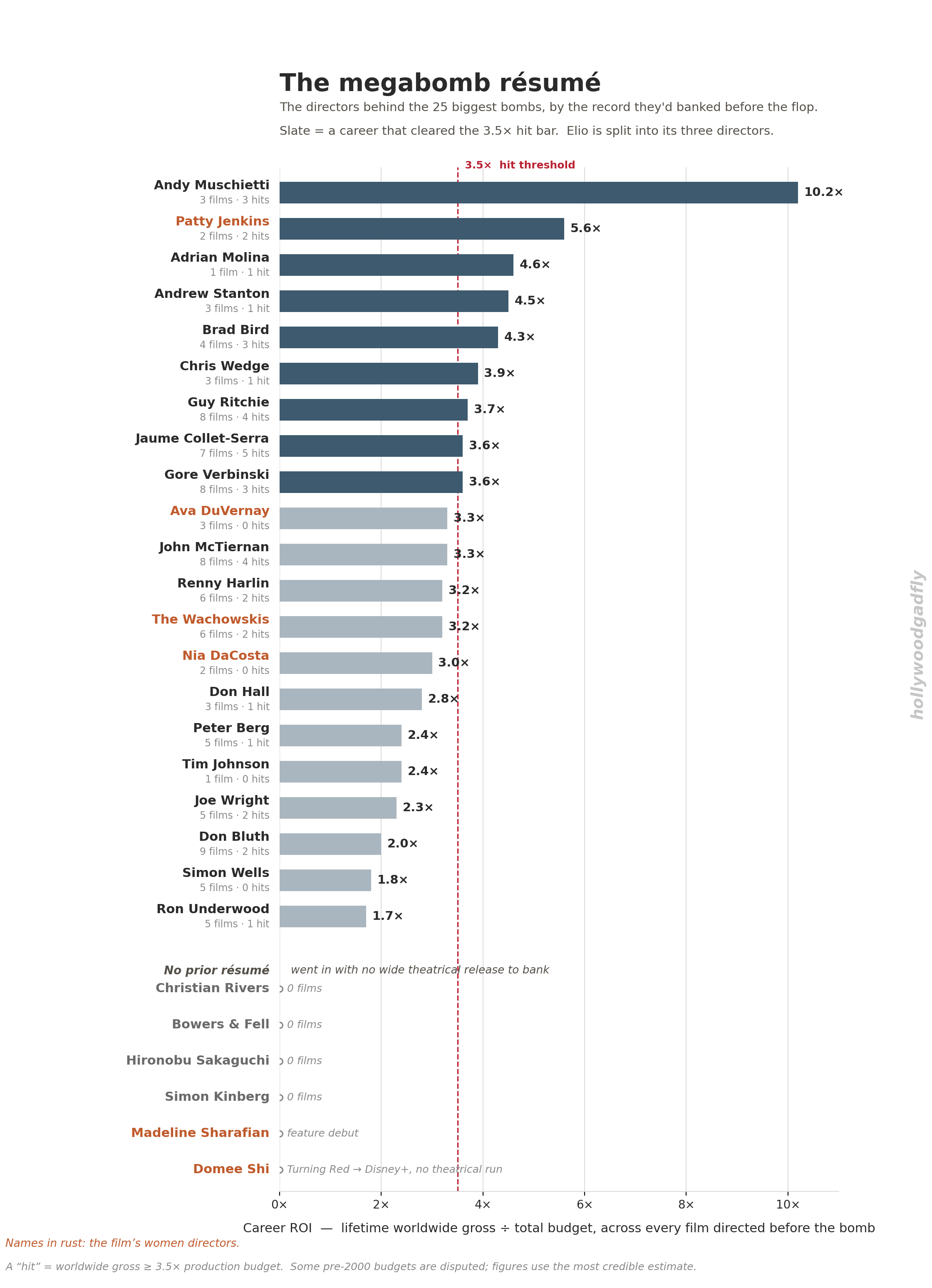
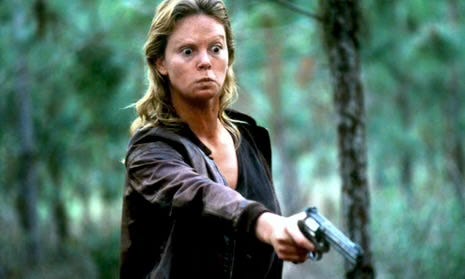
Muschietti is the clear winner here. This is because horror, with its low budgets and high returns, is the ROI king. Patty Jenkins, at number 2, is the female standout. With just two movies she delivered a sizable amount of profit, especially impressive since her first feature Monster is a bleak drama, although people do love serial killers.
Again, our crude rule of thumb is 2.5x for breakeven, which six of these directors failed to cross on average. Seven had no prior feature credits at all, which is kind of wild at these budget levels.
Only a third of the directors had directed at least one film that returned at least 3.5x its budget, a modest hit, which is also eyebrow-raising. Here’s how they did on raw money spent and earned:
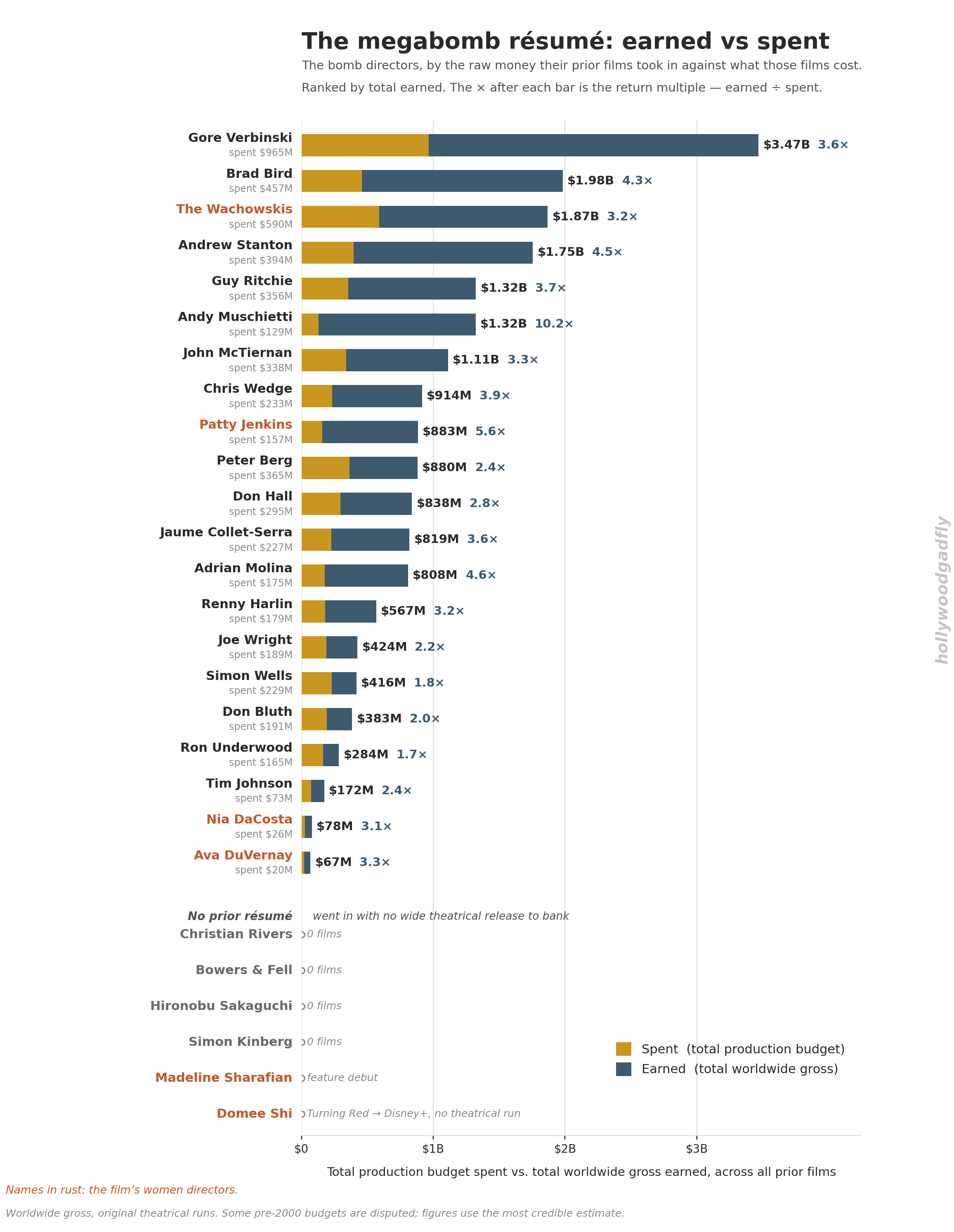
Some of these bets made a lot of sense. Towards the top of this table, investors had made a metric fuckton of money on Gore Verbinski, who made the horror hit the Ring, as well as the wildly successful Pirates of the Caribbean movies, also starring Johnny Depp.

Clearly everyone was hoping to start another franchise with the Lone Ranger. But they may have forgotten about the western curse:
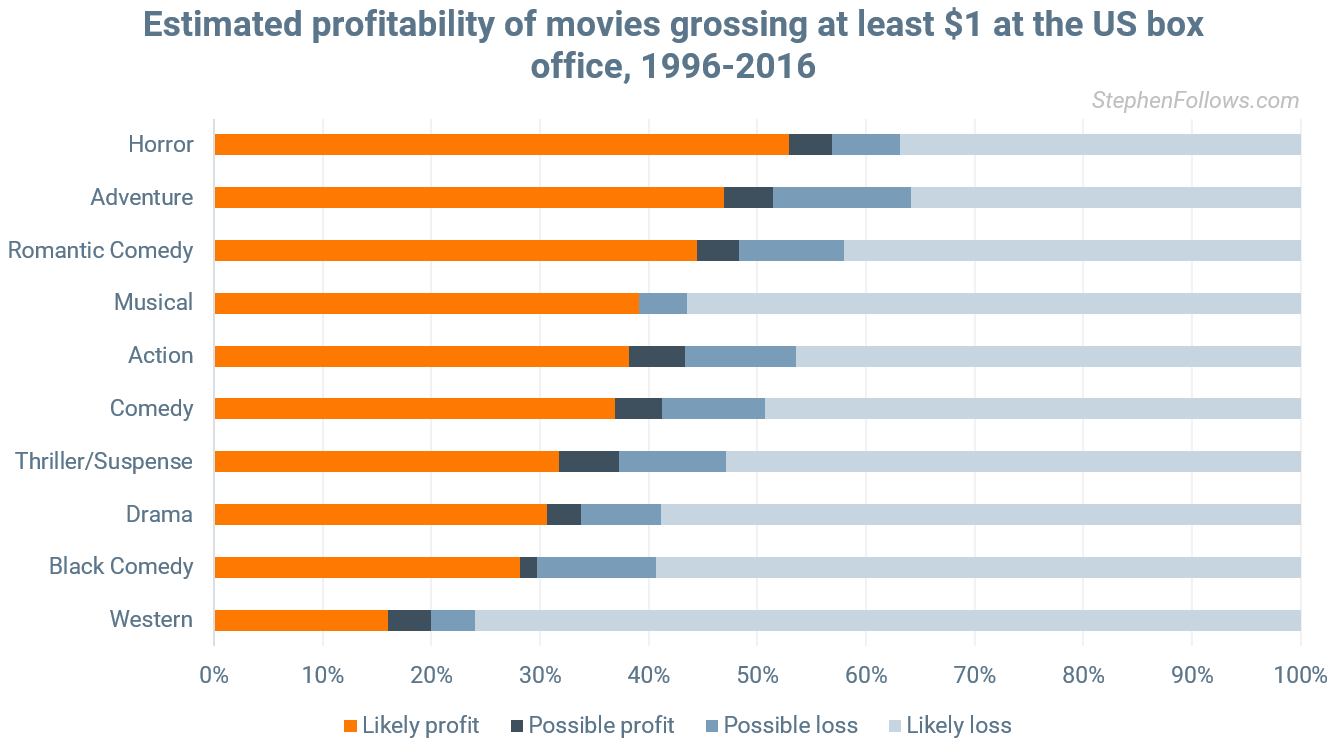
The amount the rest of these directors earned rapidly deteriorates down the pipeline, ending in seven directors who had never even done a feature.
Among the four codirecting teams, all in animation, the three Elio codirectors are a mixed bag. Domee Shi had directed the pandemic-pulled but streaming hit Turning Red, while Madeleine Sharafian had been nominated for an Oscar for an animated short. Adrian Molina had had a genuine hit with Coco, but was removed from Elio after a difficult test screening.
Farther down the line we have several directors with no credits. Simon Kinberg had written several successful X Men movies but never directed one. Hironobu Sakaguchi had created the Final Fantasy video game but never directed a movie. Christian Rivers was Peter Jackson’s Oscar winning VFX artist on movies like King Kong. Bowers and Fell of Flushed Away had no listed credits at all before their bomb.
Again, depressingly, Ava DuVernay and Nia DaCosta are at the bottom of the directors who had made actual films. There’s an even crazier way of looking at this, the budget leap from their last feature to their megabomb:
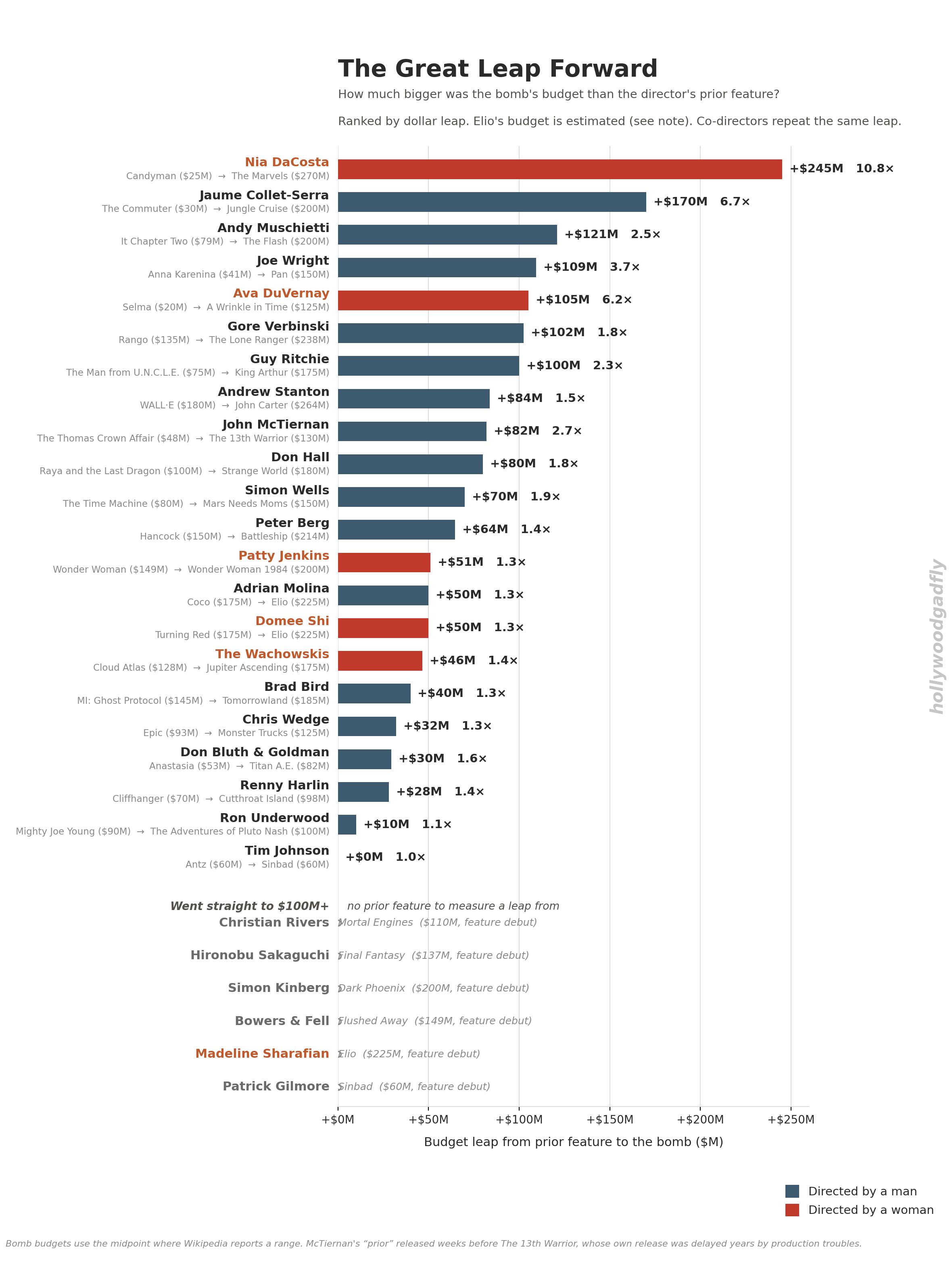
Choosing DaCosta looks downright crazy from this point of view. At 34 years old, she was not only the youngest director ever handed a budget at this level, she had the second worst total earnings, after only DuVernay (#5 biggest leap).
DaCosta is the extreme version of the problem. Her previous feature was a ~$22m horror movie. Her next was a roughly $270 million Marvel tentpole—nearly eleven times the budget. She had never banked a blockbuster, never directed a $100 million movie, and had never made anything remotely close to this scale.
Hollywood gave DaCosta her first major chance at a level where failure is catastrophic.
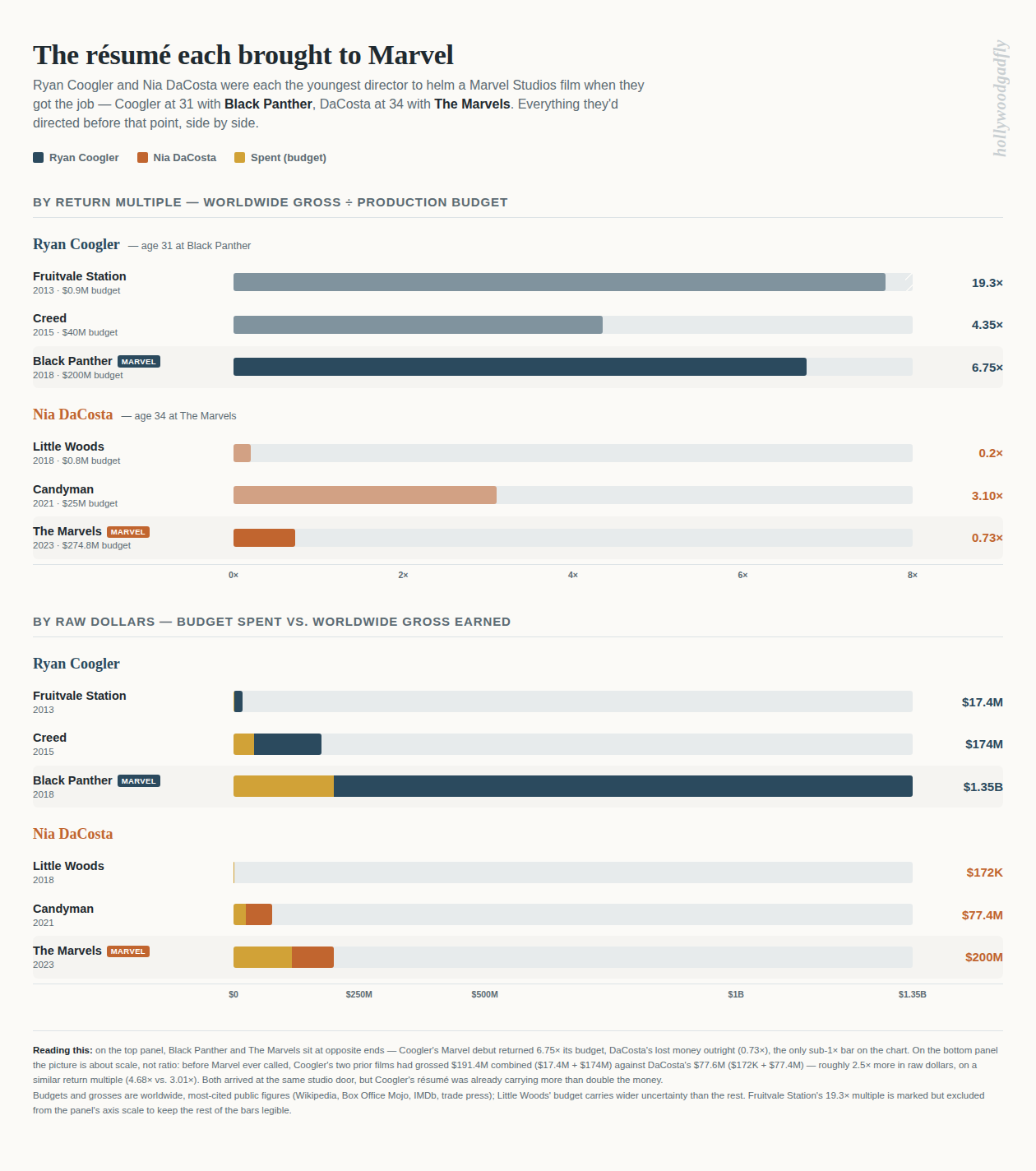
It was a truly wild bet. For reference, let’s look at Ryan Coogler’s path to Black Panther.
Coogler was the only marvel director younger than DaCosta, but he had already made larger films that had significantly outperformed hers. If we did our budgets to earnings multiple and raw money comparison, they look completely different, leading into the Black Panther box office explosion:
A Franchise and Corporate Graveyard
Twenty one of the twenty five films, or 80%, are original, while only four are sequels. None of these sequels sparked another entry in the franchise.
The originals, as we saw with Lone Ranger, were supposed to be franchise starters.
Five of the seven animated films didn’t just lose money, they literally ended a studio or a division. Titan A.E. shuttered Fox Animation Studios; Final Fantasy sank Square’s film arm; Mars Needs Moms closed Zemeckis’s ImageMovers Digital; Flushed Away ended the Aardman–DreamWorks deal; Sinbad was the flop that pushed DreamWorks to abandon hand-drawn animation for good. Last year’s Elio was Pixar’s worst box office opening ever.

Cutthroat Island was the final nail in the coffin for Carolco, the iconic company that had produced Total Recall, Basic Instinct and Terminator 2. The company had been struggling for years. After Cutthroat, Carolco’s chairman resigned, its film library was sold off to Canal+, and the company ceased to exist.
Genre Hopping Is A Landmine
Did the biggest bomb directors stay in their own established genre lane? Mostly not. Only a third kept to the genre they’d succeeded in.
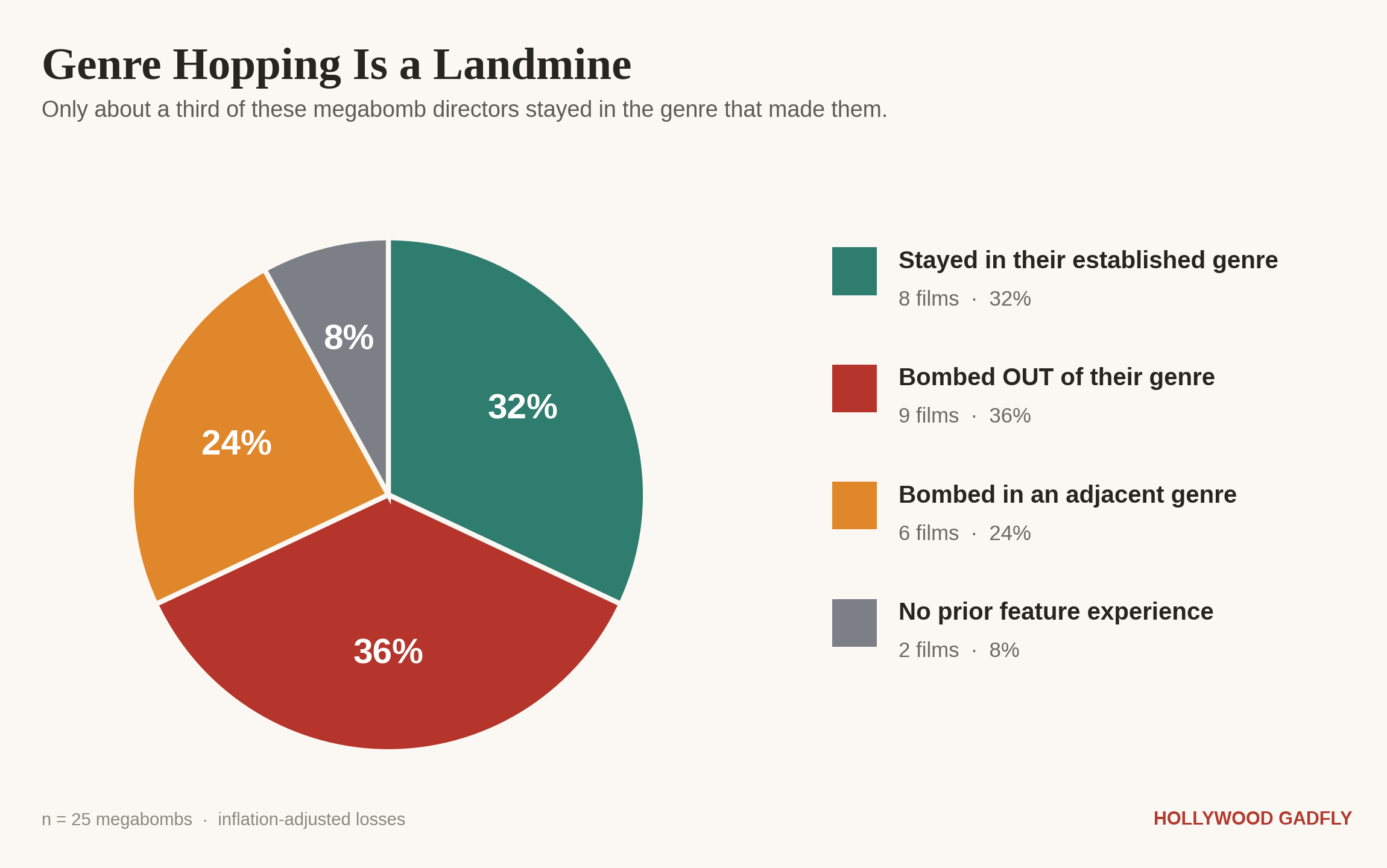
Eight bombed in their established genre, almost entirely in animation: Bluth (Titan A.E.), Wells (Mars Needs Moms), Johnson and Gilmore (Sinbad), Hall (Strange World), Molina, Shi and Sharafian (Elio), and Bowers and Fell (Flushed Away).
On the live action front: Jenkins was directing a sequel to her own movie. Simon Kinberg (Dark Phoenix) had never directed before, but had written several X-Men movies already.
Nine bombed out of their established genre:
Animation → Live-Action: Andrew Stanton (WALL·E → John Carter), Brad Bird (The Incredibles → Tomorrowland) and Chris Wedge (Ice Age → Monster Trucks), all combusted on their first attempt at live-action.
Horror → Superhero: Muschietti (It → The Flash) and DaCosta (Candyman → The Marvels), two horror breakouts crash landed a comic book franchise.
Prestige drama → CGI fantasy: Ava DuVernay (Selma → A Wrinkle in Time) and Joe Wright (Atonement → Pan), awards-circuit directors colliding with the green-screen.
Action/Thriller → Family Adventure: Collet-Serra (The Commuter → Jungle Cruise) and Renny Harlin (Cliffhanger → Cutthroat Island.
Six bombed in an adjacent genre: Gore Verbinski (pirate fantasy → western), Guy Ritchie (period action → fantasy action), John McTiernan (action → historical action), Peter Berg (superhero/action → naval sci-fi), Ron Underwood (comedy → sci-fi comedy), The Wachowskis (action sci-fi → adventure sci-fi).
Two bombed without any real feature experience to compare to: Mortal Engines’s director had worked as a vfx artist for Peter Jackson, while Hironobu Sakaguchi was a video game designer making the leap to directing with Final Fantasy.
The Bomb Shelter

And here’s where we get to the meat of the matter:
In the broader dataset, 50% of directors who bombed with a banked blockbuster hit eventually returned to $100M+ filmmaking. Among those without one, only 25% did.
That’s the bomb shelter. In giving second chances, Hollywood doesn’t appear to be asking “is this director a man or a woman?” What they’re asking is, “has this person already made a blockbuster hit?”
The problem is that, historically, the pool of incumbents was overwhelmingly male, and that’s the pool Hollywood still largely draws on. This is a big part of why the female blockbuster director growth rate is so anemic, on the order of .3% a year, as I showed in my Annenberg Ouroboros piece.
This is because the women have three options:
Drive the incumbents out.
Wait for them to age out, which happens very rarely.
Wait for them to fail, which knocks out about half.
Gender Gaps
There are twenty one men in this rarefied list (including one Elio codirector), and seven women, including the trans Wachowskis and the other Elio codirectors.
It’s important to note that the median budget for a female-directed blockbuster is also $150 million, identical to the overall.
There are several gender gaps hiding in the data.
Women are 6.1% of the directors who’ve made a $100M+ film in this database — but only 4.9% of the films themselves were female-directed. The reason is repeat work: male directors average 1.96 blockbuster credits apiece (Michael Bay has nine, Spielberg and Nolan eight each), while female directors average 1.67, Outside the Wachowskis, almost none crack a third film.
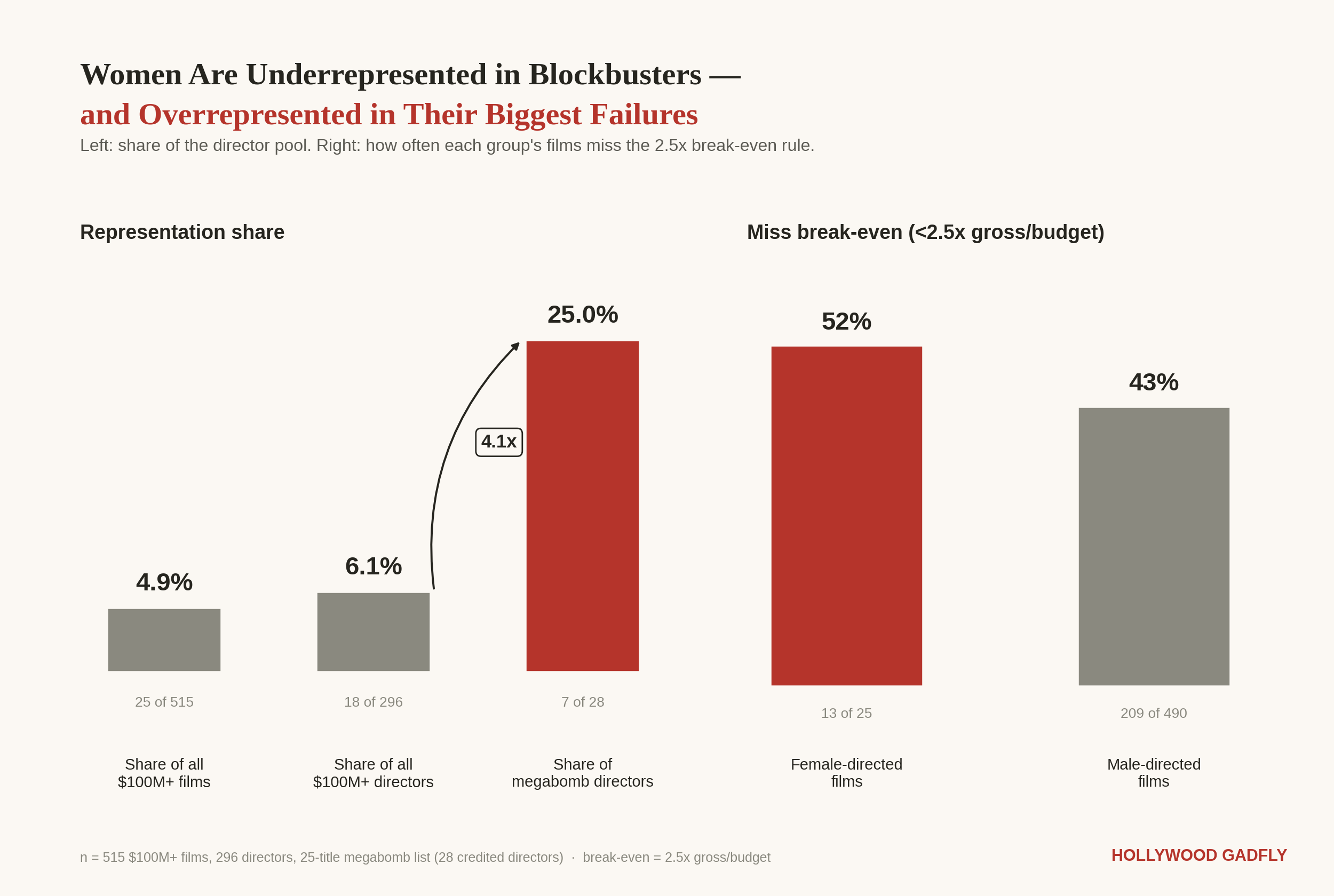
52% of female-directed films miss break-even, versus 43% for men. I tested it and relaxing the 2.5x recoupment baseline to 2.3x actually works in favor of the men, adding an extra 3-4% to their success, while having no impact on the women.
In the megabomb category, it gets even worse: women are overrepresented at 4x the rate of the general blockbuster pool. Depressingly, the only two blockbusters ever directed by Black women are represented in the megabombs: Ava DuVernay (#23) and Nia DaCosta (#3).
Overall, women received far less $100m+ films, which means the female cohort is composed almost entirely of first-time blockbuster directors — and first-timers of either sex bomb at elevated rates, because a prior hit is the single best predictor of the next one.
As Stephen Follows found, blockbuster directors are also getting older, and this is why; it pays to work with incumbents. It’s very difficult to become a successful blockbuster director, and once you do, you tend to stick around for a long time.
The Banked Hit Effect
So who got another shot at a blockbuster? Let’s look at the chart again, with the survivors starred.
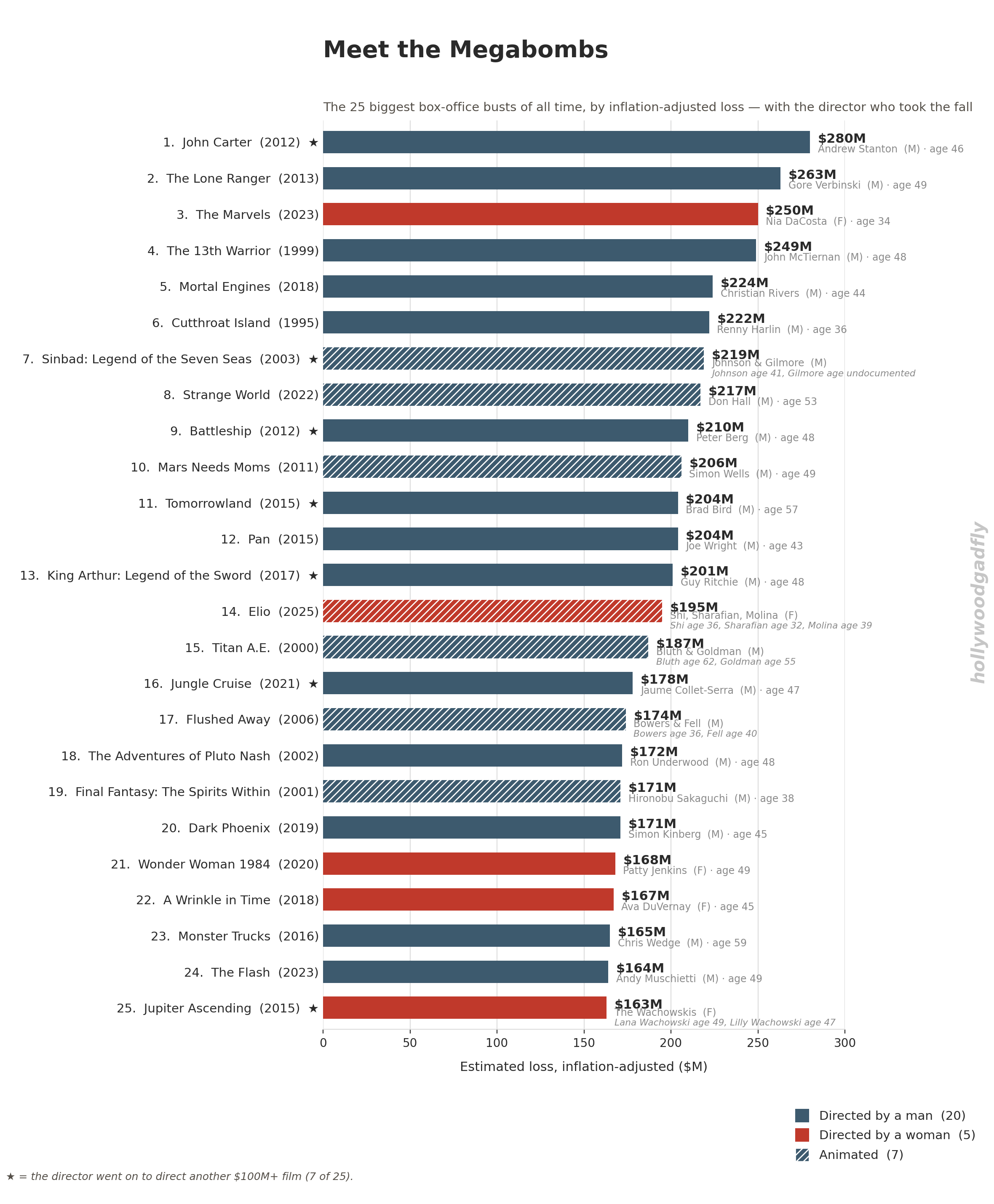
There’s a simple answer to building a bomb shelter: what best predicts survival after a massive bomb is not your gender, but whether you arrived with a banked blockbuster hit, especially in a franchise your created.
Another term for it might be “the banked hit effect.”
This is for a couple of interlocking reasons:
A prior blockbuster is enormous, measurable insurance against future failure.
One failure is enough to eject most directors from the tentpole system.

The strongest bomb shelter, let’s call it the reinforced one, was a successful franchise the director created. Three of the seven survivors used that strategy: Stanton made Finding Dory, Bird The Incredibles 2, and the Wachowskis made a 4th Matrix sequel.
It’s like how Coppola fled back to The Godfather Part 3, unwillingly, after One from the Heart and the Cotton Club tanked.
The other four got another shot without that insurance policy, but they had all directed blockbuster hits: Ritchie (Sherlock Holmes) Berg (Hancock), Johnson (Antz), Collet-Serra (The Commuter, The Shallows). Let’s look at the genders:
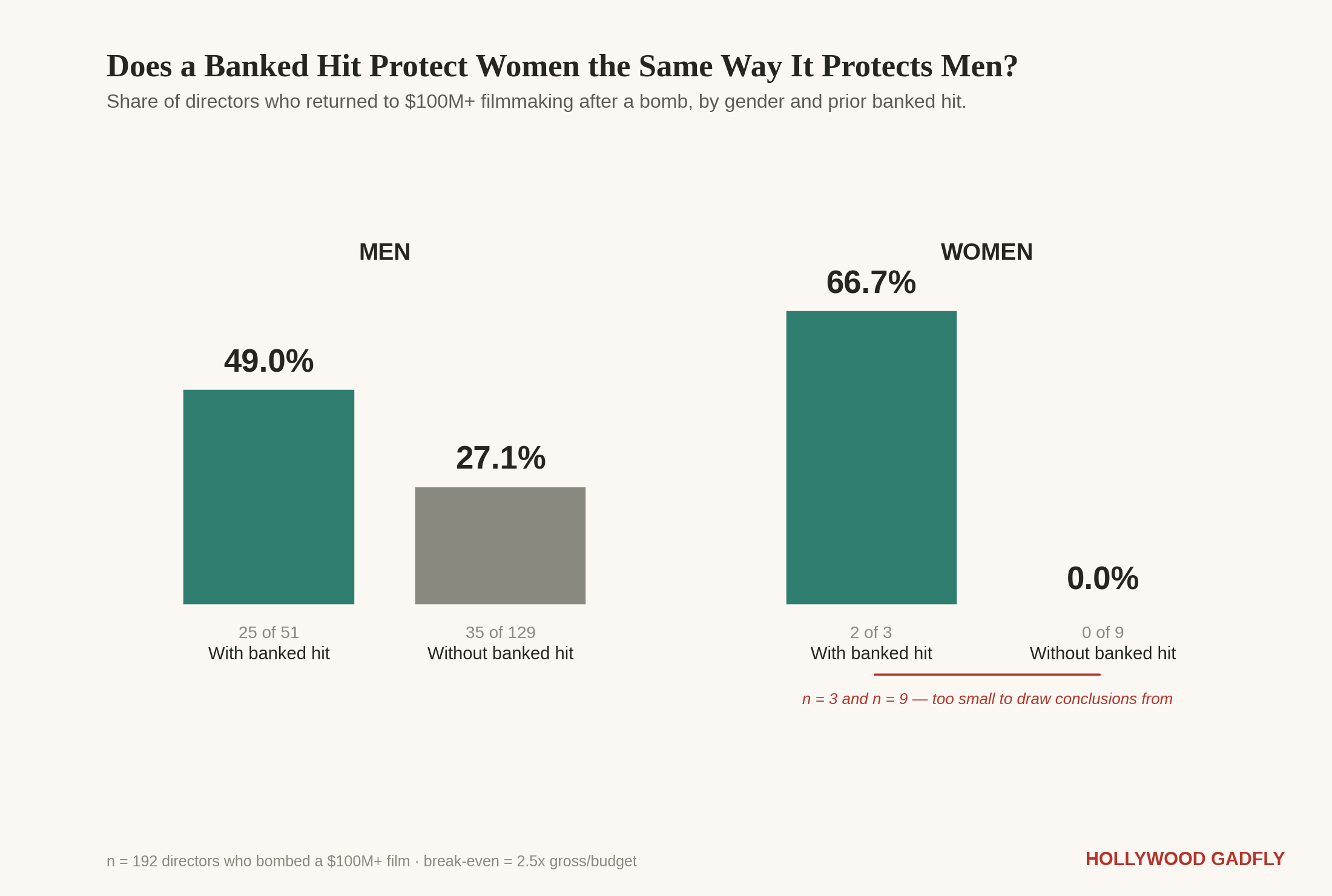
We are starting to reach the limits of the data here: there are so few female blockbuster directors that even one more returning might throw the data off. But if the men are any indication, the banked hit effect is quite strong.
Perhaps as more women get these opportunities, their numbers will converge near the male baseline. Based on what we’ve seen, this will likely take a very long time.
Bombing a Franchise is Worse than an Original
An original bomb is often interpreted as “the movie didn’t work.” A franchise sequel bomb is interpreted as “the director couldn’t deliver the franchise.”
Franchise sequels are like massively expensive episodes of television: the directors are largely expendable.
As we saw, after bombing a blockbuster, the directors who created franchises retreat to them to lick their wounds. But not all directors have this option, and it’s more brutal for someone who’s directing a sequel.
Of our megabomb directors, 25% of those who bombed an original returned. Of those who bombed a sequel, 0 did.
Of the broader blockbuster directors, of those who bombed an original, 34.0% returned (53 of 156). Of those who bombed a sequel: 25.0% returned (9 of 36).
Bombs Are the Only Thing That Can Kill Superheroes
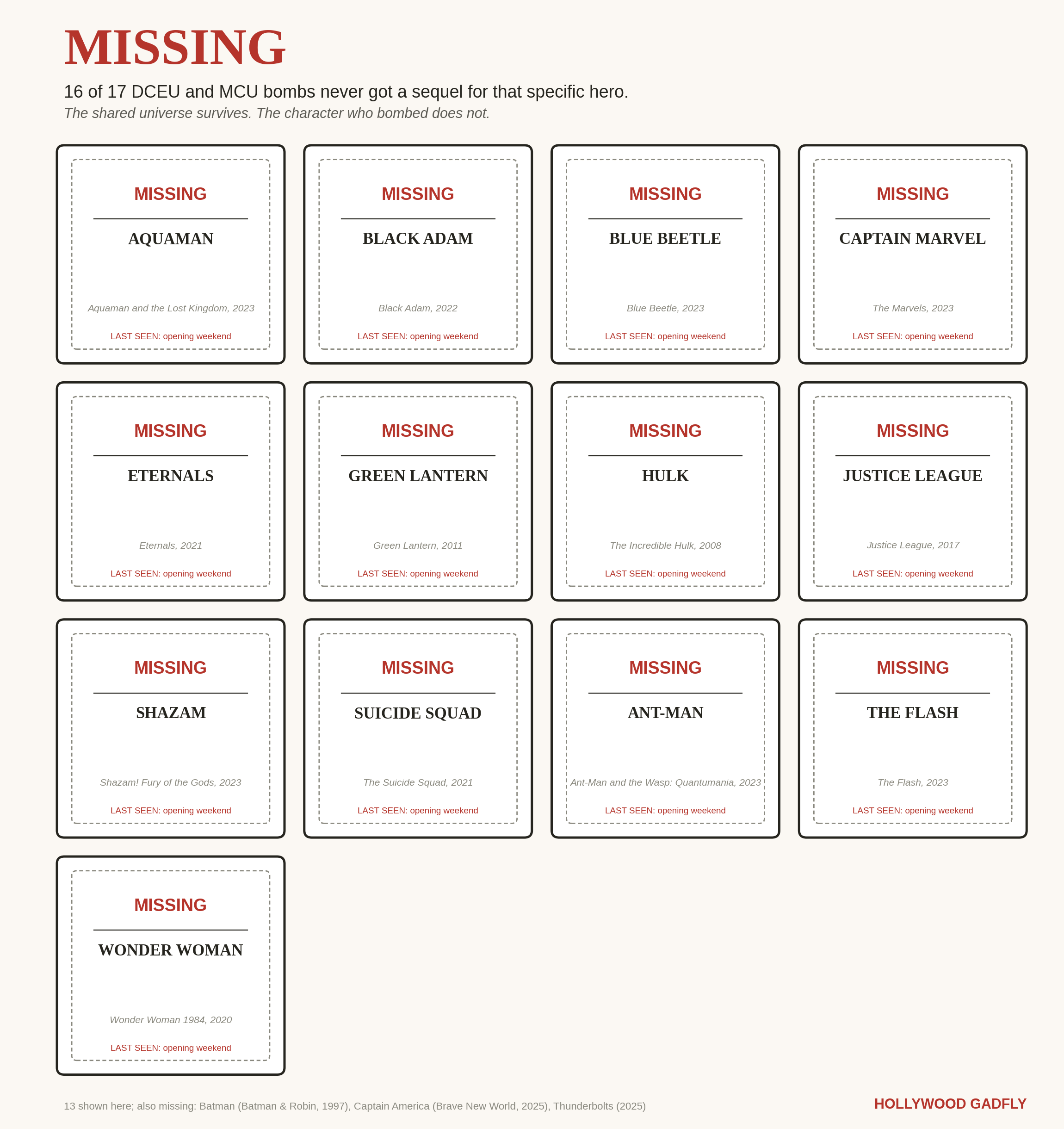
Sixteen of seventeen DCEU and MCU bombs killed the characters as standalone films. The Hulk’s first and second reboots bombed. Fantastic Four is on its third (real) reboot, which finally worked.
When an individual superhero bombs, the shared universe generally absorbs the loss, while the character is quietly buried.
But as the DCEU failures piled up in the early 2020s, megabombs like WW84 and The Flash finally brought down the entire DCEU universe.
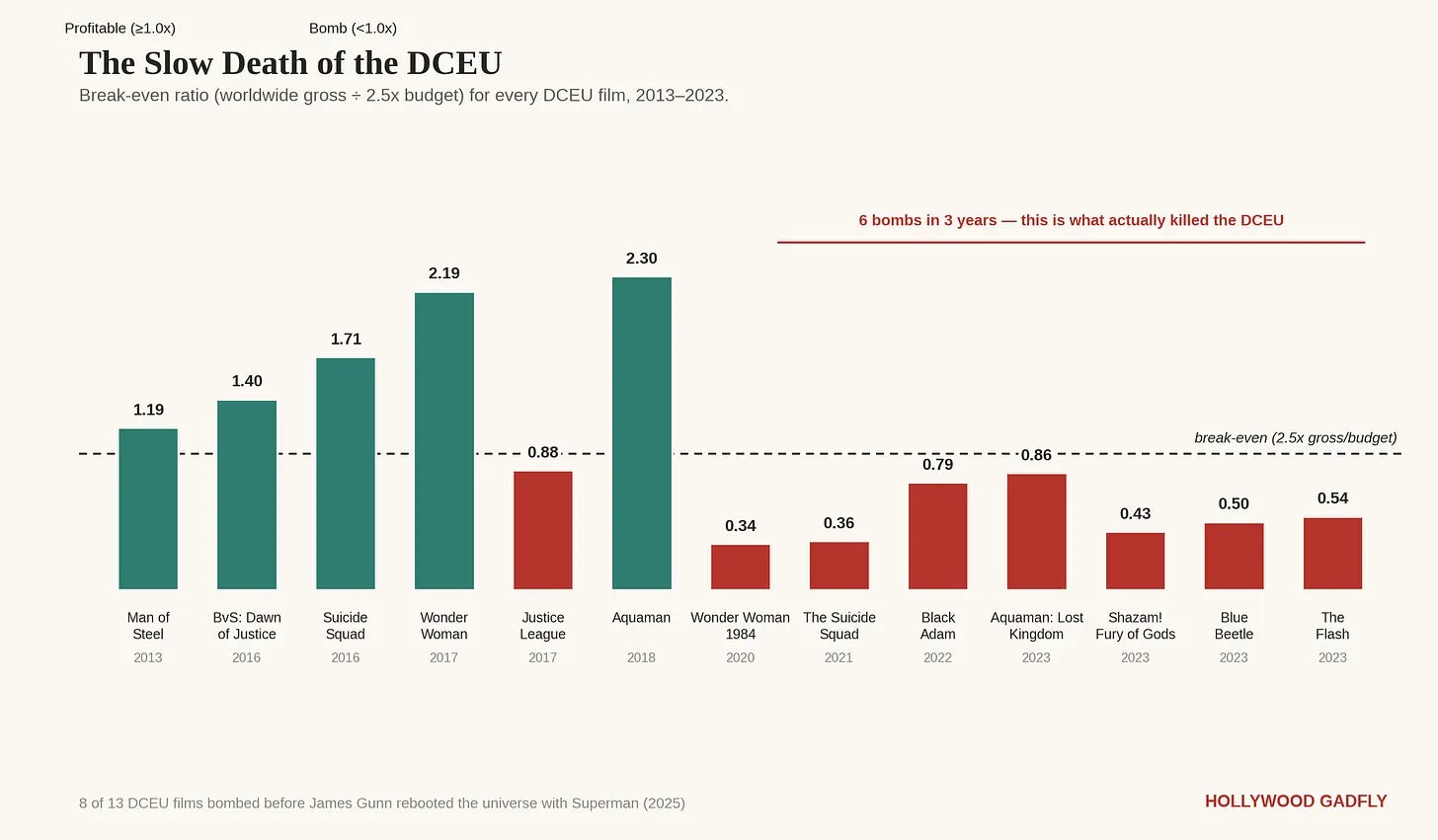
The DCEU generated six bombs in three years from 2021-2023. This pile up was so bad it drove them to scrap the entire universe and start over with James Gunn and yet another Superman. It seems unlikely that this year’s Supergirl, the franchise’s first bomb, will get another standalone movie.
If enough heroes are bombed to death, you have to kill them all and restart the whole damn universe.
Marvel too seems increasingly propped up by Spider Man:
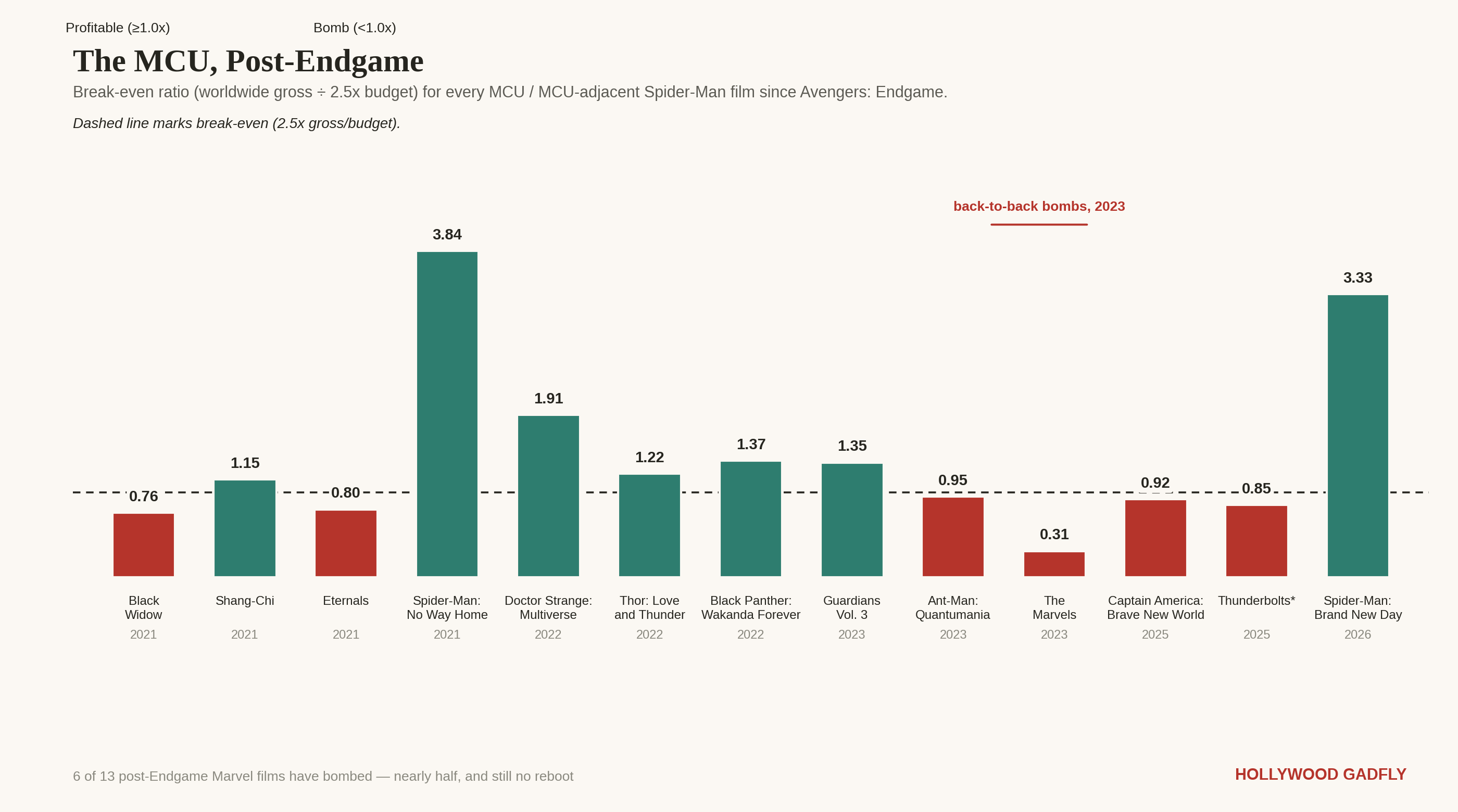
Between this and the actors getting older, we may see a full reboot in the next few years.
Seven Survivors
Only seven of the megabomb directors, or 28%, went on to get another blockbuster budget:
1. Andrew Stanton — Finding Dory
2. Tim Johnson — Home
3. Peter Berg — Deepwater Horizon
4. Brad Bird — Incredibles 2
5. Guy Ritchie — Aladdin
6. Jaume Collet-Serra — Black Adam
7. Lana Wachowski — The Matrix Resurrections
As we saw, like Coppola, 3 of these directors (Stanton, Bird, Wachowski) retreated to hit franchises they created, while Ritchie moved into a live action Disney reboot. Outside of the Wachowskis, this was the most successful path.
Some of the films, particularly Elio, are too recent to tell if the directors will get another shot at this level.
Let’s look at how these director’s next $100m+ budget films did.
Blockbuster successes
Stanton — Finding Dory: $1.025B
Bird — Incredibles 2: $1.243B
Ritchie — Aladdin: $1.042B
Commercial success
Johnson — Home: $386M (Bird is the only director who made another, under $100m movie in between that performed well before Home).
Johnson’s next feature after Sinbad was Over the Hedge, which was under a $100m budget, but grossed $340m, which was how he got another shot.
The Double Bombers
Berg — Deepwater Horizon: $122M
Collet-Serra — Black Adam: $394M
Wachowski — Matrix Resurrections: $160M
Of Our Double-Bombers:
Collet Serra retreated into the mid-budget Netflix movie Carry On ($47mn), which became Netflix’s second-most-viewed-film ever.
Peter Berg moved into Patriots Day, a mid-budget $45mn feature after Deepwater Horizon bombed.
The Wachowskis were the only (trans) women to get another shot. After the 4th Matrix film bombed, they have not made another film since. Lilly Wachowski was recently in the trades saying she can’t get a $10m movie funded.
The lesson: a bomb doesn’t necessarily kill your career. It kills your access to the blockbuster level, unless you’ve already demonstrated that you can make money there. Only a double bomb will drive you out for good.
The Others
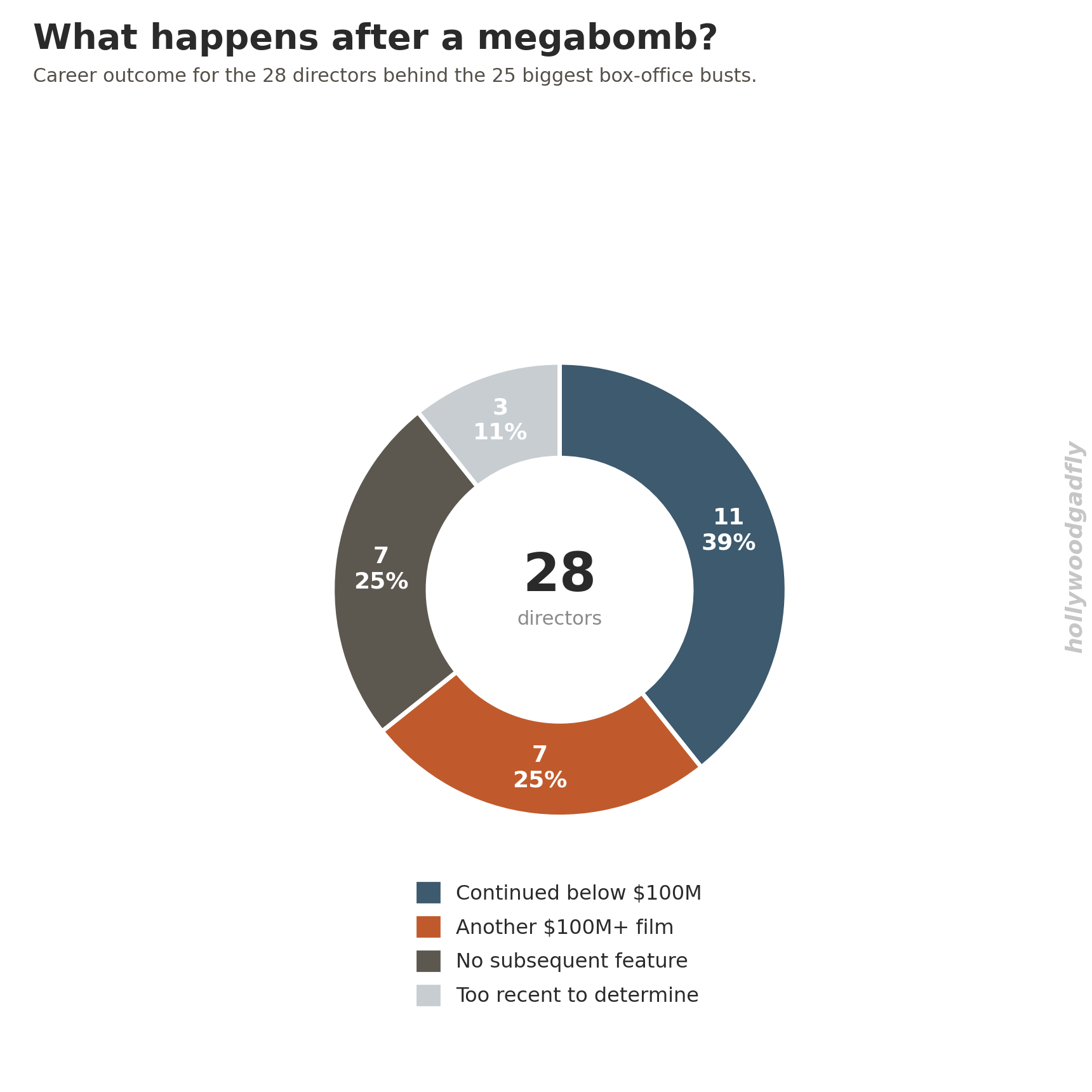
Most of these directors made another film. But outside of our survivors, nobody worked at the same budget level again, if they worked at all.
Eleven moved into smaller budgets (below $100m): Verbinski, DaCosta, McTiernan, Harlin, Wright, Bowers, Fell, Underwood, Kinberg, DuVernay.
All Retreated To A Genre Safe Haven: Not a single one went to a genre that they were not already established in.
Seven of them never made another film: Rivers, Wells, Hall, Muschietti, Bluth & Goldman, Sakaguchi and Jenkins.
One is Too Early to Call: Elio is the most recent movie on this list, so it seems unfair to include them yet.
Interestingly, the only woman to not make another feature outside of team Elio is Patty Jenkins, who would have been my best bet.
The Emotional Toll
Making a megabomb is emotionally disorienting, often devastating. You’re working the same hundred hour weeks, but without the big payoff at the end.
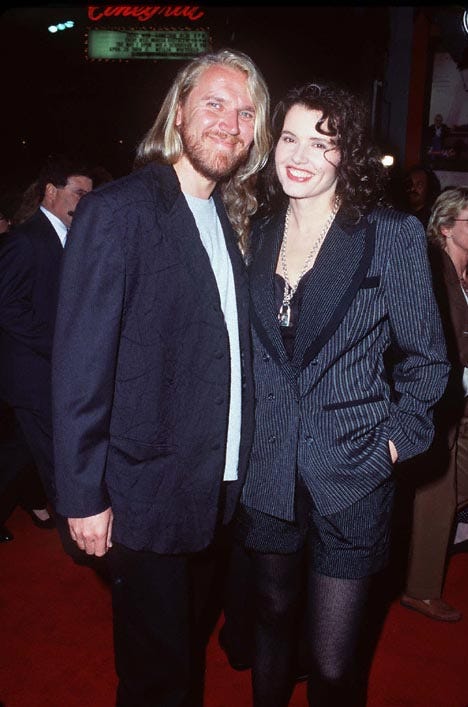
Renny Harlin’s marriage to Geena Davis didn’t survive Cutthroat Island. According to Harlin, both considered quitting after her original co-star Michael Douglas walked away. Contractually bound, they were forced to shoot it anyways. It bombed and took their marriage with it.
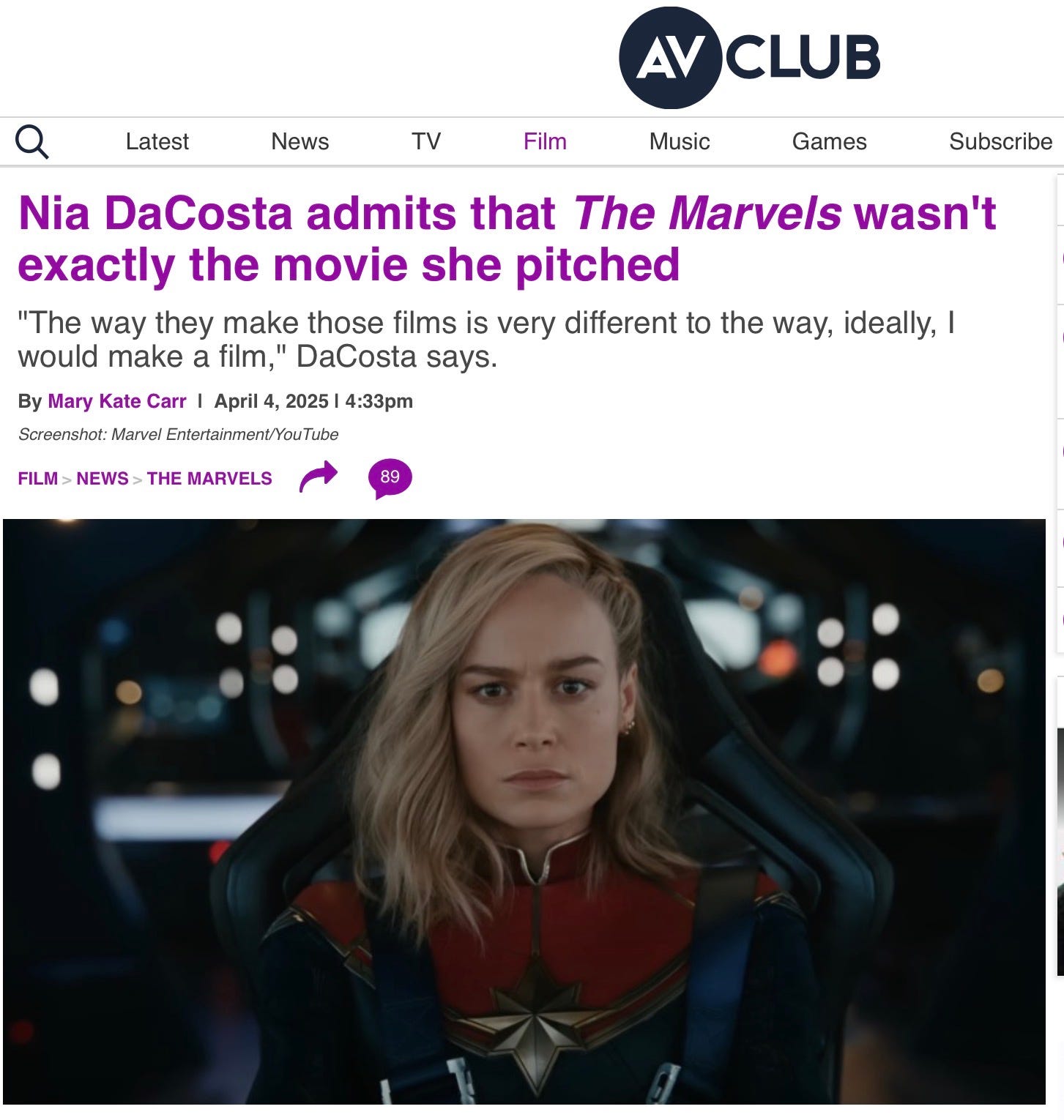
Nia DaCosta ultimately was forced to leave the Marvels for her next film after its release date was pushed four times. It was the lowest grossing Marvel film of all time. None of the characters from The Marvels have appeared in any of the cast announcements for the new Avengers movie, and they didn’t appear in the trailer either.
Simon Kinberg (Dark Phoenix) had the classiest response. He went on KCRW immediately after it was clear the film had bombed and said, unprompted: "I'm here, I'm saying when a movie doesn't work, put it on me." He soon bombed again with 2022’s The 355 which, with its $75m budget, had an even steeper proportional loss than Dark Phoenix.
In the aftermath of John Carter, Andrew Stanton was forced to scrap two planned sequels to a film he had dreamed about making since he was a boy. He described riding the New York city subway trying to "make sense of it all.” In the years since the movie has slowly built a fanbase. A decade later, crew members still whisper "John Carter" near him on set. He now tells them they don’t have to whisper the title anymore.
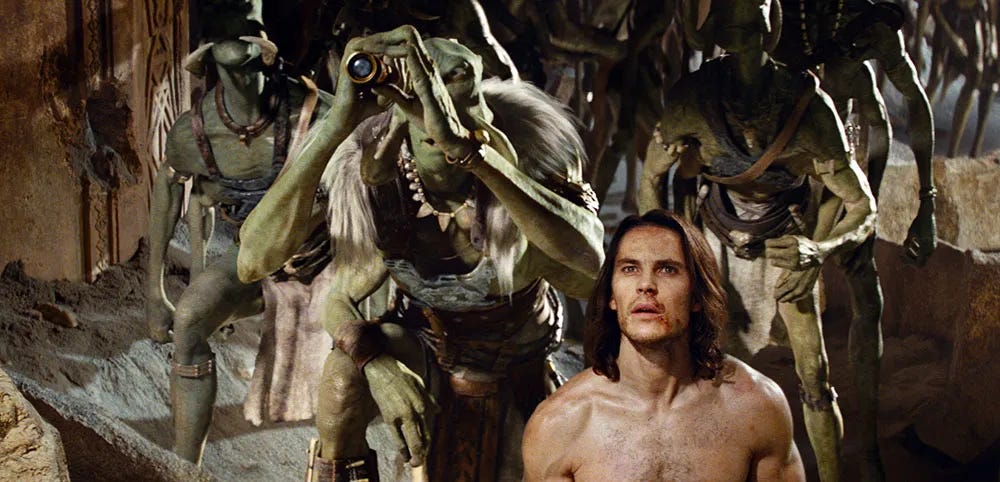
Writing about the film for its ten year anniversary, the Hollywood Reporter wrote:
“This was the moment Disney became the servant of sure bets […] That was when we entered the age of name recognition, where familiar characters and concepts—Jedi, superheroes—became worth more than any actor's name.”
Interestingly, it was the same year of the first smash hit Avengers movie, which set a multi-yeat path for Hollywood which is only now starting to crumble. In many ways, John Carter killed original blockbusters in the same way Heaven’s Gate killed the new auteurs.
Patty Jenkins's fall has been the slowest and most public. First Wonder Woman 3 quietly died under the new Gunn regime. Then Rogue Squadron — a Star Wars film she'd paused to prioritize WW3 — got pulled from Disney's schedule entirely, with an anonymous source telling a podcast she was "a nightmare" to work with. She posted a lengthy response on twitter rebuffing it.
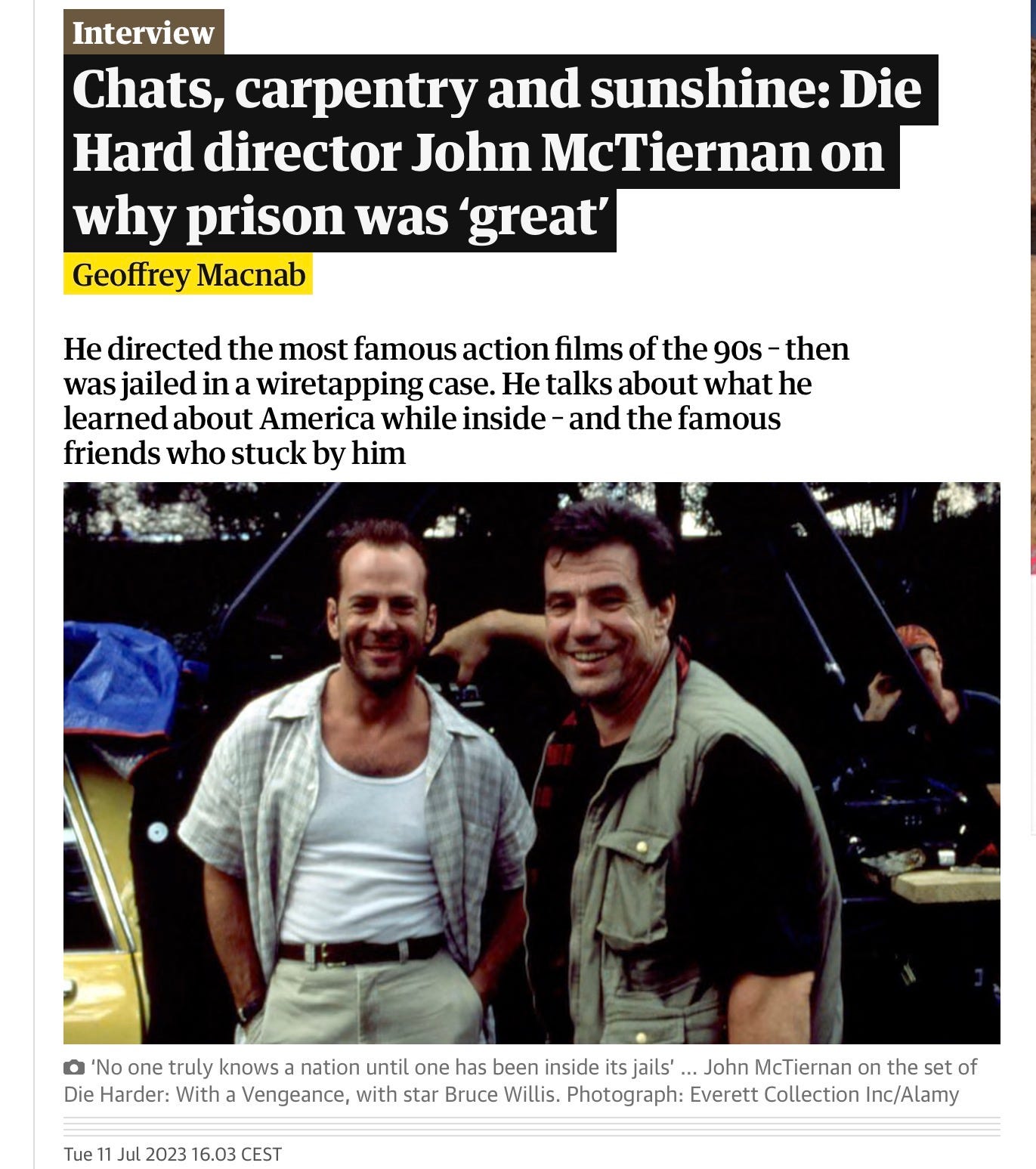
John McTiernan, the iconic director of Die Hard and Predator, was by far the craziest aftermath. It started with the 13th Warrior: a bitter, chaotic production he abandoned before it was even finished. Three years later, while battling a producer over his Rollerball remake, he hired Anthony Pellicano, an iconic Hollywood private investigator, to tap the producer's phone.
In 2006 Pellicano was taken down in a sprawling FBI wiretapping case. McTiernan was soon convicted of lying to federal investigators. He pled guilty to perjury, and served ten months in federal prison in 2013–14. While inside he filed for bankruptcy and lost his ranch to foreclosure. He hasn’t directed a studio film since 2003.
Why Women Are More Exposed
Stephen Follows was right; women do get fewer second chances. But if you trace the money backward, the answer isn’t really that women are punished more harshly for failure.
It’s that the blockbuster system has a much deeper reservoir of battle-tested male talent, who have prior hits to fall back on.
I’ve written several essays on the pipeline now, and a couple of points are becoming clear:
Directors generally have to work their way up through bigger and bigger budgets into a blockbuster.
Only a big budget hit protects them from a big budget flop, especially if it’s in a franchise they created.
Most directors do not survive a big budget bomb.
Blockbuster directors are getting older in general because of the “banked hit effect.”
If a banked hit is the best protection against a bomb, where do directors traditionally get those hits?
Historically, they worked their way up from small, to medium, to big. But the middle of that ladder is disappearing.
The decline of mid-budget features is likely harming women, because there are less intermediate proving grounds for higher budget films, forcing them to make dramatic leaps like DuVernay and DaCosta did. Jenkins successfully worked her way up through television, which seemed to help her tremendously on the original Wonder Woman, the only true female solo-directed comic book hit.
In 2009 there were approximately 65 mid-budget features, defined as $20-100m budgets. in 2025 there were 43, marking a 34% decline.
This means that, even as female directors make progress, there are a third less mid-budget films for them to prove themselves in, while the industry itself continues to retreat to its older, proven talent pool. This makes sense because the blockbuster budgets are so much bigger that the amount of money on the line is enormous.
So let’s go back to that strange statistic we saw earlier, that women bomb at double the rate of men. If I were to speculate on a structural cycle causing the lack of female blockbuster directors, it might look like this.
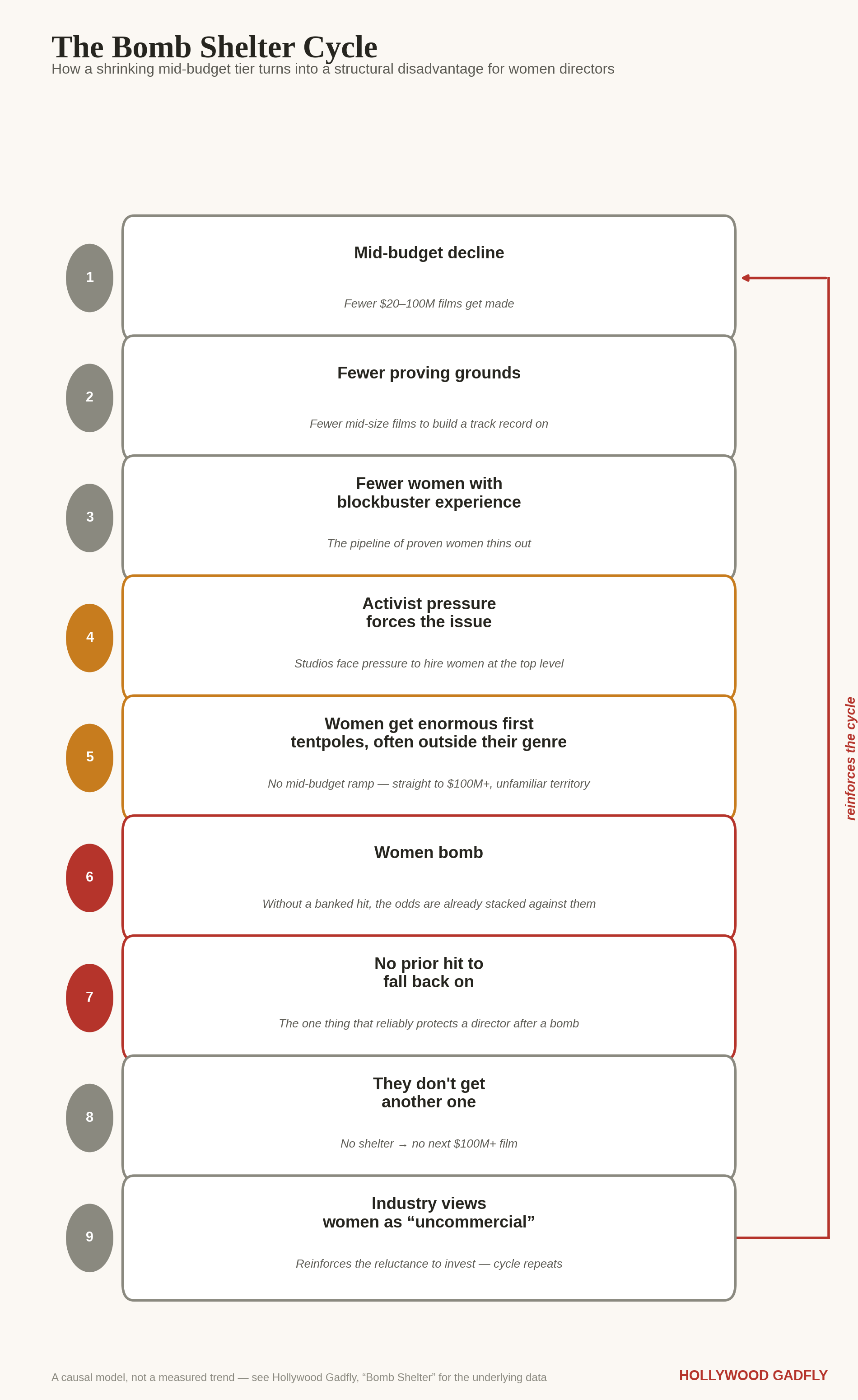
The key takeaway is that the industry seems to often be choosing their female blockbuster directors based on the wrong characteristics. I’ll continue to write more about this soon.
Wrapping Up
Follows is undeniably right about the outcome. Women get fewer second chances. But the answer isn’t “Hollywood forgives men.” Hollywood rewards directors who arrive with a banked hit, which functions as a bomb shelter (at least for one bomb, no shelter seems strong enough for two).
A director who has already made a blockbuster has demonstrated something extraordinarily valuable: that audiences will show up for their movies at scale. That success functions as insurance when the next movie fails.
Women have historically had far fewer opportunities to accumulate that insurance.
Because women have historically been almost entirely absent from the blockbuster pool, they have less banked blockbusters, and are disproportionately exposed when they’re handed their first giant tentpole.
Hollywood may be giving women “second chances” at roughly the same rate once they have proven they can make a blockbuster. The problem is that women almost never get the opportunity to bank that first blockbuster in the first place.
Coppola had The Godfather.
Stanton had Finding Nemo.
Bird had The Incredibles.
The Wachowskis had The Matrix.
The rest had none.
Coda: Life After John Carter
Andrew Stanton’s most recent, original live action film, In the Blink of An Eye, premiered at Sundance. He was asked about John Carter while promoting it. Stanton defended his film, which has since grown a cult audience.
I firmly believe there was always that audience. We just didn’t understand that, and we didn’t cater to them [in whatever way] it got overlooked. But it’s nice to know there was an audience for it, and that it’s founded. The nice thing about finishing a piece of creative work — whether it’s a book or an album or a movie — is that it’s there for people to find for the rest of time. Unless it’s banned, it can’t be stopped. So it’s been nice to live long enough and go far enough to know that it’s found its audience. It’s very nice.
In the Blink of an Eye currently has a 16% on Rotten Tomatoes. Perhaps, with time, its perception will change.

Stanton’s next film is already in theaters. Toy Story 5 beat Toy Story 4’s opening weekend, setting a record for the franchise.
As of this writing it has already grossed over a billion dollars.
Nothing beats a good bomb shelter.
Budget Sources:

A director new to the blockbuster budget is going to have far less power in making directorial choices. The producers and studio executives, who have certainly been involved in multiple blockbusters, are going to have yes/no power in pretty much every creative decision. There’s also definitely a dangerous leap from the Sundance indie aesthetic to blockbuster ambition. As a screenwriter, after the relative success of Smoke Signals, I was a writer for hire on a few movies that would’ve had blockbuster budgets had they been made. I love giant films (and Sundance indies) so why not try to write a blockbuster? But I was just a lowly screenwriter who’d never be blamed for a blockbuster’s failure (unless I was also the director). Whenever I read the news about an indie director leaping to blockbuster budget, I worry for them. On their first indie films, they were the dictators of a small country. On a blockbuster, they are a U.S. Representative from Missouri.
the depth of your research and writing is incredible.