

Obsession Doesn’t Prove the System Is Rigged Against Women
What the data actually shows.

As some of you have probably figured out by now, I suffer from Obsessive Compulsive Disorder (OCD), which is part of why I have such a hard time letting things go, including, perhaps ironically, a movie called Obsession.
For the past few weeks I’ve been puzzling over a post by Raquelle David, a Hollywood manager, called “Obsession Is 2026’s Biggest Box Office Story. A 20-Year Diversity Study Explains Why It Could Only Happen To A Man.”

To quickly recap for the people living on the moon, Obsession is a $750k horror movie that has grossed over $300m worldwide. It’s so successful it’s already outgrossed all 68 Sundance Dramatic Competition films this decade combined.
My response to David’s piece became too big for my other essay on the sizable flaws in the Annenberg Directors Study, the twenty year diversity study from David’s title, so I’m going to include my critique here as a separate post, as it makes separate arguments.

I’m critiquing this piece so hard, and the Annenberg study it uses, because it does several things I feel we need to stop doing; heavy pessimism about female directors, citing flawed data that makes women look less successful than they actually are, and feeding an endless narrative of female failure that is ultimately counterproductive.
Women, in spite of severe underrepresentation and significant obstacles, are making real progress at the highest levels of commercial filmmaking. According to Annenberg’s own numbers, they tripled from 2007-2025, no small feat. Directors of color nearly doubled.
That needs to be just as clear, and studied, as the obstacles they face. They need better studies, and better pipelines, if they want to keep advancing.
When a woman reads a piece like the one above, which implies her success is a structural impossibility, it could read as defeatist, like the game is rigged, and I sincerely don’t believe it is, at least not in the way these flawed studies describe.
One could call this “activist-pessimism.” It’s great as a tool for activists to try and get change NOW, but not so much for representing reality.
And it wouldn’t be true anyways. The reality is, as I discussed at length in my Annenberg piece, that activist studies systematically describe women as less successful and less empowered than the data actually suggests.
If that’s the case, then any explanation of the industry must account for that success, not just the remaining gap.
That’s the question I think these studies increasingly struggle to answer.
David’s Headline Argument:
David’s headline argument is this:
But the facts are far softer than they look.
David’s “Smoking Gun”
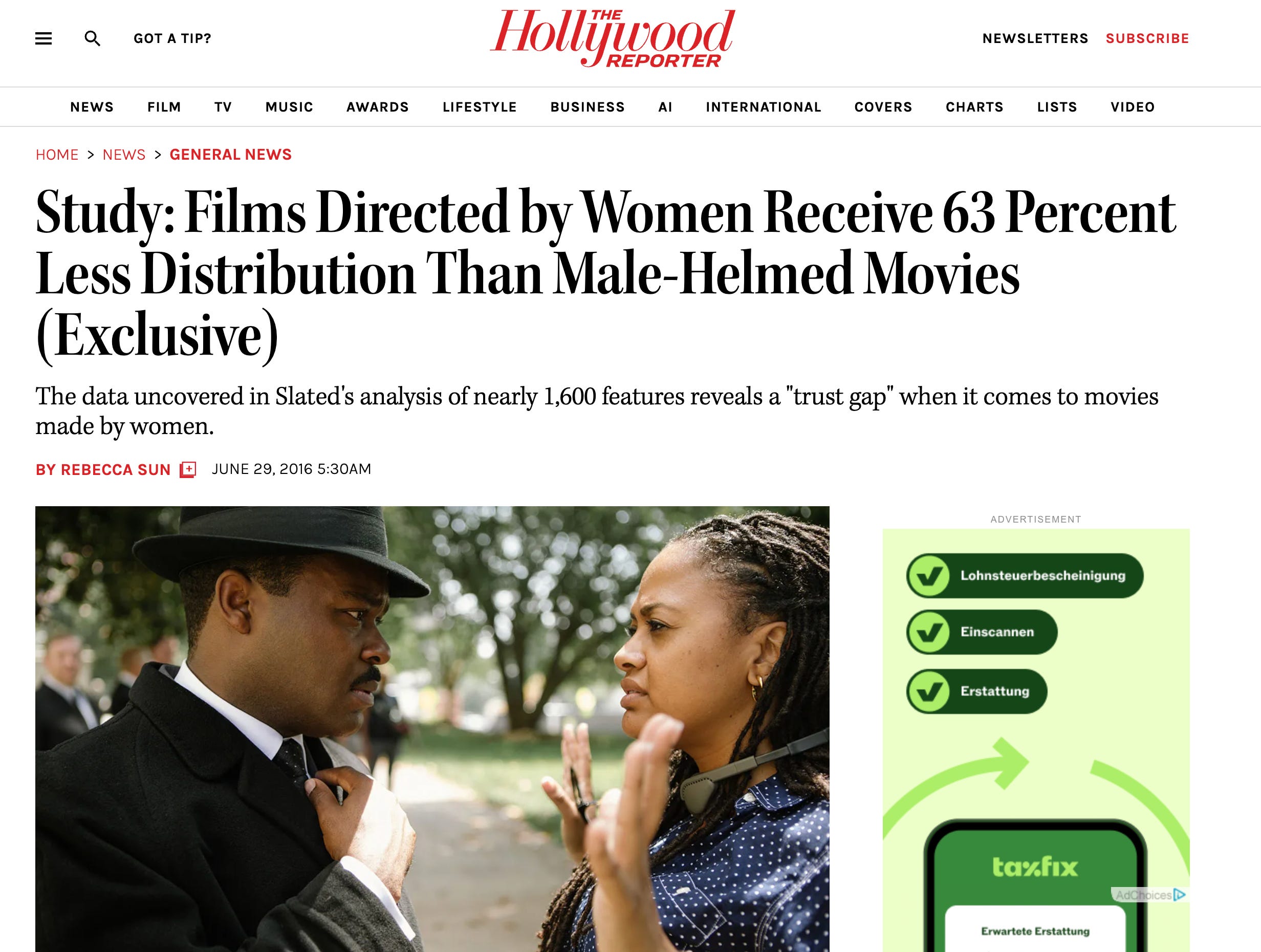
David opens with what she calls a “smoking gun”: a 2016 study from the film-finance firm Slated.
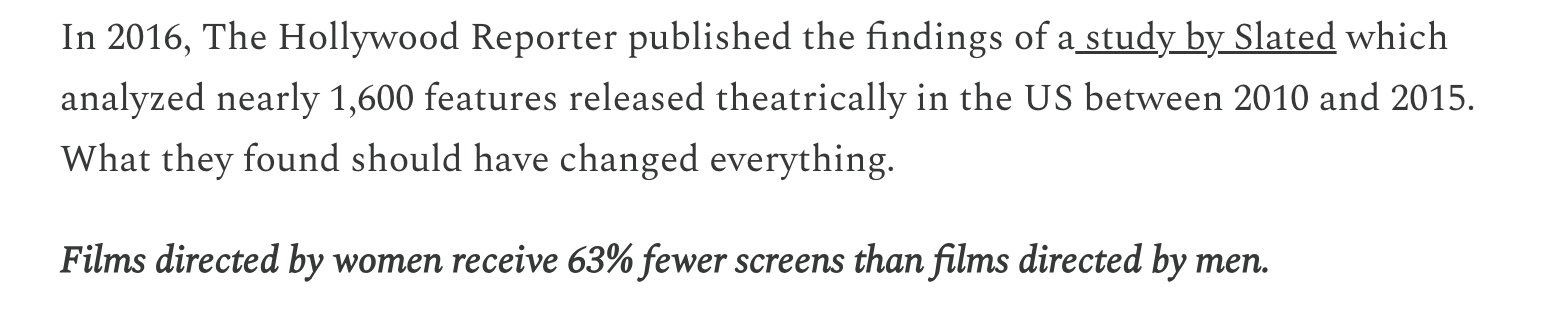
The line she’s quoting is correct; the Slated study found that low-budget films directed by women went out on roughly a third as many screens as men’s - 242 to 646.
I went looking for the study itself - methodology, controls, underlying data. It was never released. Ultimately, without those pieces available, it wasn’t really a study, it was an infographic, which is exactly what they call it.
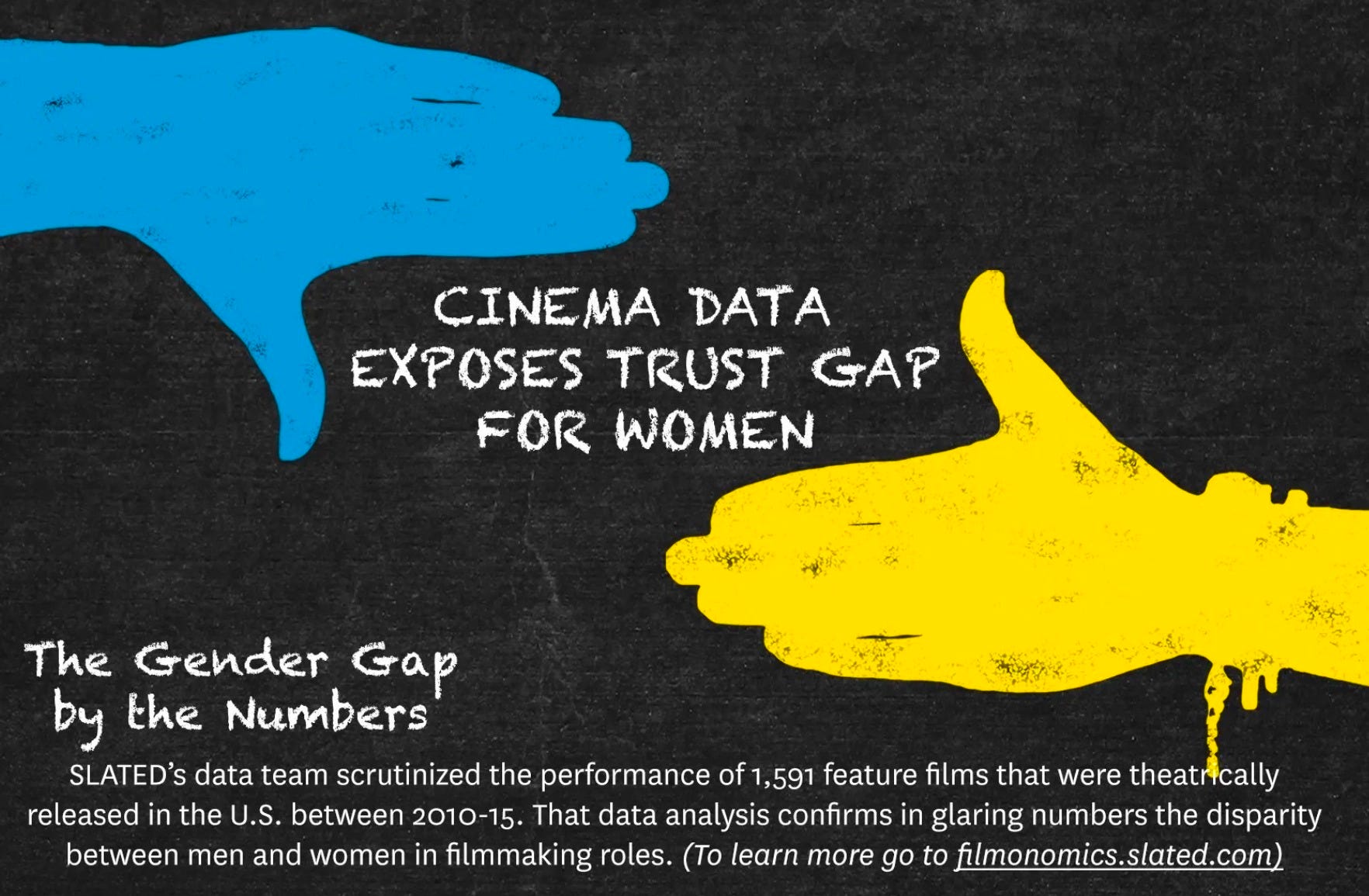
What’s public is the handful of headline numbers in THR and Forbes, alongside the Medium Post. I can’t verify how the infographic was built, and neither can anyone citing them. But I can read what’s reported - so let’s read all of it, not just the one stat.
Start with what the study actually isolates by director. There’s exactly one such finding: that low-budget, 242-to-646 screen gap, a decade ago. At the studio level - films over $25 million, the tier my entire Annenberg essay is about - it doesn’t report a director number at all.
It switches to films “led” by women (produced, written, or starring) and finds distribution there roughly equal. Likely there were simply too few women directing $25M-plus films in 2010–2015 to compare, because that was the nadir of female blockbuster directors, as I’ll show later.
Either way, as David says, the documented gap against female directors is a purely low-budget phenomenon. The smoking gun never fires at the blockbuster level; it fires in the sub-$25M indie tier I’ve already argued is a different animal.
Slated’s Budget Range is Comically Large
Slated’s low budget feature numbers have a very odd skew: under $25m.
