

Promising Young Director
Hollywood elevated a new generation of women. The results are more complicated than anyone hoped.

In The Permanent Correction, I wrote about how some film festivals began a campaign of favoring female filmmakers over their submission numbers. The campaign began at Sundance in 2013 and soon spread across the top five festivals (Cannes, Venice, Toronto, Berlin). It has been going on for over a decade now, so how has it played out at the highest levels of the industry?
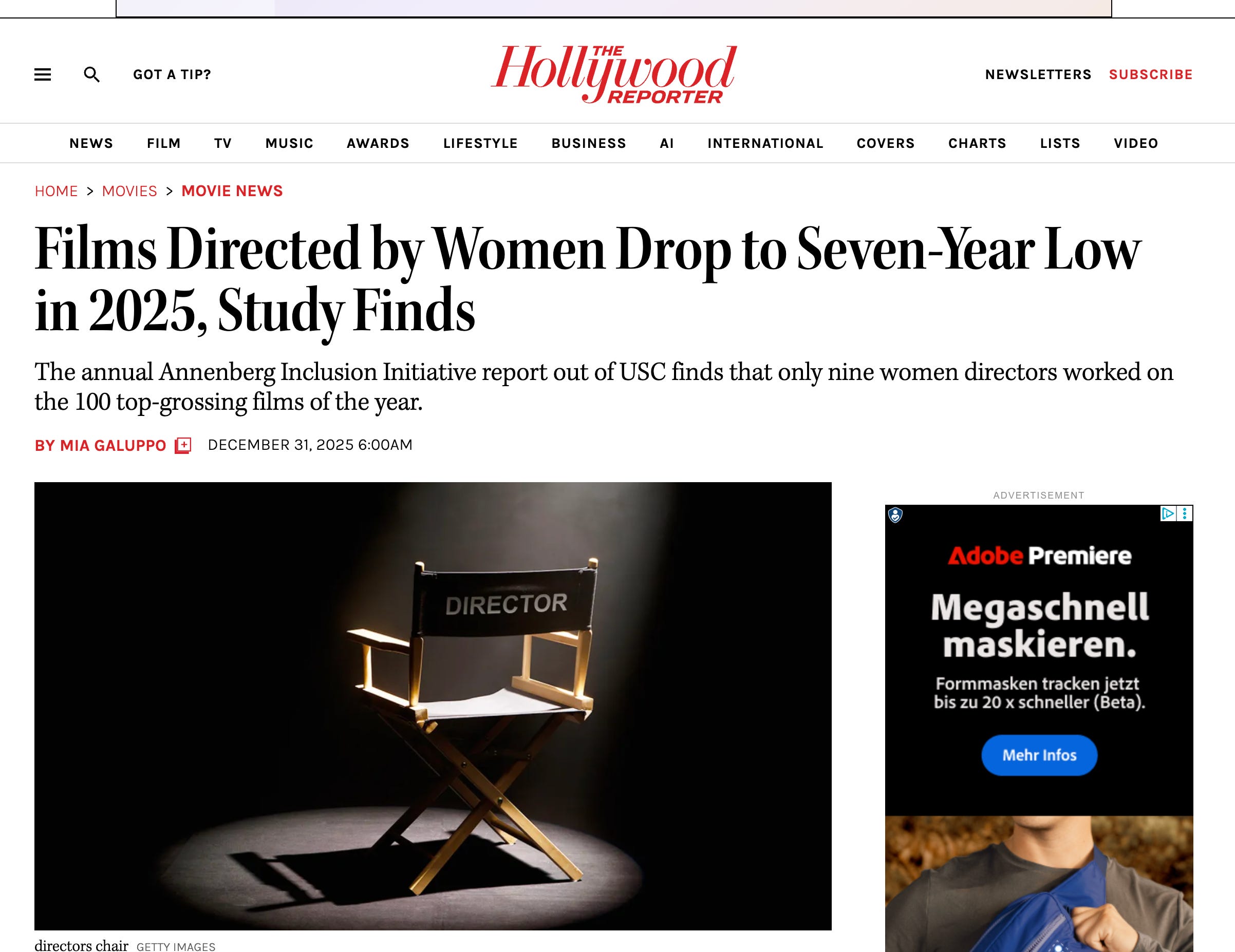
We are regularly exposed to grim headlines like this one from the Annenberg Institute’s 2025 report, which found that “looking at the top 100 grossing films of the year, the report notes that only 9 women worked as directors on these movies, representing 8.1 percent of all directors on these films. This is a drop from 2024’s 13.4 percent and is the lowest since 2018’s 4.5 percent.” Notably, “Across its 2024 slate, women accounted for 20.5 percent of the directors of Netflix movies.” So streaming is slightly less dire.
I find these reports, which originate mostly at USC and UCLA, difficult. Yes, we know there are fewer female than male directors in Hollywood, but we spend a lot less time on why.
Why are there still so few top performing female directors?
After over a decade of pushing women at every level, from film schools to film festivals, shouldn’t this number have gone up? There are also now at least a handful of female directors who have gotten massive studio franchise movies, so how have they done?
And how do we measure success at all?
This article will look at the two biggest, clearest measures of money and prestige…
The Box office
The Directing Oscars
And how the two compare. This is admittedly a small sample size, but let’s see what we can learn.
The Box Office
Let’s start at the very top, the highest grossing filmmakers of all time. These numbers are slightly dated, but I enjoyed the graphic and the rankings haven’t really changed since then. Important to note that these numbers are not inflation adjusted, which would actually make the gender disparities worse in favor of men.
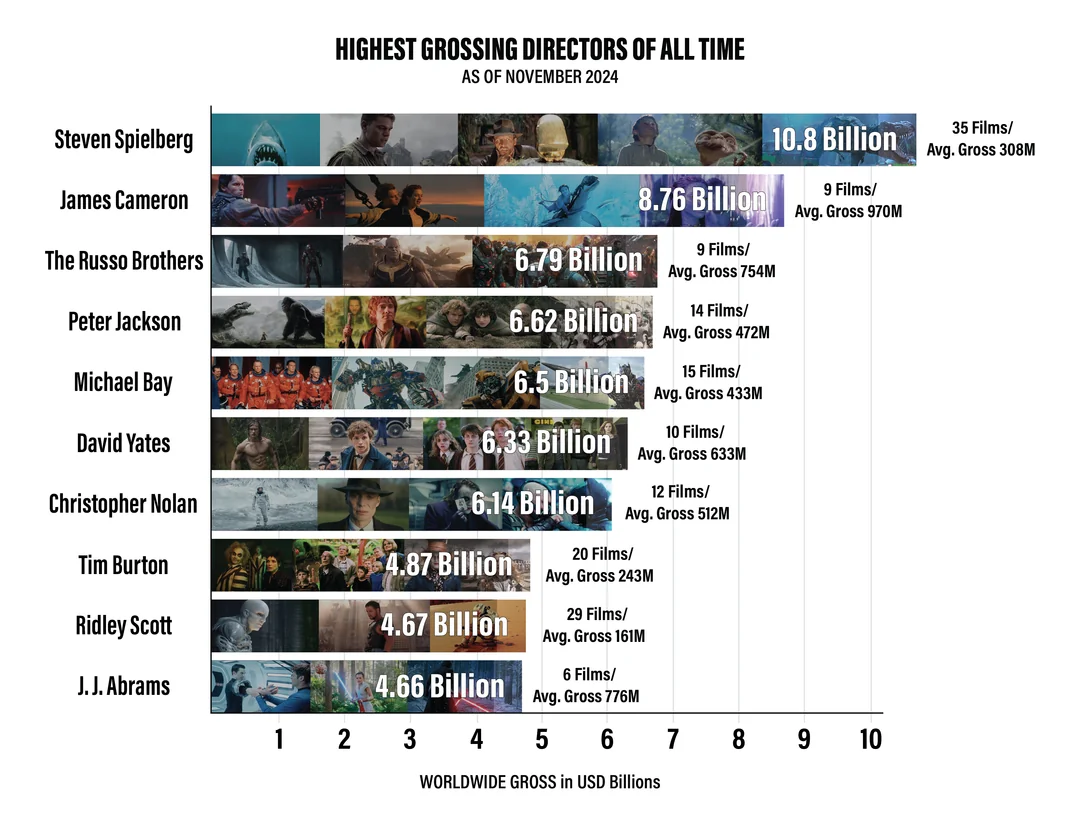
These are all solo-directing men, who’ve all directed multiple successful entries in large IP franchises (Avatar, Batman, Harry Potter, Jurassic Park, Lord of the Rings, Transformers, Avengers, etc.).
The formula is obvious: to be a very successful director financially, you have to identify, or generate your own live action IP franchise that has multiple hit entries.
Now, let’s look at the highest grossing women directors.
The first female director to make the list is Jennifer Lee of Frozen, at #48. It’s difficult to use her because she codirected both Frozen movies with a man, Chris Buck. Her entire career as a director thus far consists of two completed Frozen movies, and two upcoming sequels. Unlike the men ahead of her, she has no solo directing credits. But she is the only female director in the top 100. If we only use solo-directing women, the numbers fall so far as to look catastrophic.

(48 overall) Jennifer Lee $2,720,906,734 | 2 Films | $1,360,453,367 Average
(102 overall) Greta Gerwig | $1,746,632,344 | 4 Films | $436,658,086 Average
(103 overall) Lana Wachowski, $1,475,285,846 | 7 Films | $210,755,121 average.
*Wachowski is also tough, because she is a trans woman.
(145 overall) Nancy Meyers | $1,351,418,684 | 6 Films | $225,236,447 Average
(166 overall) Jennifer Yuh Nelson | $1,223,388,200 | 3 Films | $407,796,067 Average
*Yuh codirected Kung Fu Panda 3, with a man.
(180 overall) Anna Boden | $1,137,804,364 | 5 Films | $227,560,873 Average
*Boden is another codirector, this time with Ryan Fleck.
(181 overall) Patty Jenkins | $1,056,764,765 | 3 Films | $352,254,922 Average
(210 overall) Betty Thomas | $1,016,552,451 | 7 Films | $145,221,779 Average
(240 overall) Nora Ephron | $877,802,434 | 7 Films | $125,400,348 Average
(299 Overall) Phyllida Lloyd | $697,267,580| 3 Films | $232,422,527 Average
This is admittedly imperfect, and skewed by both women who co-directed with men (numbers 1 and 6) and trans women (number 3). Half of the top 6 directors fall into this category. Without co-directors and trans women the numbers would be much, much worse.
Some Observations:
The men dramatically outperform on average: $526m per film versus the women’s $372m per film. But they’ve also directed more films. Again, we have to account for the fact that the highest grossing woman co-directed her films with a man. If we were to remove Jennifer Lee and replace her with Anne Fletcher, the next solo director on the list, the average would drop by another $32m.
All of these directors also have outlier films that drive up the averages, like Avatar for James Cameron, Jurassic Park for Spielberg, Barbie for Greta Gerwig, and Captain Marvel for Boden, respectively.
The female success stories: Frozen, the Kung Fu Panda sequels, What Women Want (Nancy Myers’s #1), Mamma Mia (Phylidia Lloyd’s #1), You’ve Got Mail (Ephron’s #1), tend toward animation and romantic comedy, with Barbie classified as a comedy, but close to a romantic comedy as well. These generally have lower budgets, and, sadly, the romantic comedies are mostly from a bygone golden era of the 90s and 2000s. Comedy also tends to play better nationally than internationally, as it’s heavily cultural, likely why we’ve never seen a $1b comedy outside Barbie.
So if large, live action franchise films are how directors build the biggest box office runs, this raises another interesting question: How do women perform when given the most expensive franchises on the planet?
