

Survival of the Richest: The BIPOC Problem
Why every 2025 top-grossing female director of color was Asian.

While I was working on my Annenberg Ouroboros Piece, about USC’s strange annual study of the top 100 grossing directors, a startling fact emerged.

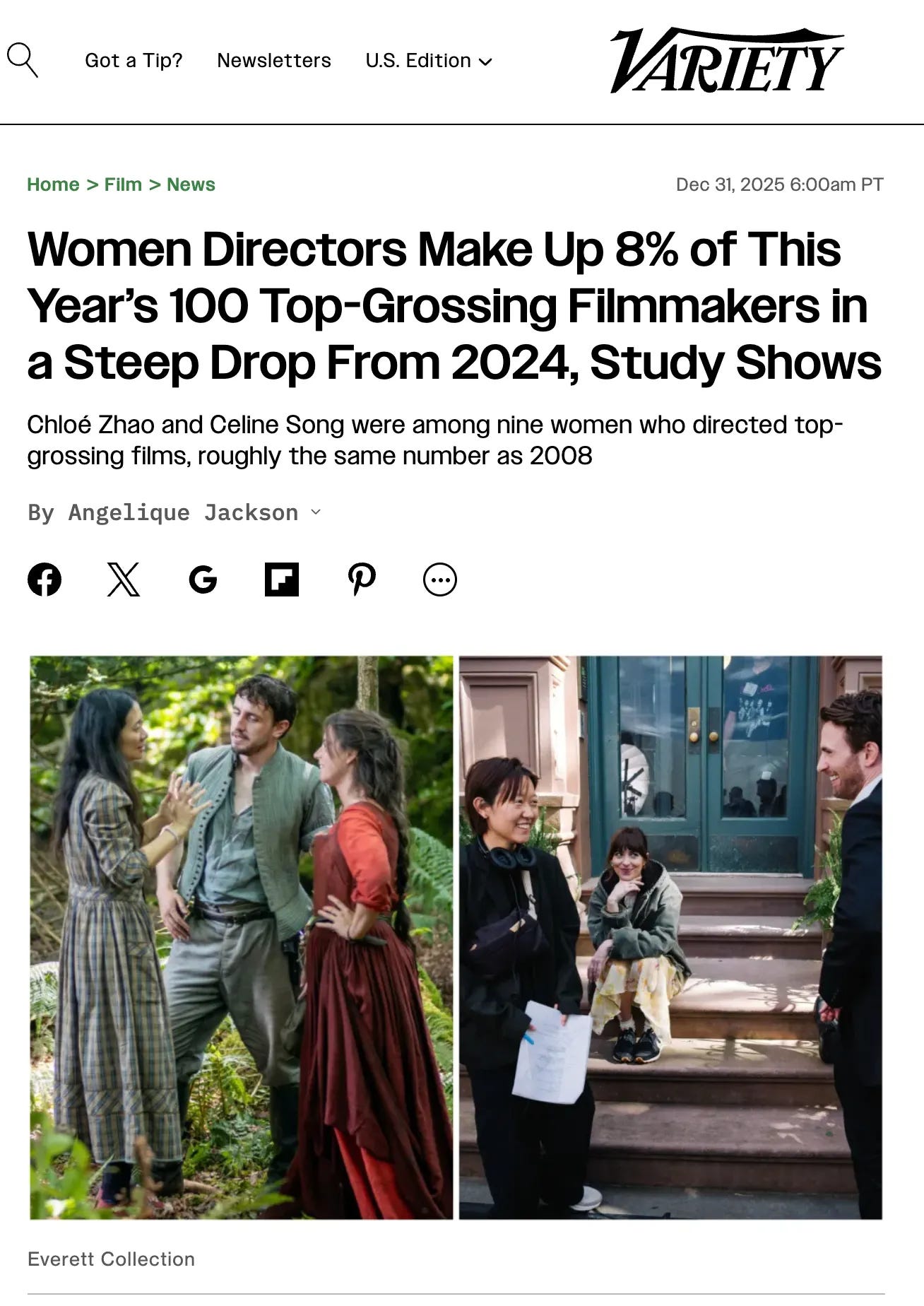
Among the women who directed 2025's 100 top-grossing films, there were nine total: six Asian, three white, zero Black, zero Hispanic.
Every woman of color in the group was Asian - and for the first time, Asian women (and therefore women of color) outnumbered white women two to one.
And each of them share the traits of what I call Elites of Color (EOCs): from the highest-earning, most-educated subgroups. For the last decade or two, elites of color have been some of the accidental beneficiaries of Hollywood’s attempts to diversify. A large part of this is the progressive tendency to ignore subgroup differences, i.e, the Nigerian diplomat’s son is the same as the Mississippi descendant of slaves.
This is unintentional, but it’s an obvious outcome of the strange pipeline Hollywood has built over the last few decades by ignoring class.
As we'll see, "elite" here is doing triple duty — family money, elite credentials, and the positive-selection of diverse immigrants.
Before going further, let me concede what's true in the view I'm about to argue against. Representation has real intrinsic value: who sits in the chair shapes which stories get told, and seeing someone like you direct matters in ways no spreadsheet captures.
But the specific mechanism we use to pursue diversity — proportional representation across one enormous "BIPOC" bucket — is class-blind, and a class-blind mechanism, applied to racially aggregated groups with wildly different wealth and educational attainment, will reliably select the richest, most-credentialed members.
And this is where it gets a bit saucy, because, as I keep saying everywhere…
The BIPOC Term Obscures Important Class Differences
Annenberg, like all good university research programs, leans on the term “BIPOC” as their catch-all term for nonwhite. As the YWCA describes it:
BIPOC stands for Black, Indigenous, and people of color. Pronounced “bye-pock,” this is a term specific to the United States, intended to center the experiences of Black and Indigenous groups and demonstrate solidarity between communities of color.
As a term, BIPOC centers the specific discrimination experienced by Black and Indigenous people.
BIPOC aims to bring to center stage the specific violence, cultural erasure, and discrimination experienced by Black and Indigenous people. It reinforces the fact that not all people of color have the same experience, particularly when it comes to legislation and systemic oppression.
It’s a term specifically designed to center the discrimination experienced by Black and Indigenous people. But again, there’s an irony here: all of the 2025 BIPOC female directors are actually Asian.

Because six of the top nine grossing women were Asian (one as a co-director), this year's snapshot reads — on the surface — as a story of Asian female success at the box office. Six directors prove nothing on their own; treat it as a vivid illustration, and let the sturdier numbers below carry the structural weight.

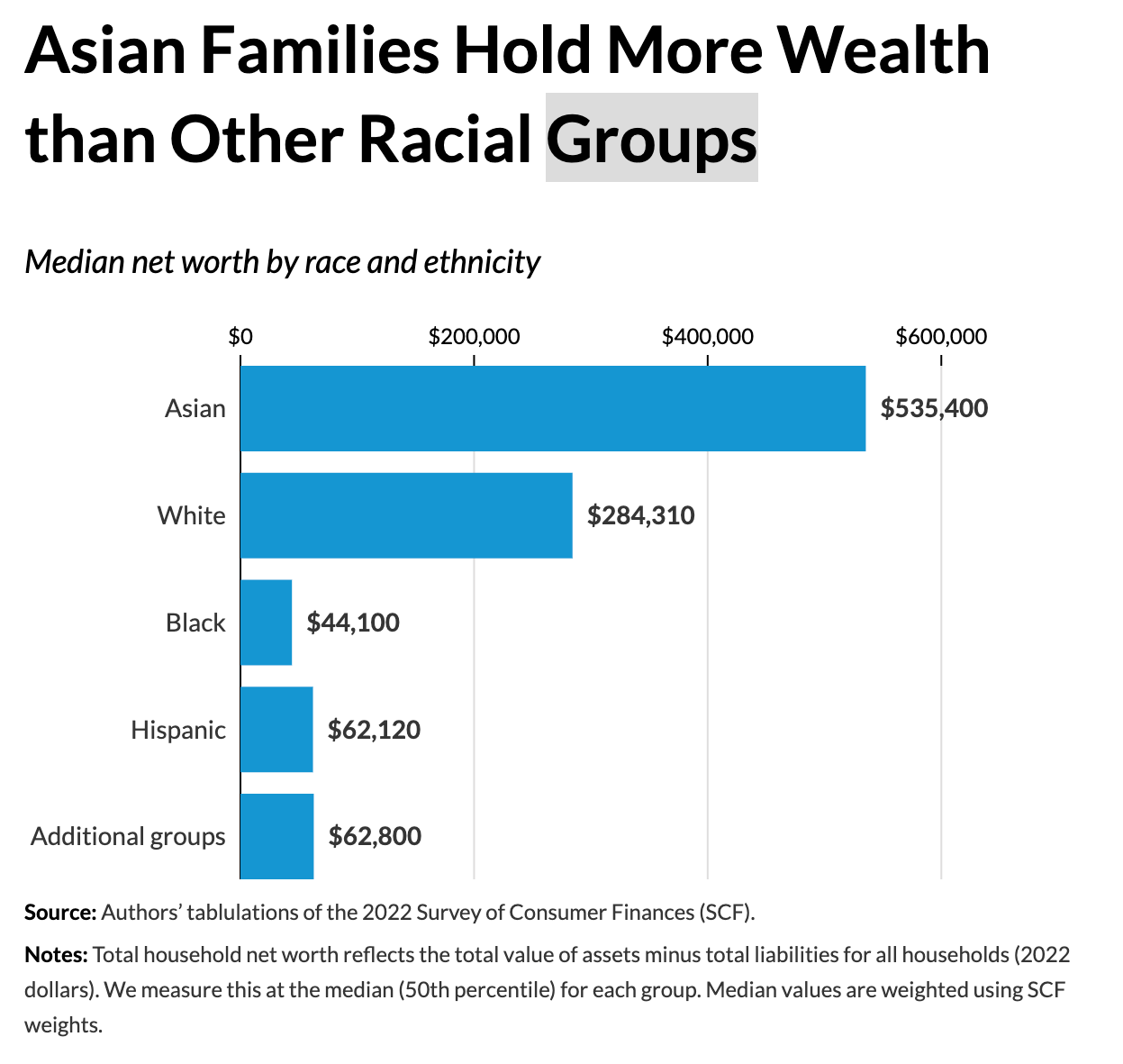
There’s a clear class dynamic at play here: by the Federal Reserve's Survey of Consumer Finances — the most authoritative wealth data we have — Asian American households hold a median net worth around $536,000, versus $285,000 for white households, $61,600 for Hispanic, and $44,900 for Black.
Asian household wealth is thus roughly double white wealth, nearly nine times Hispanic wealth, and twelve times Black wealth.
This makes the BIPOC data point extremely confusing; who are we trying to uplift and bring into the film industry here? The wealthiest BIPOC populations or the poorest?
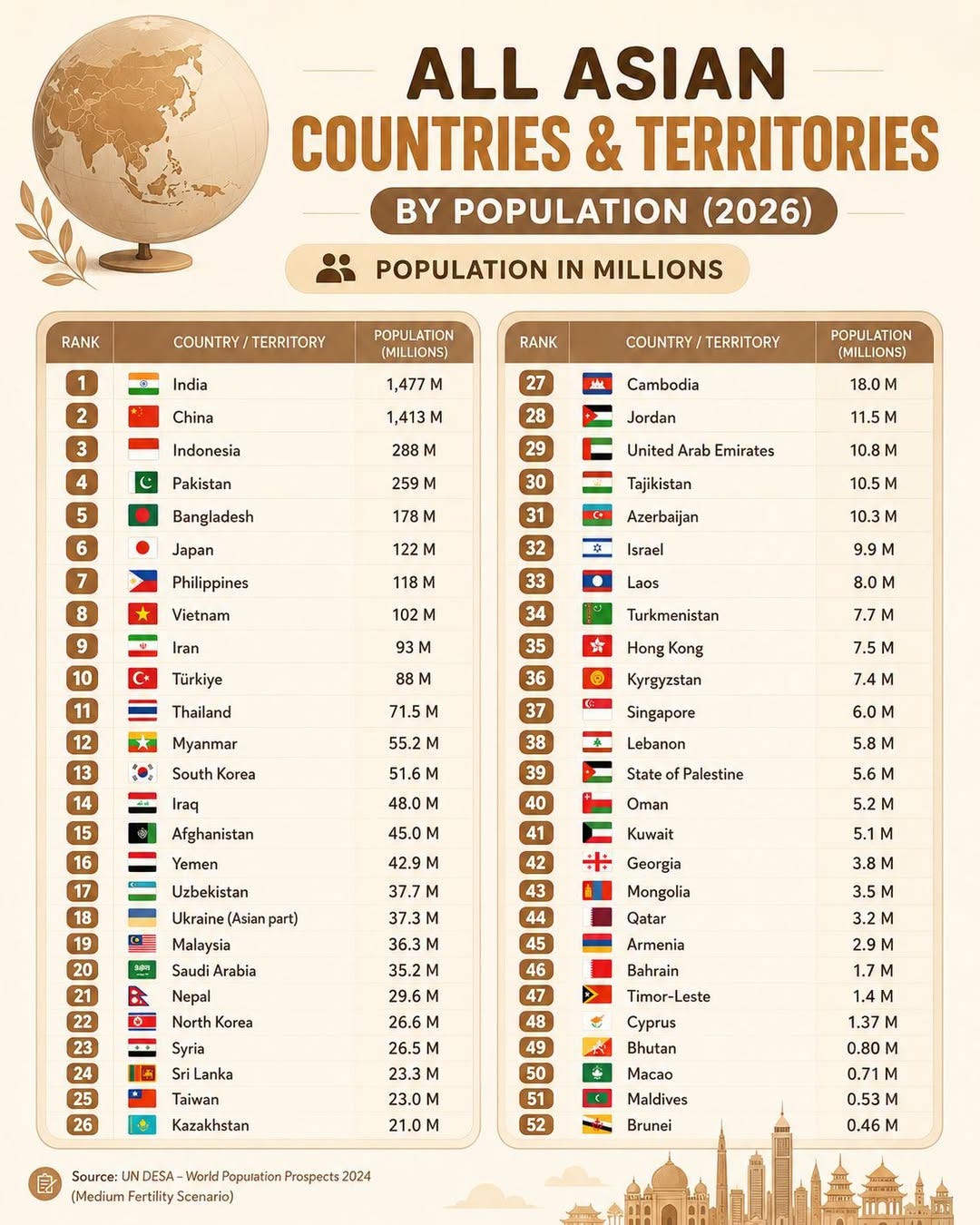
There is also of course a huge disparity within the term Asian itself. Asians are the largest global population, so the term lumps together quite a few different people and nationalities.
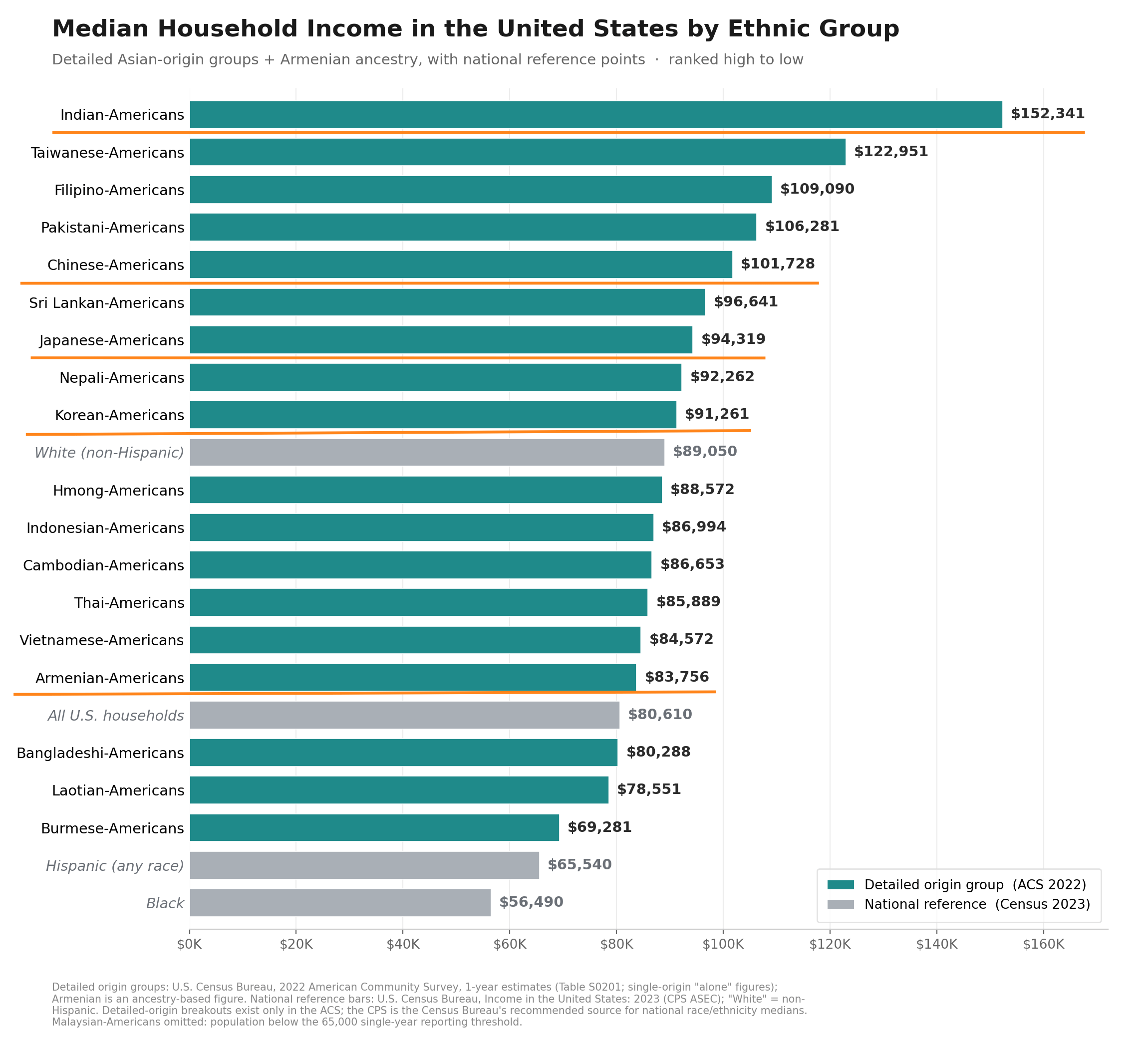
And within the term Asian in America, there are huge class differences as well. These are the highest earning groups in the United States, with the top 100 directors’ subgroups highlighted.
Finally, as Pew Center research has shown, Asian immigrants are by far the most likely to be highly-educated:
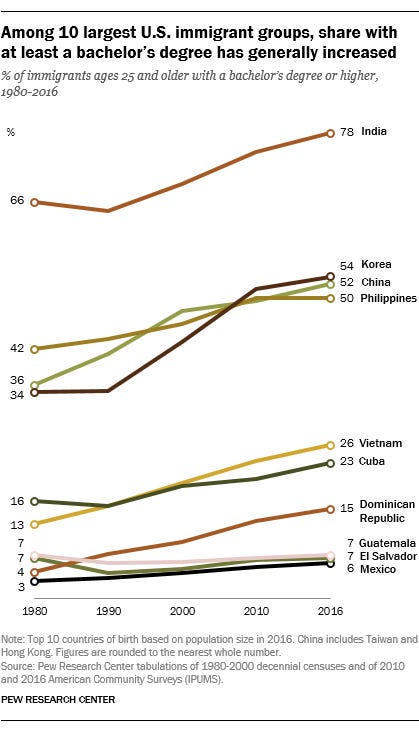
Let’s start with how the top subgroups enter. The dominant legal paths for Indian, Chinese, and Korean immigrants run through skilled-worker and student-visa pipelines that screen, by design, for advanced degrees in high-wage fields.
With this filtering mechanism, you aren’t sampling India or China as a whole, you’re getting their top engineers, physicians, and graduate students. And notice how many of these directors arrived via Canada — Ganatra, Song, Kang, and Shi.
Canada’s immigration runs on an explicit points system that scores education and skilled work right at the border, if anything a harder credential filter than the American one. These women are, overwhelmingly, the children of immigrants chosen for their human capital.
Now look at the other Asia. The same census category holds people admitted by the exact opposite logic: refugees, screened for danger — Hmong, Laotian, Cambodian, Burmese, and Bhutanese families who arrived fleeing conflict. Per Pew, while roughly 75% of Indian Americans hold at least a bachelor’s degree, the figure falls to about 18% for Laotians and 15% for Bhutanese; Burmese and Hmong Americans carry some of the highest poverty rates of any Asian group (around 19% and 17%), and Burmese and Bhutanese households earn less than half the median. These Asians are not directing top-100 films.
Pull on these threads and the same pattern emerges: the industry selects for wealth, credentials, and diverse status — and because the first two vary wildly within each racial bucket, 'diverse status' reliably delivers the wealthiest, most-credentialed members of the group.
The Real Story
The real story here demographically is this:
Asian women from the top earning subgroups are doing exceptionally well in blockbuster commercial filmmaking.
White women are doing worse.
Black, Latino and MENA women are not represented at all.
Lumping everyone together into BIPOC simply obscures what’s actually happening.
Let’s look at the top female directors:
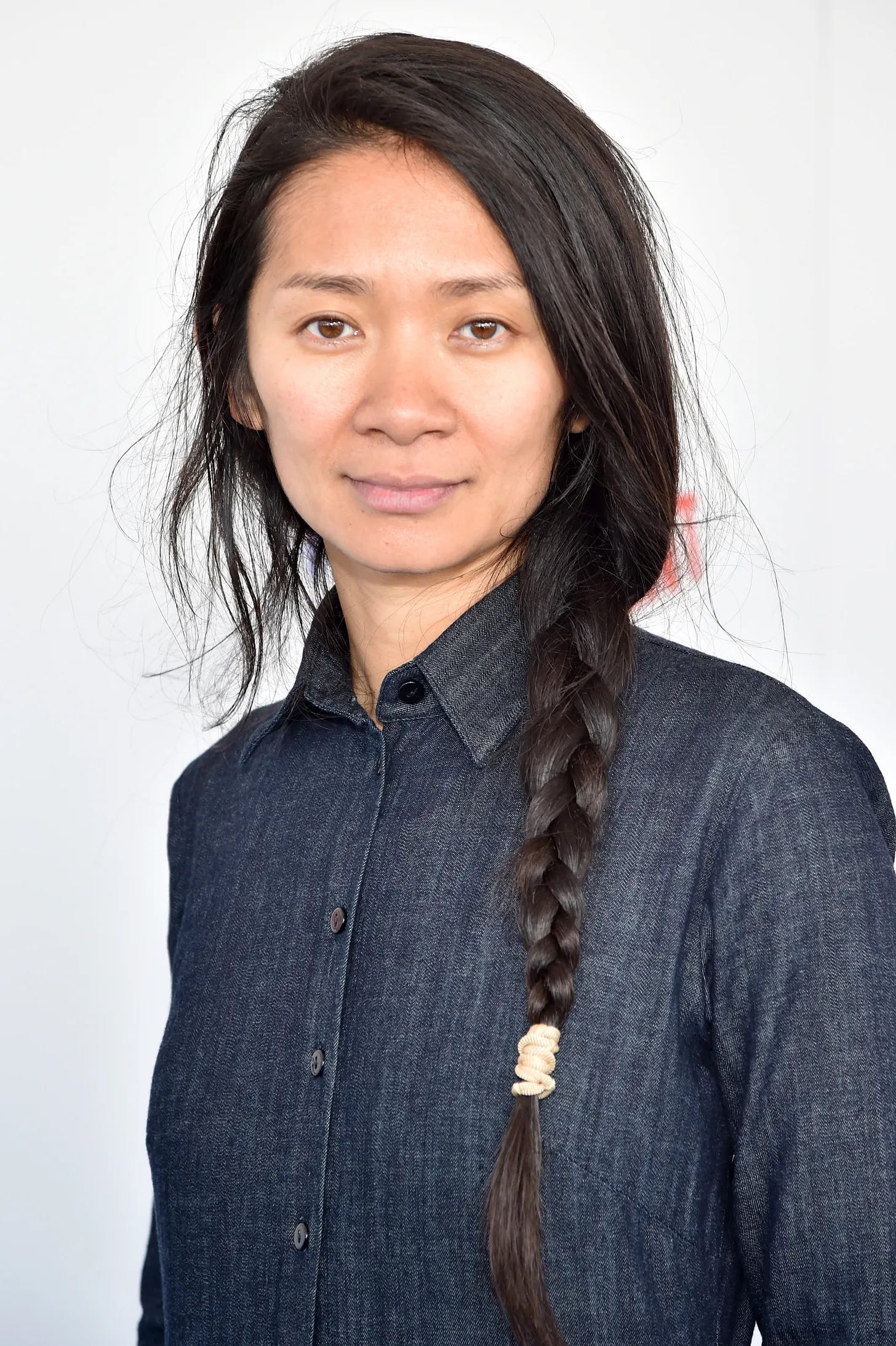
Nisha Ganatra (Freakier Friday) is of Indian descent, she came to Hollywood via Canada and has an MFA from NYU.
Celine Song (Materialists) is of Korean descent via Canada and has an MFA from Columbia.
Fun fact: when your humble author visited Columbia Film School, the first thing the admissions officer said was “don’t expect financial aid.”
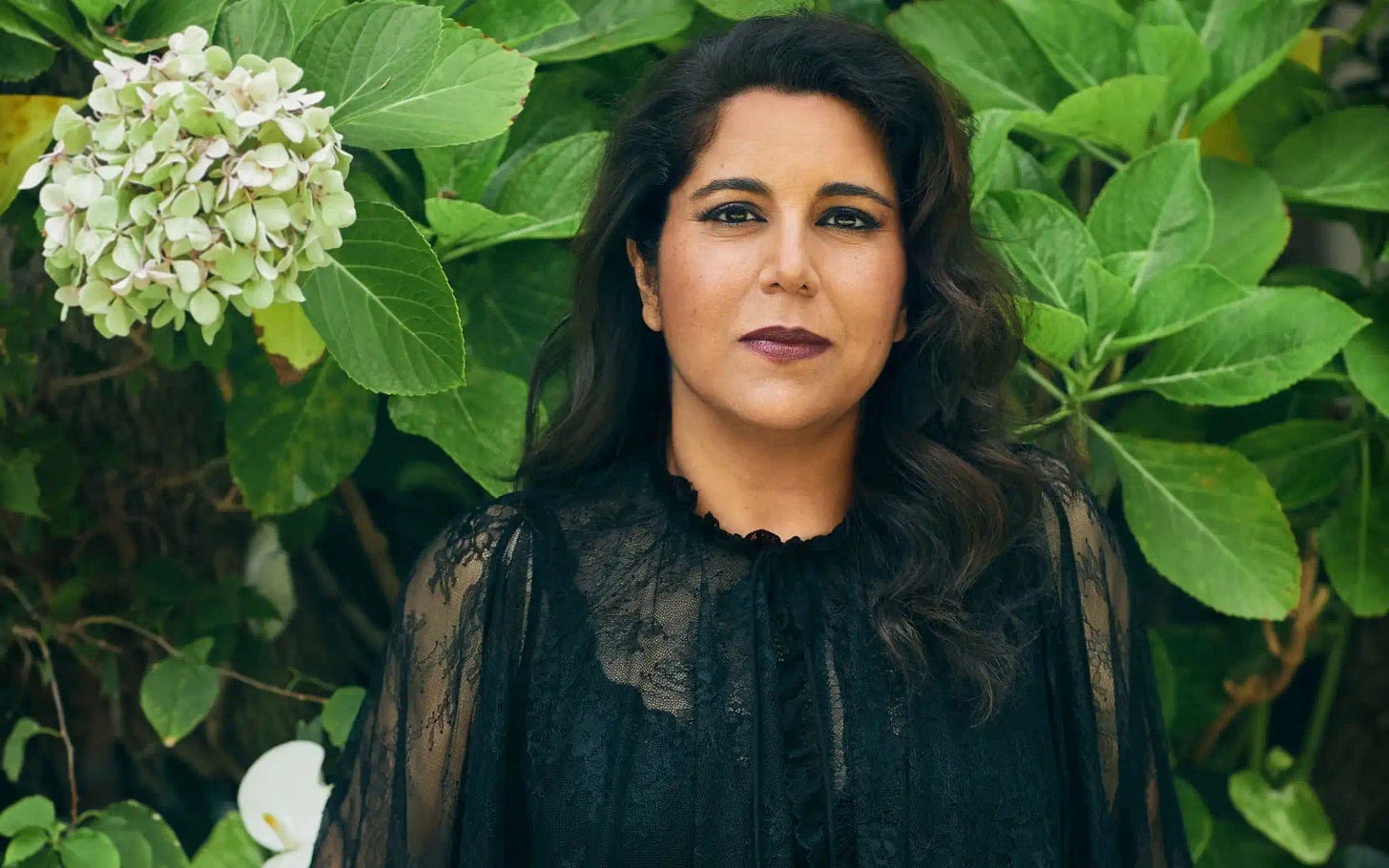
Nisha Ganatra got her MFA from NYU. Chloé Zhao (Hamnet) is from China and got an MFA from NYU.
Hikari (Rental Family) is originally Japanese and got an MFA from USC.
Maggie Kang (K Pop Demon Hunters) is South Korean and studied at Sheridan College in Canada
Domee Shi (Elio) is Chinese-Canadian and also went to Sheridan College.
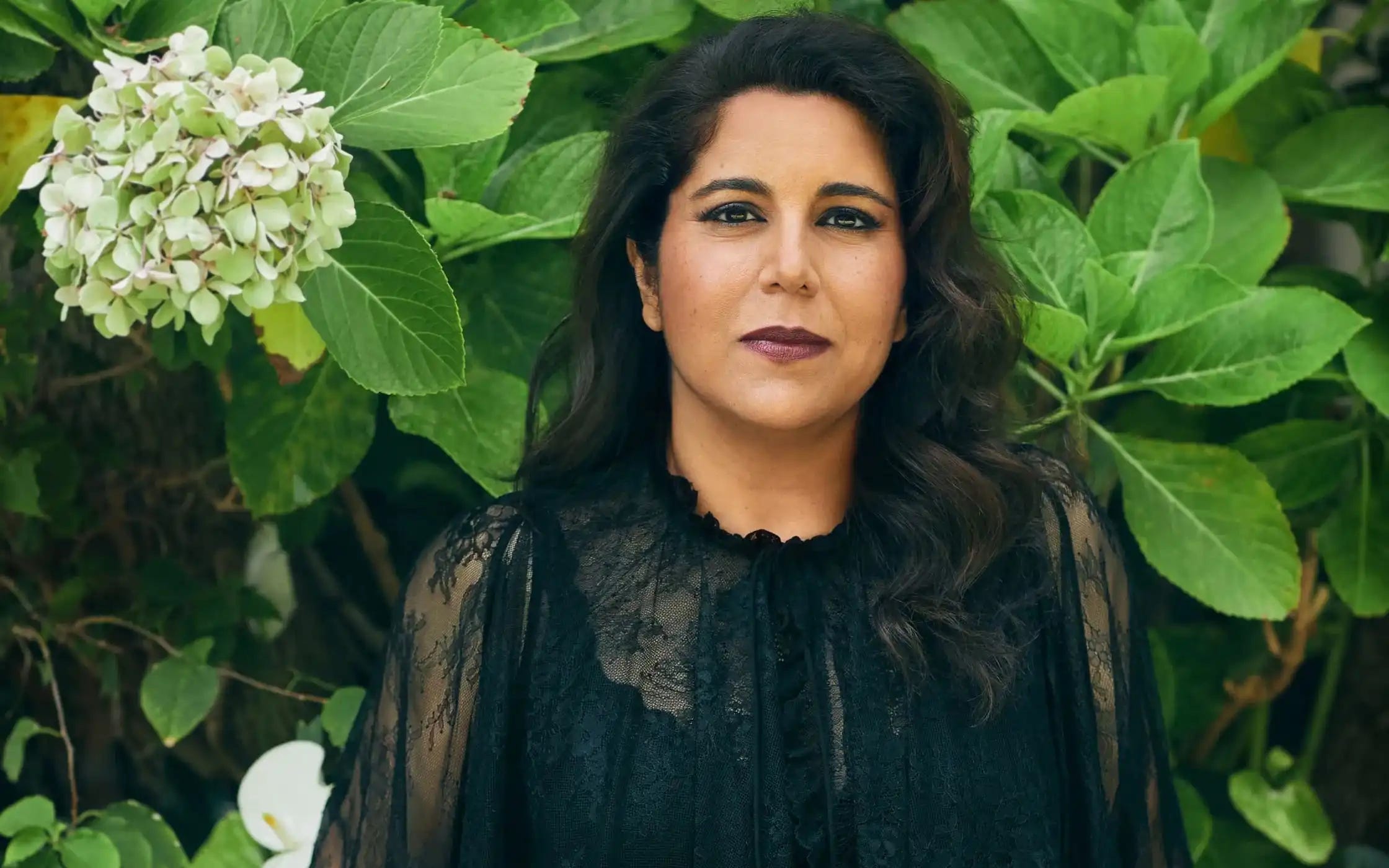
It’s interesting how many of them came from Canada: half got their start at Canadian colleges. More importantly:
All of them are in the top ten income groups from the Asian subcategory, and 2/3rds, all the live action directors, got MFAs from extremely expensive private film schools.
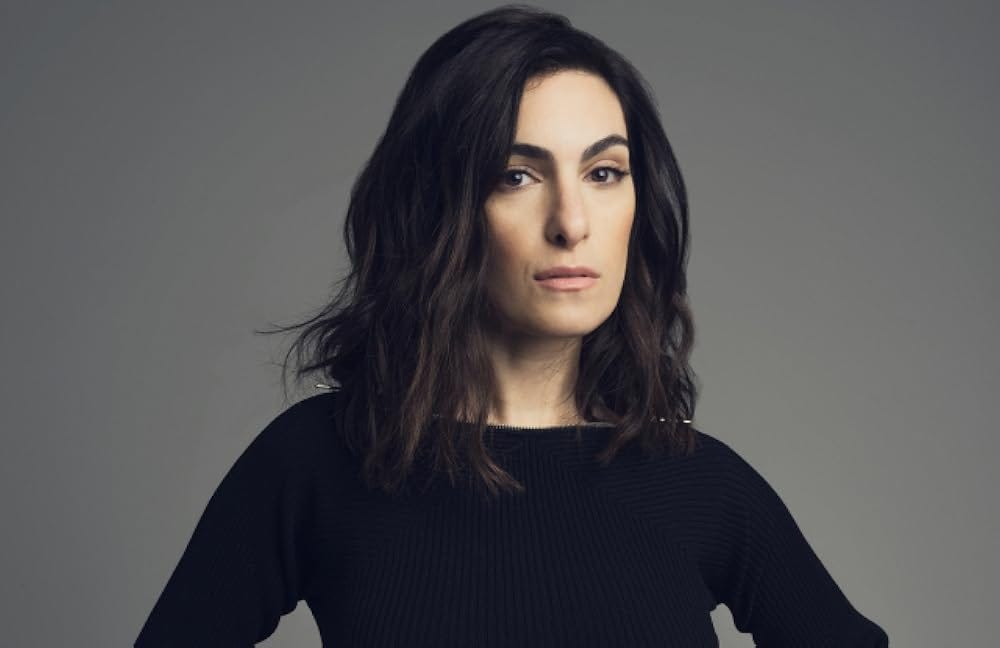
There are also three white women:
Madeline Sharafian (codirector on Elio) is Armenian-American with a BFA from Calarts.
Jennifer Kaytin Robinson (I Know What You Did Last Summer) is the only one of the 2025 top-grossing directors to not go to college at all (interesting that she selected into horror). She worked her way up through acting and screenwriting.
Emma Tammi (Five Nights at Freddy’s) went to Wesleyan, consistently one of the ten most expensive private schools in America, which has become a feeder for Hollywood, including alumni like Benh Zeitlin (Beasts of the Southern Wild) and Julius Onah (Captain America: Brave New World).
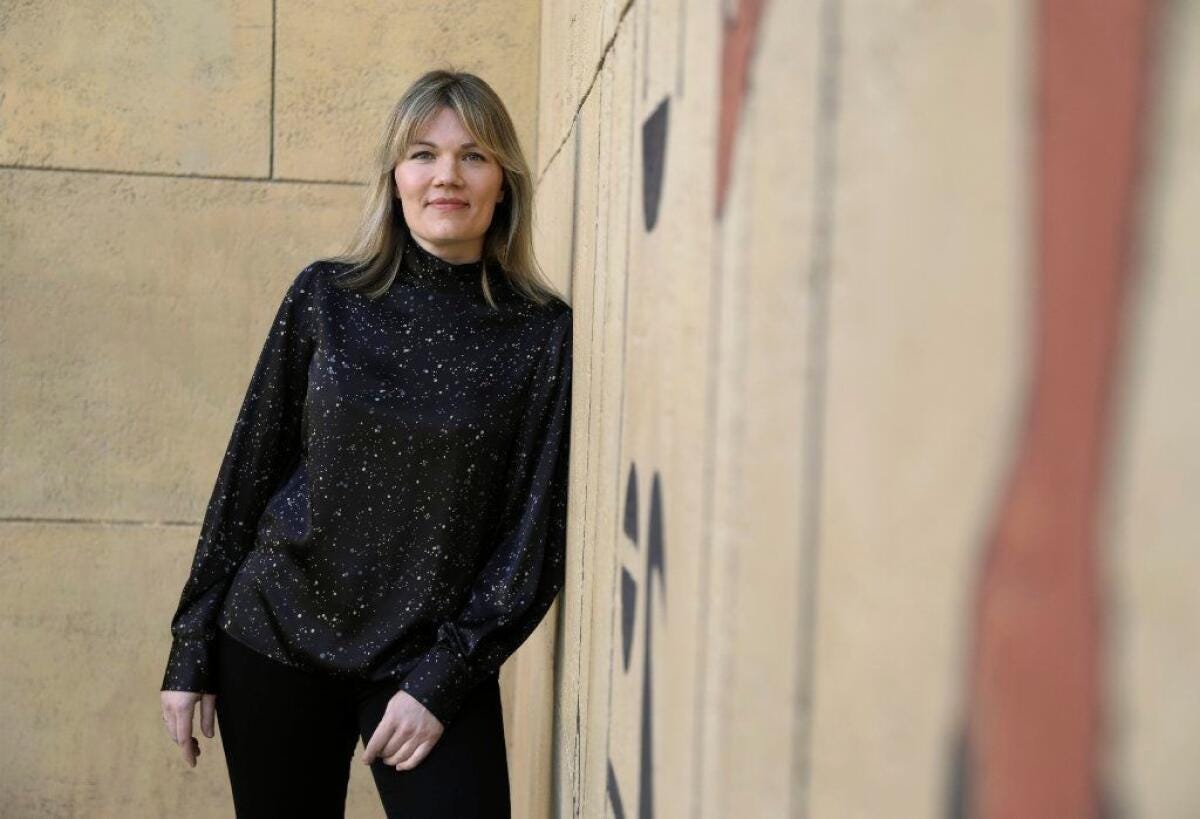
Why Armenian ancestry qualifies as white is a strange and complicated story, but we see even here that there are two elite private degrees, and just one, of the entire cohort, with no college degree.
Indian and Chinese Americans aren't only high-income, they also have the highest college-completion rates. So some of this is education pipeline, not family wealth as such. But that's kind if the point — schooling, income, and financial runway all travel together, and 'BIPOC' compresses them all into a single checkbox.
If we were trying to build a formula for a bipoc group to produce a lot of successful directors, a hat trick emerges:
High income.
Elite education.
Diverse status.
The first two make them competitive for the nonprofit pipeline, the latter makes the nonprofits feel they’re doing good by selecting them.
Again, the path of these directors seems pretty explicitly driven at least partly by class. Six out of the nine directors have degrees from elite, private programs. There are no graduates of American public film schools.
It's worth being precise about what's actually doing the filtering, because at least three different things get bundled into the word "class," and they don't point to the same fix. The first is money: the family runway to spend years on unpaid or underpaid creative work without going broke. The second is credentials and access: an MFA from NYU or USC, especially if you can afford them without loans, opens doors. The third is BIPOC immigrant selection: the U.S. preferentially admits the most educated, most driven slice of diverse immigrant countries, so a Nigerian or Chinese immigrant's child can carry enormous human capital without the family ever having been "wealthy" in the American sense.
So when I say the system selects on class, I mean this braided thing — money, credentials, and cultural background — not net worth alone.
Again, none of the top directors come from Asian subgroups that are at the bottom of the income distribution. I won't pretend a sample this small proves the industry selects on income. But it's entirely consistent with a system that filters, at every stage, for the most-resourced, the most-credentialed, and increasingly at the nonprofit and festival level, the most diverse.
It’s also flatly inconsistent with the story “representation” and “social justice” is usually invoked to tell.
This Trend Holds Within the Black Community
As I’ve wandered through the film industry, I noticed something interesting; so many of the Black people I meet are Nigerian or Ghanaian.
And there’s a reason for this. The highest earning “Black” subgroups are, in fact, Ghanaian and Nigerian.
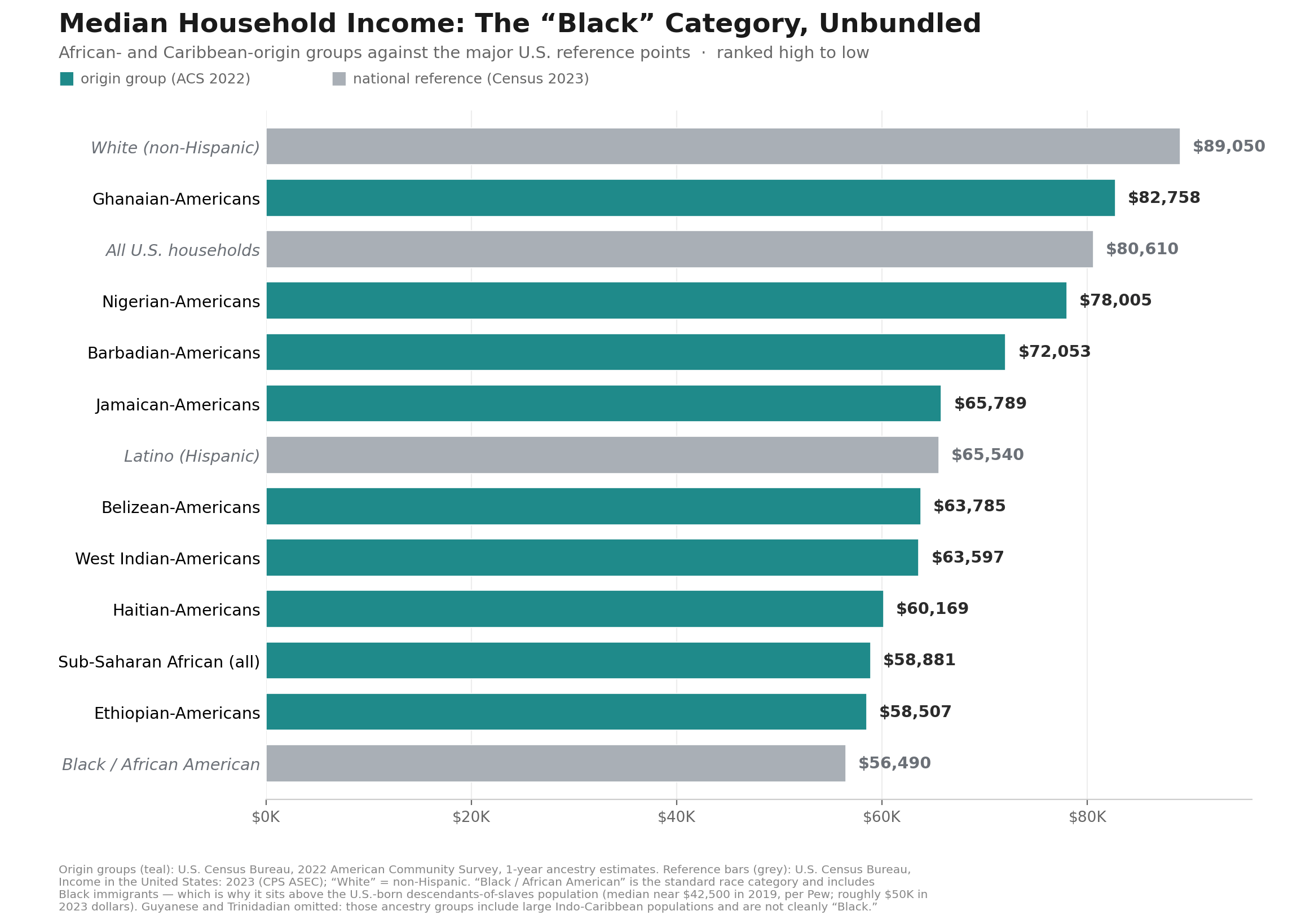
Nigerians are some of the most successful people in the Black subgroup for similar reasons to the Asians; a heavy focus on education, and a grind culture. They are the “tiger moms” of the Black community. For an interesting take on this, I recommend Anthony Onah’s SXSW film The Price, which focuses on the pressures young immigrant Nigerians face.
The film was originally titled Dara Ju. In the Nigerian Yoruba language, "dara ju" translates to "better" or "the best." It is often used to describe striving for excellence and continually improving yourself. Onah himself went to Harvard and then UCLA.
As you can see, Nigerian-Americans outperform even Asians in educational attainment:
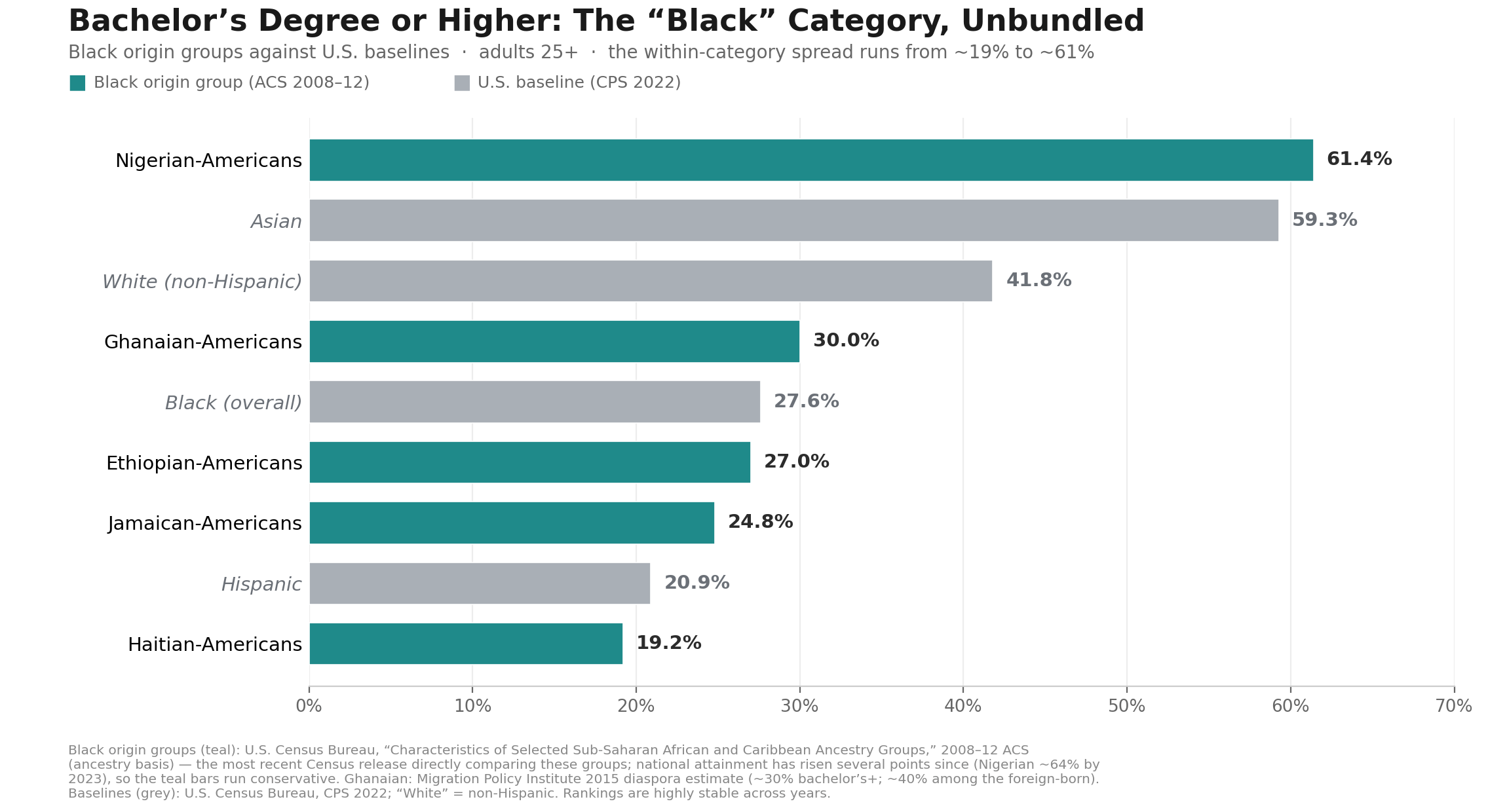
All this is to say that many of the Black directors who succeed in this system are the first generation children of recent African and Caribbean immigrants. It goes to the highest levels: Barack Obama is first generation, half Kenyan, Kamala Harris is first generation, half Jamaican.
If nine directors are an anecdote, a decade of the Sundance Dramatic Competition is closer to a pattern.
Across the Sundance U.S. Dramatic Competition from 2017 through 2026, twenty-four directors are identifiably Black . Of these, roughly a third — eight — are of recent immigrant heritage, the U.S. or foreign-born members of African and Caribbean immigrant families.

Notably, the overrepresentation lives entirely in the second generation; foreign-born directors alone (two of twenty-four, ~8 percent) actually fall just below their ~11 percent population share. The sharper pattern is not national origin but credentials. At least ten of these directors passed through NYU's Tisch School of the Arts, or 41%. If we include Yale and USC it hits 58%.
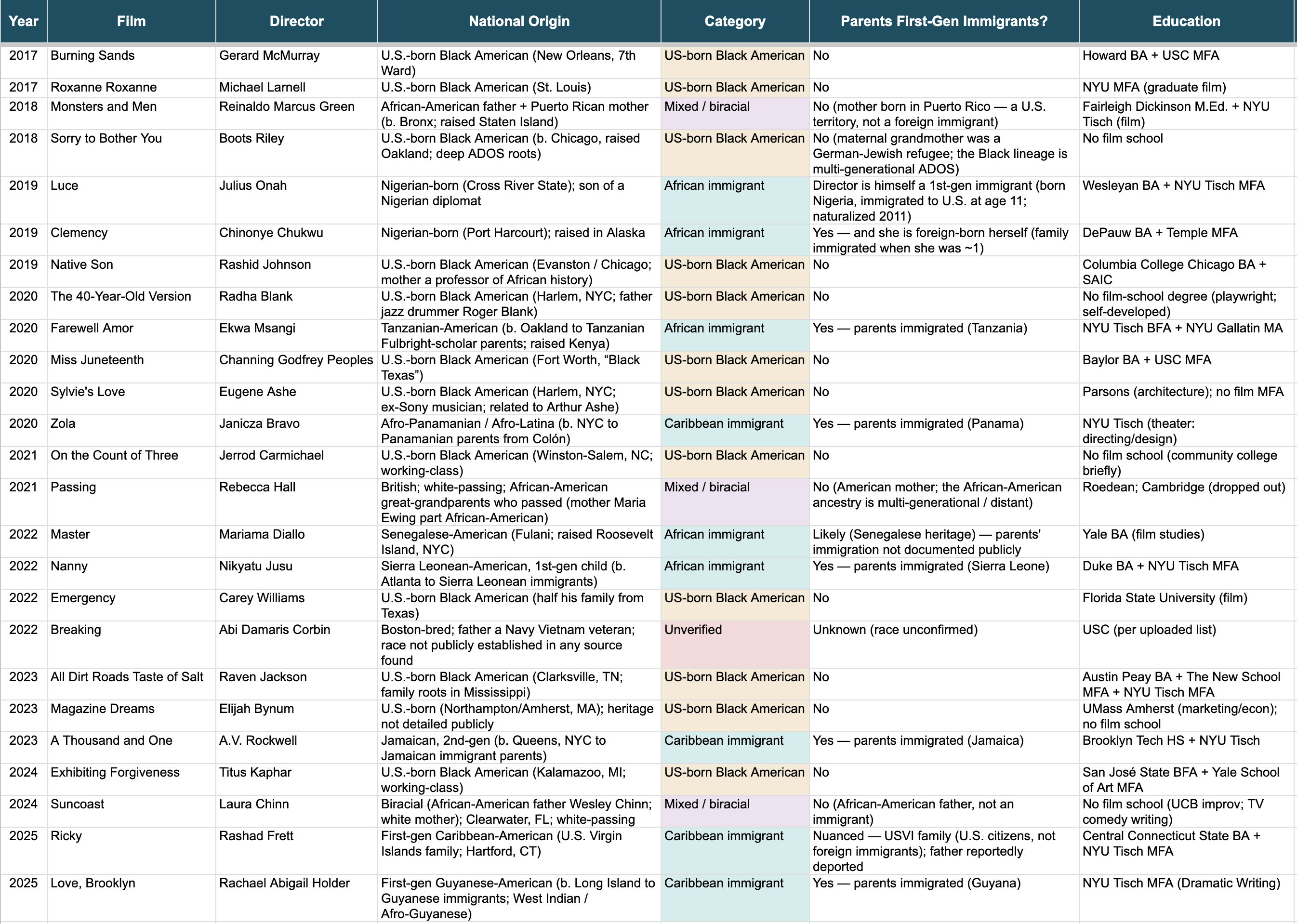
The divide sharpens if you look at who arrived without a credential. Every one of those eight immigrant-heritage directors holds a degree from a selective university or film school — six through NYU Tisch, the rest through Yale, Duke, Wesleyan, and Temple — and not one reached the competition without it. The directors who got there with no film-school training at all — Jerrod Carmichael, Radha Blank, Boots Riley, Laura Chinn, Eugene Ashe, and Elijah Bynum — are, without exception, U.S.-born descendants of the American Black experience rather than recent immigrants. The uncredentialed lane, the one that rewards a self-taught playwright or a rapper-turned-director, is open only to those already rooted here.
The two stories are not independent: immigrant-heritage Black Americans are far more likely to hold college degrees — 67 percent of Nigerian-born immigrants, against 26 percent of U.S.-born Black adults — so the pipeline that rewards elite credentials and the one that favors immigrant-heritage candidates are, to a significant degree, the same pipeline.
What the single "Black" category obscures, in other words, is less a quiet demographic substitution than a class filter: the directors who reach Park City are disproportionately the most credentialed members of an already-aggregated group, and U.S.-born descendants of slavery — about half the directors here but the substantial majority of Black America — are, if anything, underrepresented relative to their numbers.
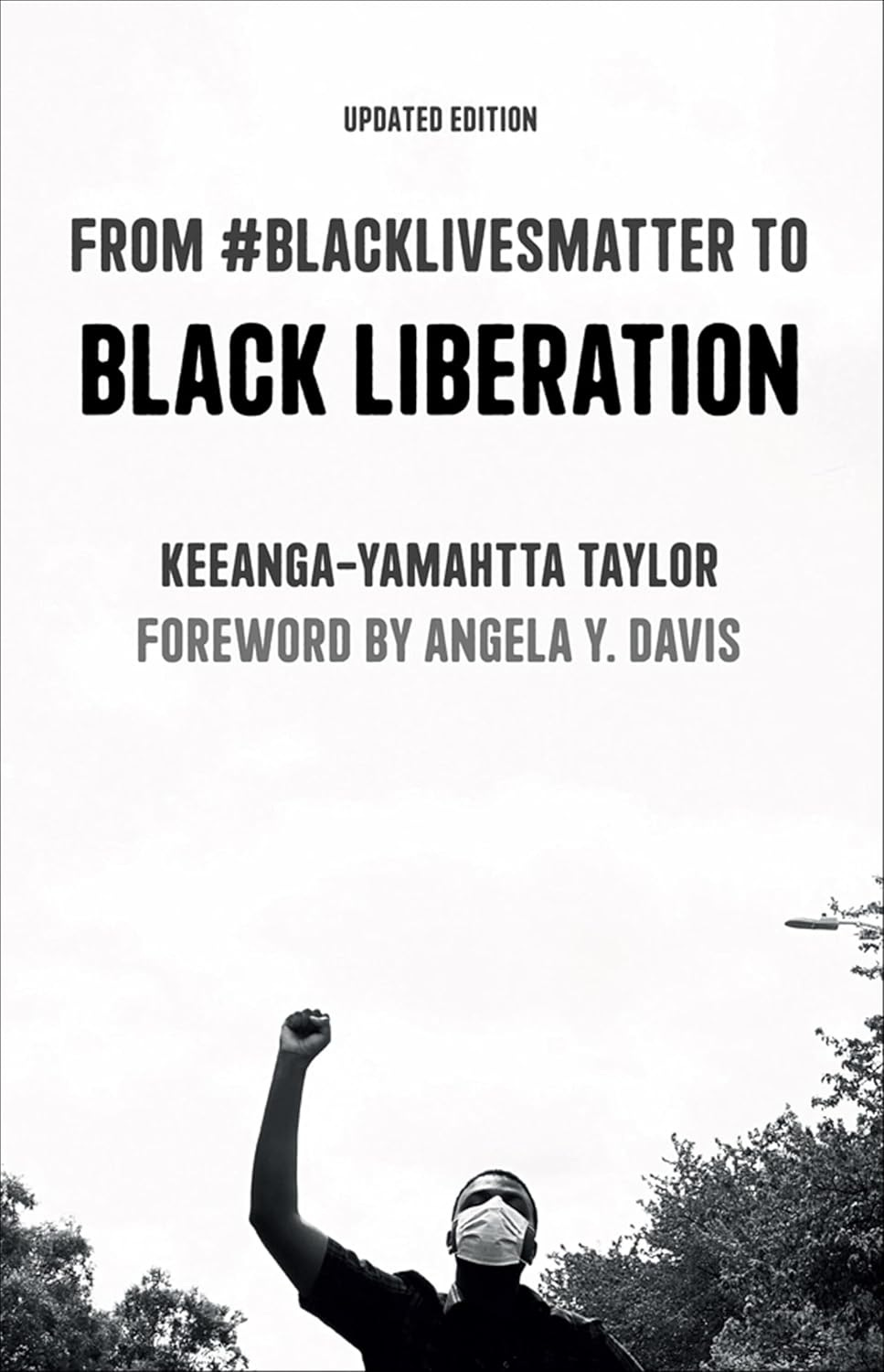
Again, the class disparities within the Black community are even more extreme than in other groups. As Keeanga-Yamahtta Taylor writes in her excellent From #Blacklivesmatter to Black Liberation:
the richest whites have seventy-four times more wealth than the average white family. But among African Americans, the richest families have a staggering two hundred times more wealth than the average Black family.
She drives it home: the richest 1% of Black families average $1.2 million in net worth against roughly $6,000 for the average Black family — and as far back as 2007, Pew found 40% of Black Americans saying the diversity within their own community meant Black people could no longer be treated as a single race.
This again shows the absurdity of using race as a proxy for marginalization without including class factors, potentially of using race at all: it benefits only the elites of the groups it’s claiming to uplift, the people who generally need that support the least.
Musa Al Gharbi, in his excellent We have Never Been Woke, also makes the universalist turn directly. Programs meant for the marginalized, he notes, routinely end up serving the elites of those groups — and if the aim is to help people in need, "it isn't clear why a factor like race would be used as a criterion at all."
Target the disadvantage itself and you still lift the group disproportionately, without denying aid to desperate people because they're the wrong race. He goes on to cite Karen and Barbara Fields’s excellent Racecraft: The Soul of Inequality in American Life:
“Racial equality and racial justice are not figures of speech, they are public frauds, political acts with political consequences. Just as a half-truth is not a type of truth but a type of lie, so equality and justice, once modified by race, become euphemisms for their opposite.”
Hollywood’s “Soho House Diversity”
As Hollywood works to diversify based on gender and race, it has unintentionally been hardening the class lines for decades. I like to call this “Soho House Diversity.” It’s a private club based not just on race and gender, but also class (high entry costs) and credentials (an expensive, elite education).
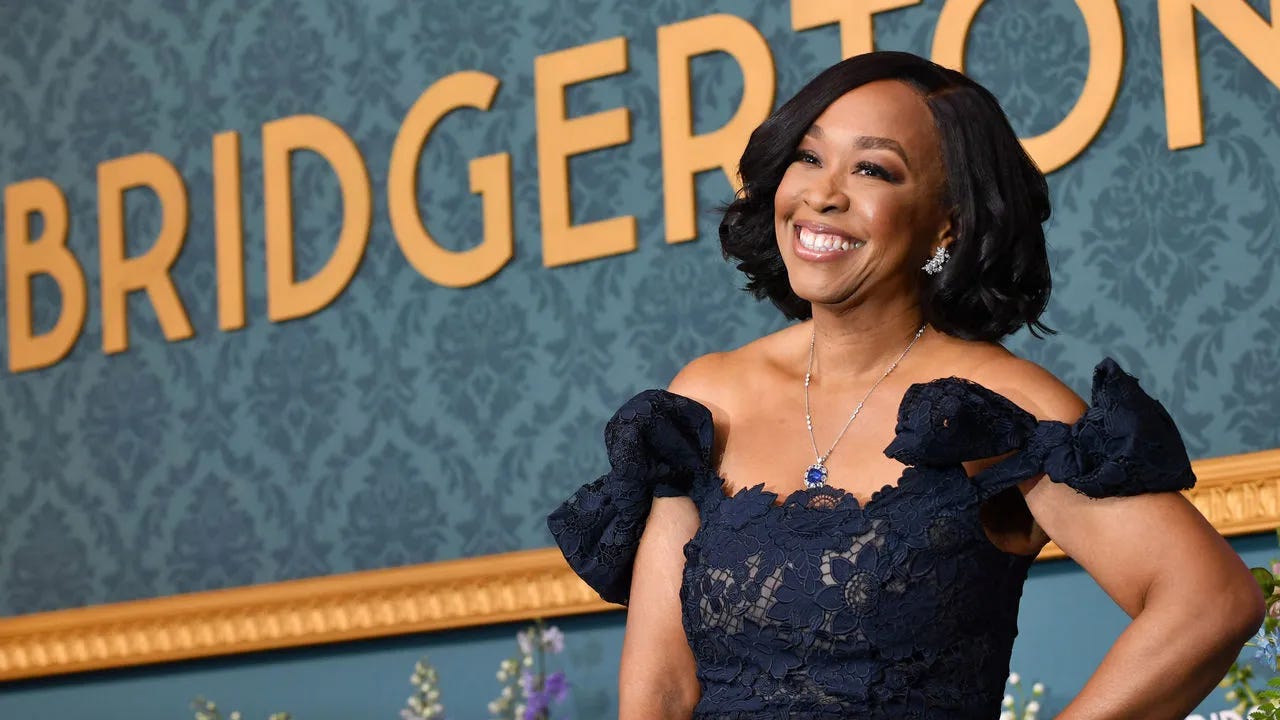
This is probably apocryphal, but an interesting thought exercise nonetheless. The iconic Shonda Rhimes, creator of Grey’s Anatomy and Netflix’s Bridgerton, is the daughter of a professor and a university administrator, with a bachelor’s degree from Dartmouth and an MFA from, you guessed it, USC.
Anyways, Rhimes once spoke to a class of Black Americans. She was trying to get more of the graduates to come to Hollywood. One student apparently raised their hand, then asked a question:
“So you’re telling me I have to move to one of the most expensive cities in the world, get an expensive graduate degree, then work unpaid jobs for a decade, while working at night to learn my craft, all in the hopes that I might find out in my mid to late thirties that I’m one in a thousand people who can actually break in and earn a decent living?”
Obviously this is not the story she was hoping would emerge, but again, if you’re from the lowest-earning income group, with the lowest net worth, our current Hollywood pipeline is a terrifying proposition. Let’s break it down visually:
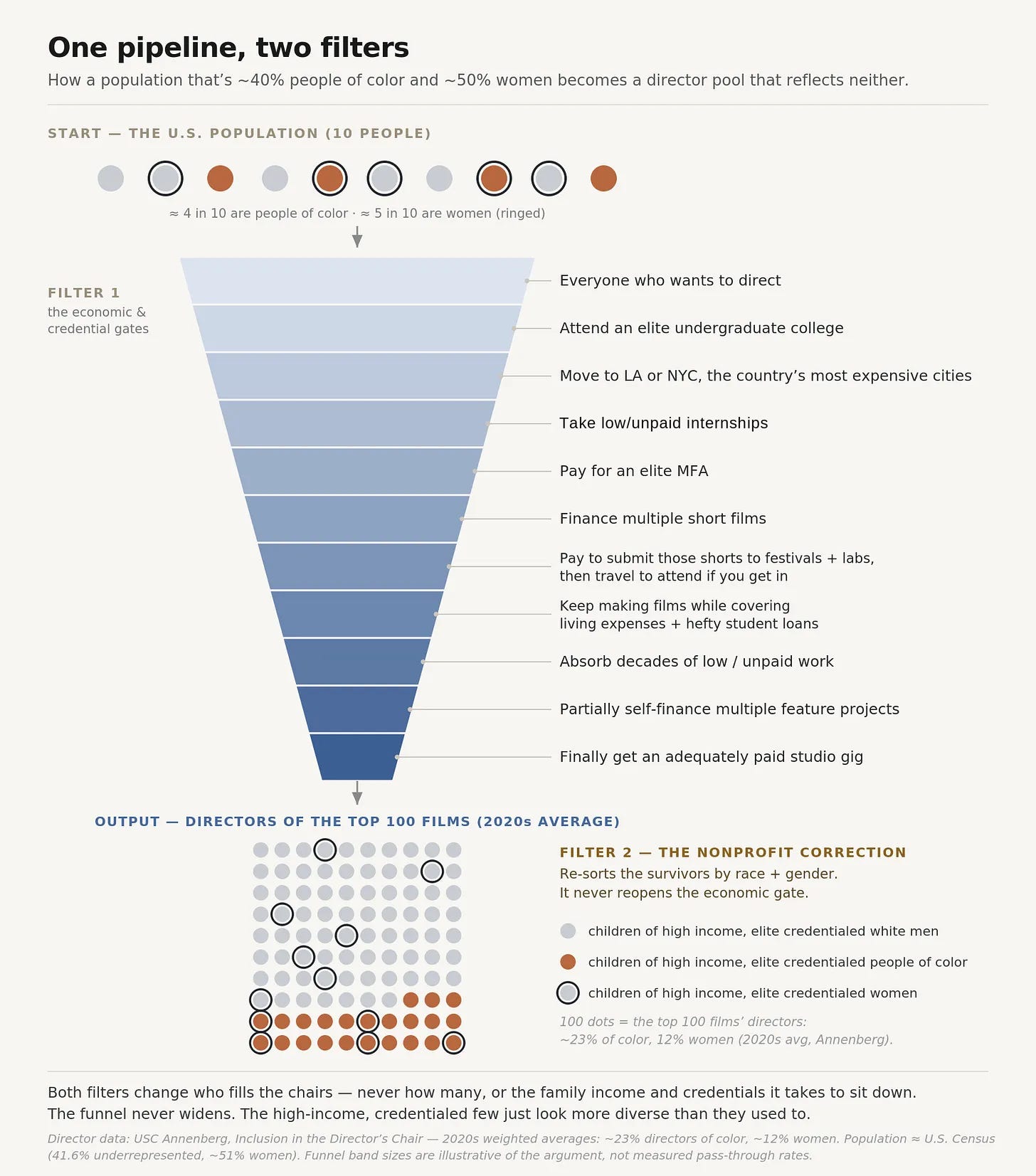
The current Hollywood pipeline gatekeeps in extremely expensive ways: unpaid internships, expensive, private MFA degrees, decades of low and unpaid work, multiple self-financed indie films. The nonprofits try to correct this by obsessively focusing on race and gender, which is producing this tilted pipeline (yes I’m aware that there are a lot of rich white men, just not very many young ones at places like Sundance anymore).
Again, class data should be taken into consideration when promoting funding and mentorship opportunities, as I argued in my piece Survival of the Richest.
Film careers are unusually dependent on financial runway, making family wealth an important variable that current studies rarely measure. If the median Asian family has 12x the wealth of the median Black family, that’s a pretty compelling argument for what’s happening.
Under activist pressure, Hollywood didn’t solve the underlying class issues, it simply switched which elites it was taking. And because Black American poverty is entrenched for a variety of issues, the easiest groups to select were the wealthiest, most credentialed groups that were also Black.
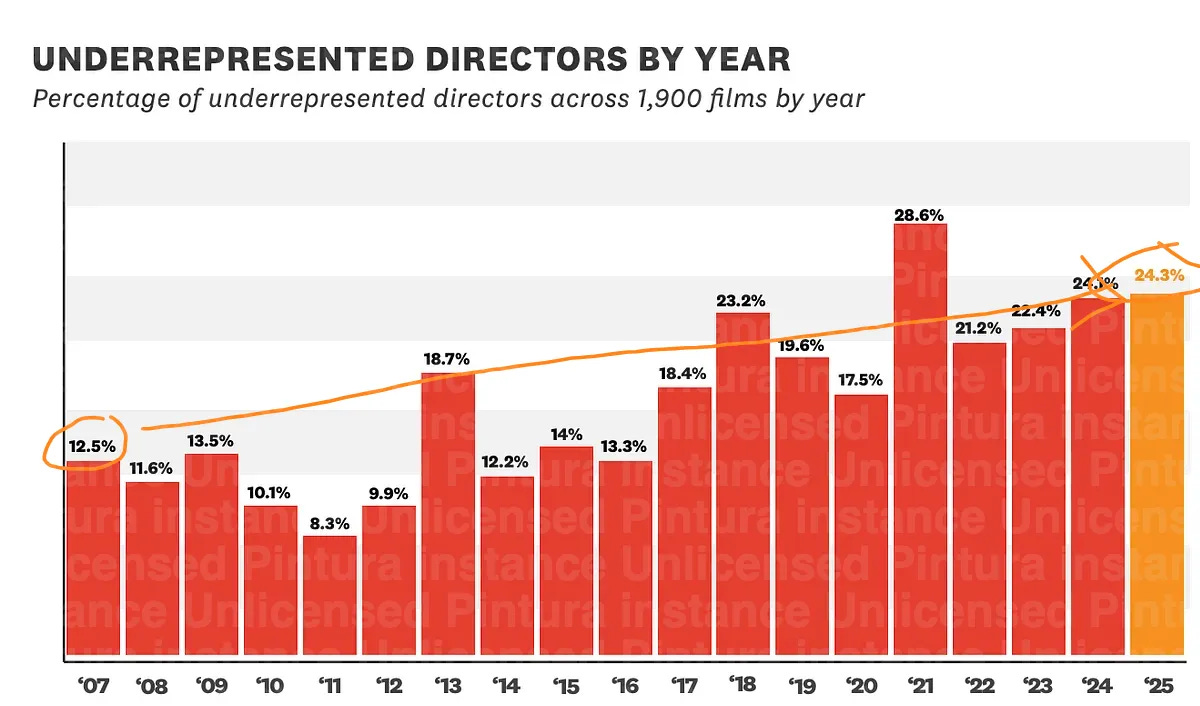
Ignoring the subgroup differences was how they were able to diversify so quickly, again, per Annenberg, nearly doubling the BIPOC representation in the last twenty years:
Terms Like “BIPOC” Serve Intra-Elite Competition
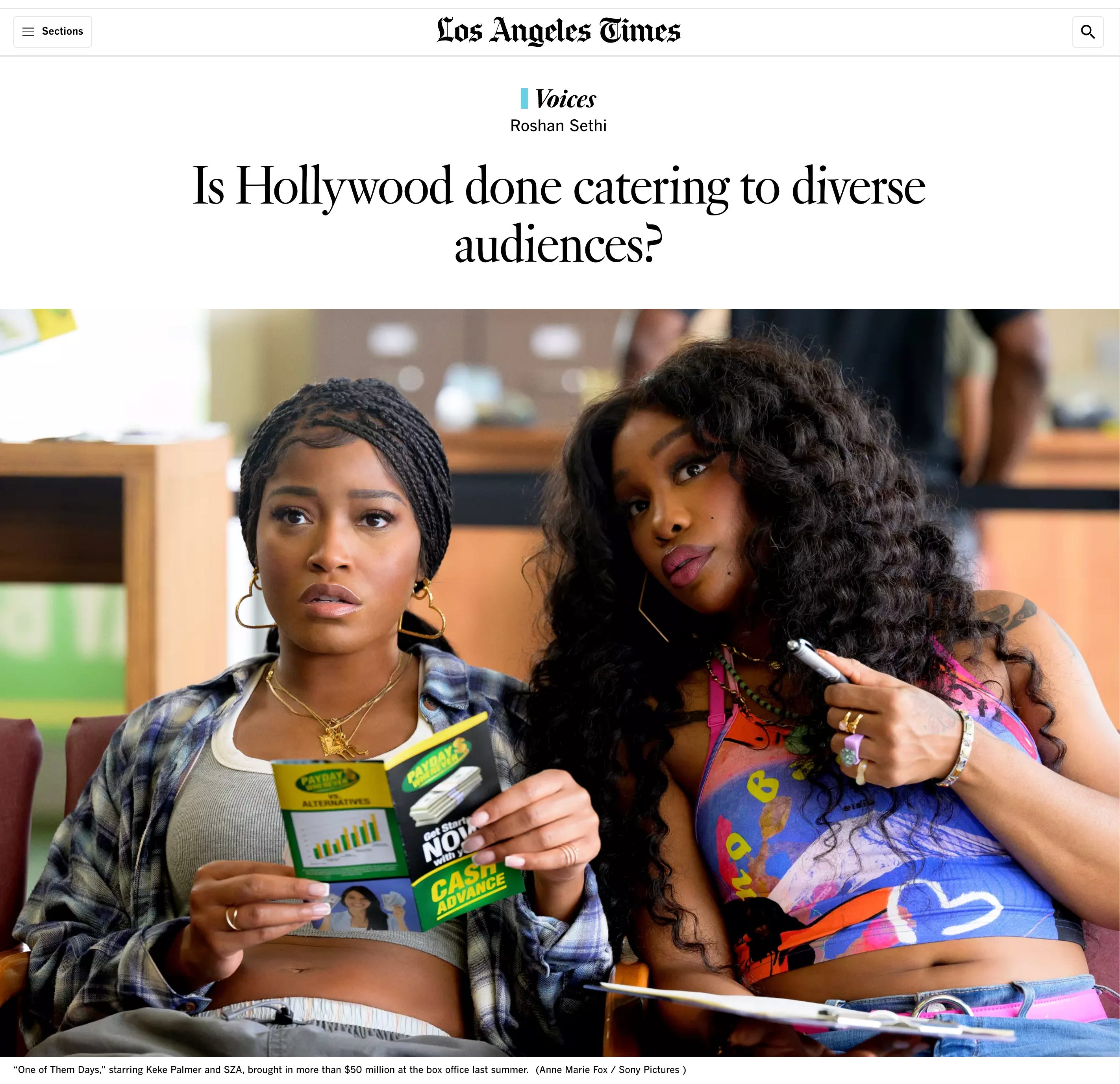
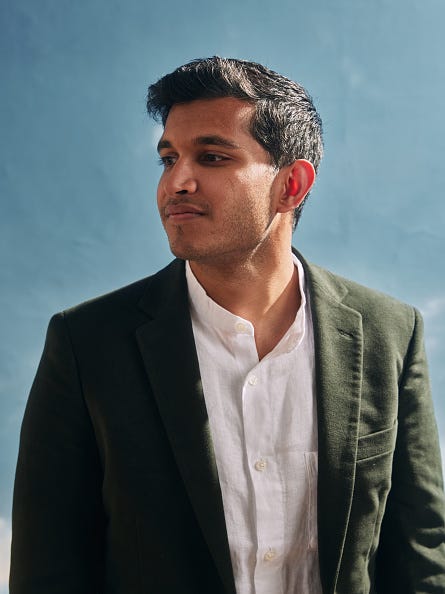
I thought of these unique subgroup differences while reading Roshan Sethi’s recent LA Times polemic. The article opens on an image of Black women. But the marginalization it documents — and the author’s own demographic — point somewhere else entirely.
The ‘BIPOC’ frame lets a piece illustrated with Black women be written by an Indian, a member of the highest-earning group in the country, who also happens to be a medical doctor. But let’s hear what he has to say:
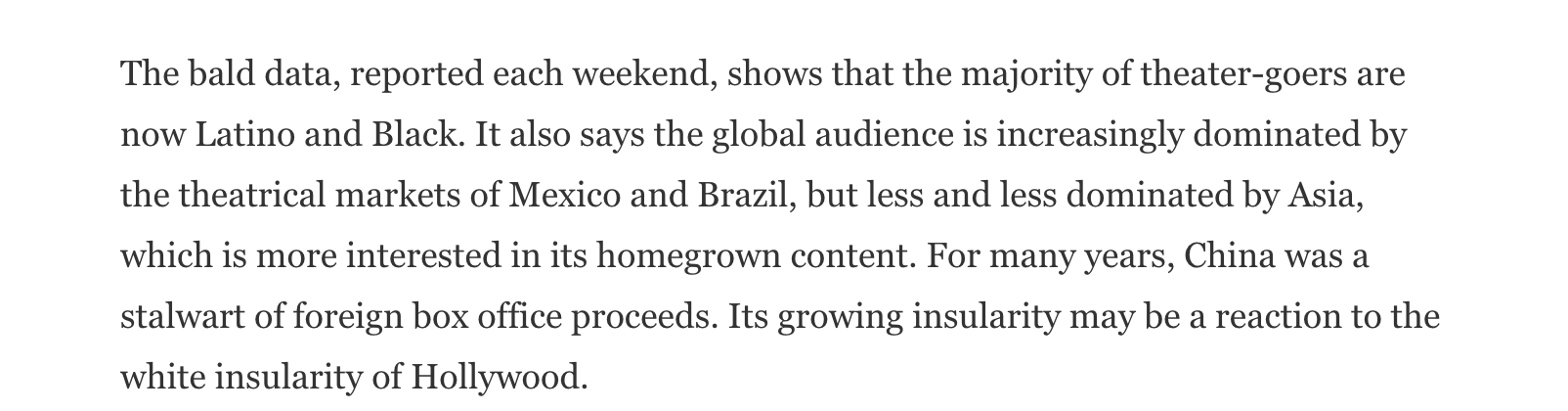
I would love to see the evidence for the Chinese backlash against the “white insularity of Hollywood.” Sethi certainly doesn’t present any.
The main study he does cite, like everyone who writes these kinds of op-eds, is the UCLA Diversity Report, a highly flawed study which I have read and may need to deconstruct in the way I did with Annenberg.
Sethi’s LA times piece has many of the same issues I already addressed in my response to Raquelle David, cherry-picking box office winners and ignoring losers.
He also uses “edgy,” borderline offensive terms like “white noise” to refer to films and television that feature white characters (imagine someone using the term “black noise”). It echoes Hillary Clinton's unbelievably unpopular "deplorables" comment, which arguably helped Donald Trump win in 2016.
He also obscures the massive differences that exist within these groups, and uses strange truisms like the one below.
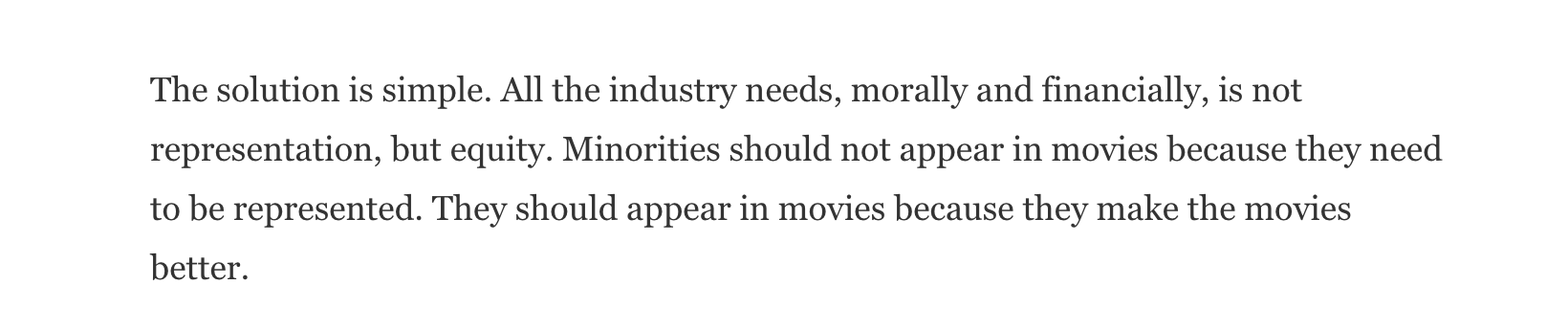
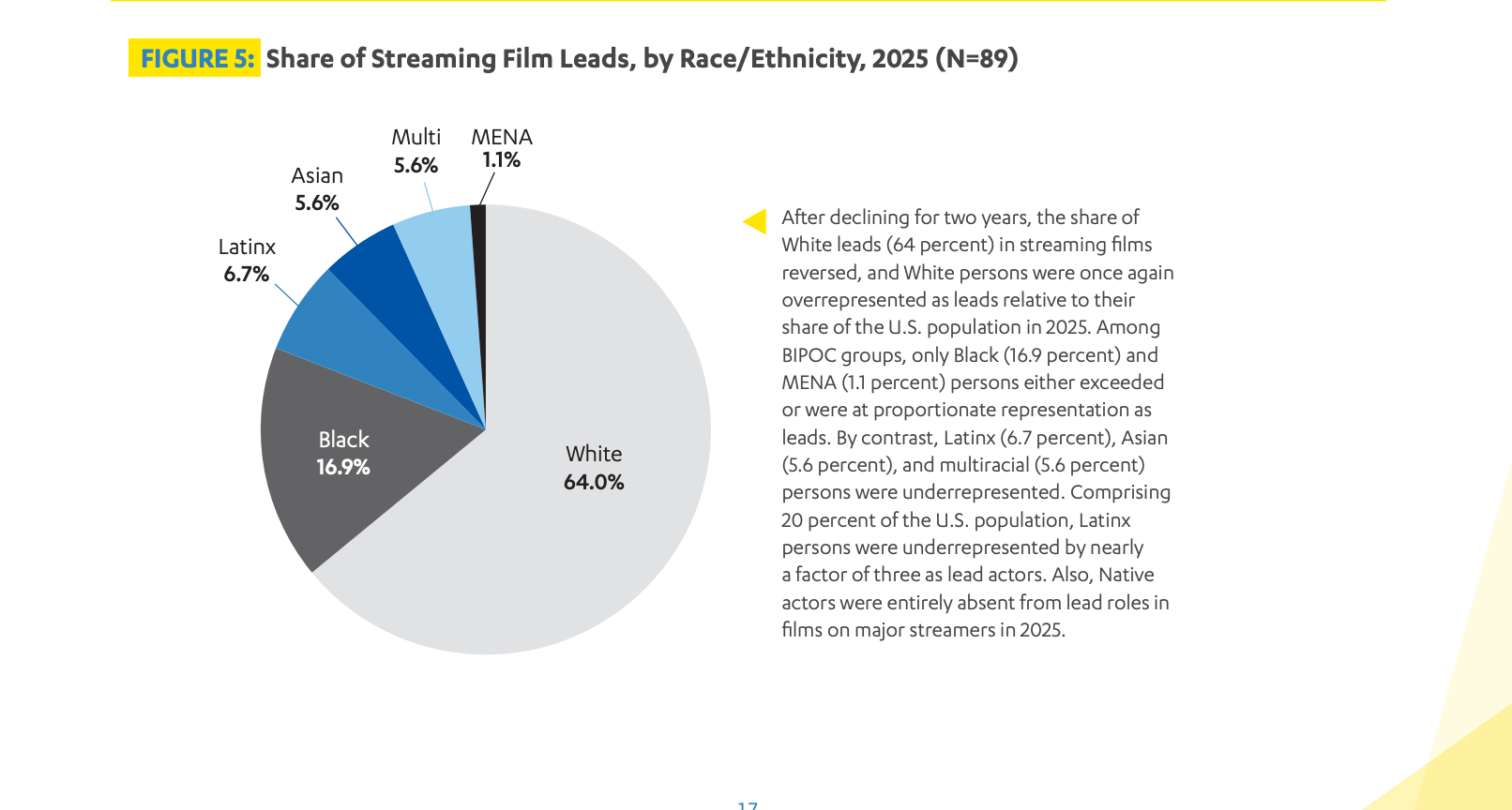
Just on a basic level, Black actors have been at or above population parity in speaking roles in recent Annenberg/UCLA streaming counts (though lower in top 100 theatrical), while Latinos sit far below in both. I don’t have time to do the giant averaging critique of this study like I did with Annenberg, but the same issues apply to UCLA.
So shouldn’t we have more programs chasing Hispanic representation? (Also, the activist term Latinx is broadly hated in the Latin community and arguably contributed to Donald Trump’s reelection).
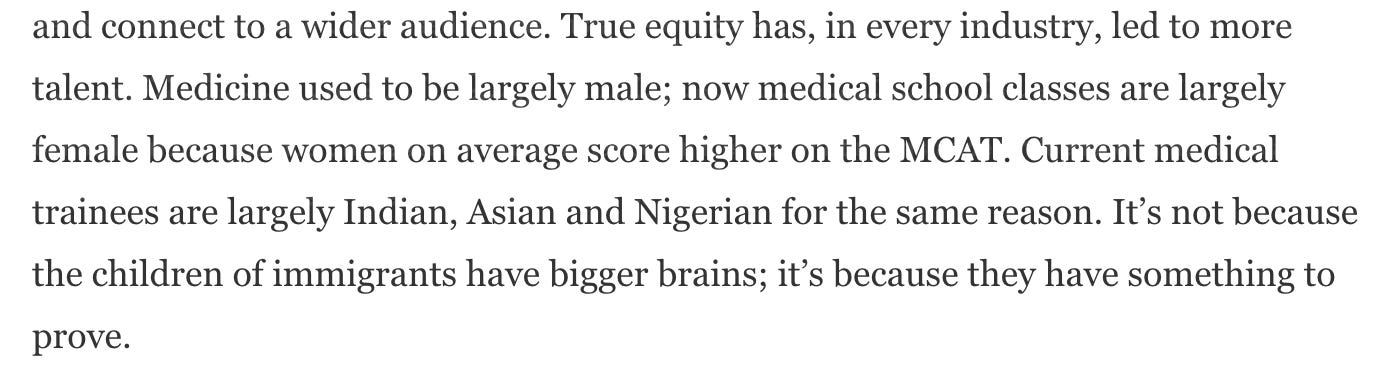
Equity, defined as racial proportionality, predictably routes opportunity to the wealthiest, most-credentialed subgroups inside each racial category. This perfectly fits his description of Nigerians (highest educational attainment), Indians (highest median worth) and Asians (you get it by now).
But many of these programs were designed with other groups in mind.
Virtue Hoarders
Sethi’s op-ed, like so many others, is an example of what UC Irvine Professor Catherine Liu might call “Virtue Hoarding.” The term refers to how educated, white-collar elites, who she calls the Professional Managerial Class (PMC), use performative morality, educational credentials, and progressive language to protect their class status and justify their superiority over the working class.
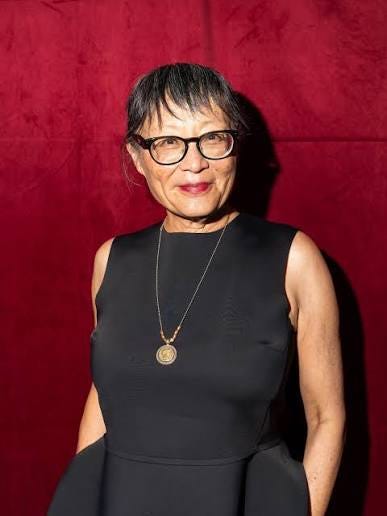
In her book, Liu specifically attacks the form of identity warfare Sethi is engaging in, saying that it directly leads the working class toward the right wing populism of figures like Donald Trump. To defeat Trump’s populist policies, she says, we need actual class struggle from the left, “not more identity politics, which has become just another vehicle of PMC virtue signaling.”
She traces the obsession with identity as a specific way of avoiding the broader class struggles necessary to reshape society in more equitable ways. Liu's argument is that this identity-first posture is itself a class strategy — performative morality that guards elite status — and that it shoves the working class toward right-wing populism. The PMC, as she puts it, "loves to talk about bias rather than equality, racism rather than capitalism, visibility rather than exploitation.”
Note that there is not a single mention of class in Sethi’s op ed, and that it closes with what is essentially a self-congratulation. People like Sethi became doctors because they earned it through hustle, just like how they are apparently more deserving of Hollywood jobs.
Bonus: For those interested, Catherine Liu has done some delightful podcast appearances.
Elite Overproduction and Opportunity Hoarding

Peter Turchin’s book End Times: Elites, Counter Elites, and the Path of Political Disintegration is crucial for understanding the era we live in. As Musa al Gharbi summarizes in We Have Never Been Woke:
“Elite overproduction occurs when a society produces too many people who feel entitled to high status and high incomes relative to the capacity of that society to actually absorb them.” Those surplus elites, Turchin argues, then ally with genuinely marginalized groups to unseat the incumbents and take their place — alliances that don't hold afterwards, because at the end of the day elites mostly just want to be elites.
To put it simply: we are in an age of elite overproduction. There are more and more aspiring elites being credentialed by top film schools, and fewer and fewer high status jobs for those people to fill, particularly in the culture industry. To compete for those same positions, a sort of virtue war is forming among the elite, who use their identification with the marginalized as a means of scoring points and advancement against their rivals.
One of the most reliable ways that elites protect desirable jobs is by creating what Erik Olin Wright calls “social closure,” i.e. forcing people to get expensive credentials in order to gain access to certain desirable jobs like directing, via expensive MFA programs.
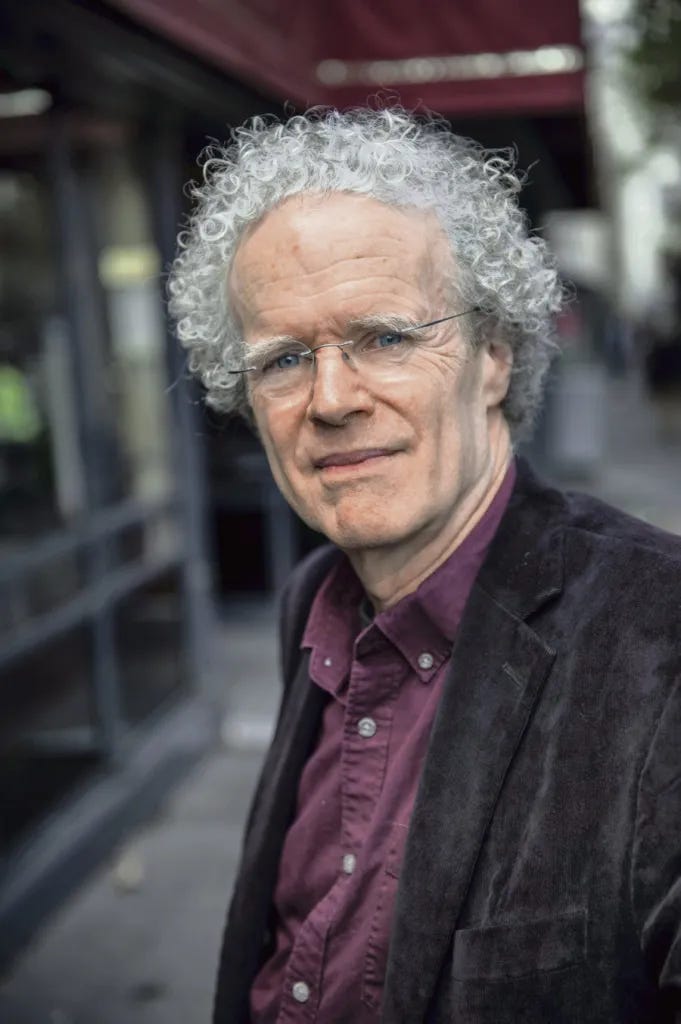
Wright is a sociologist at the University of Wisconsin who has been studying class for decades. His book Understanding Class is highly valuable. Drawing from Charles Tilly’s work in Durable Inequality, Wright discusses the idea of “opportunity hoarding” as a means of guarding class status.
As Wright puts it, "one way of achieving social closure is by creating requirements for filling the job that are very costly to meet." Educational credentials are the textbook case: tuition, admissions gatekeeping, and low-income applicants' rational fear of debt all wall off access — and that wall is the function, not a side effect. An NYU or USC MFA is social closure via diploma.
The USC / NYU MFA programs are a specific way of reserving special jobs for special people; the children of the already wealthy and educated. These people want jobs in an industry that is dominated by elite white incumbents, and one of the absolute best strategies for breaking in is a tried and true one; identifying with the marginalized in order to seem more virtuous than the incumbent elites.
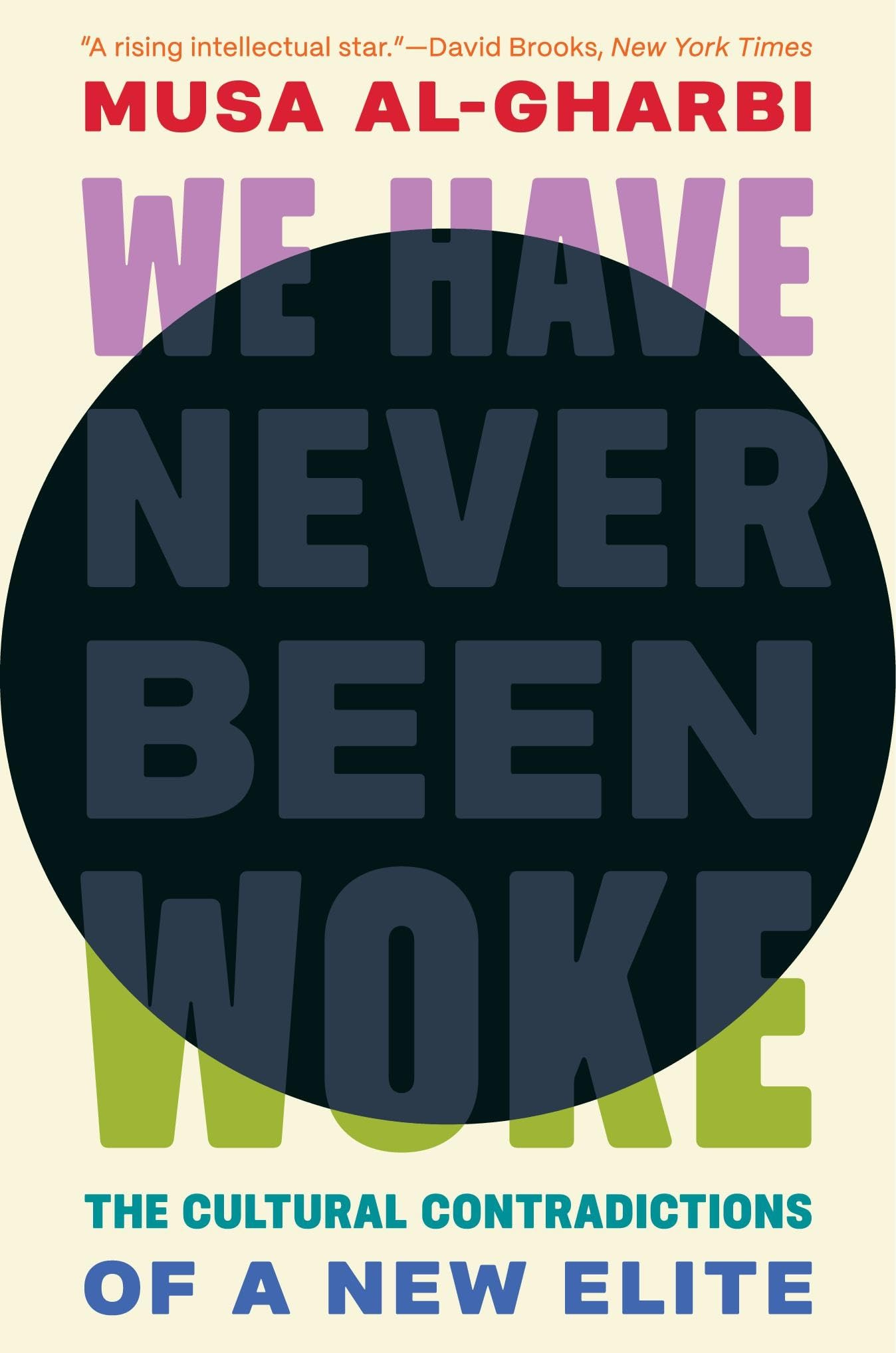
But there’s a tension here. Gharbi expertly diagnoses this clever identification of the elite with the marginalized for their own advancement. As he puts it…
“being an elite from a minority population doesn’t negate the fact that one is an elite.”
“Racial Reaganomics”
Gharbi goes on to quote philosopher Olufemi Taiwo, who designates these kinds of strategies as a form of “racial Reaganomics:”
Such treatment of elite interests functions as a racial Reaganomics: a strategy reliant on fantasies about the exchange rate between the attention economy and the material economy.... after we in the chattering class get the clout we deserve and secure the bag, its contents will eventually trickle down to the workers who clean up after our conferences, to slums of the Global South's megacities, to its countryside. But probably not.
The arrangement is reciprocal: majority-group elites have an interest in "consecrating" minority elites as "authentic" voices for their people, and those elites have every incentive to see themselves that way too. The overlap, Gharbi argues, is how elites from marginalized groups end up "legitimizing broader elite attempts to enrich themselves… in the name of social justice."
In an era where there are more and more qualified people for elite jobs, and fewer and fewer of them to go around, a strategy emerges wherein elites like Roshan Sethi, again a practicing doctor and successful television writer from the group with the highest median income in the United States, identify with marginalized people for their own advancement.
As Gharbi documents, "a radically disproportionate share of Black people capitalizing on affirmative action policies… are of immigrant or multiracial background," and tend to be "already affluent compared with most other Black Americans." The pattern isn't Black-specific: across ethnicities, and across gender, these programs reliably reward the already-comfortable members of the target group — affluent white women prominent among them.
This is the process at work in the current film industry, which selects for race and gender but not class.
Once you see it, you can’t unsee it.
Towards Solutions

To avoid these strange situations, the Hollywood, festival, and nonprofit worlds need some real metrics for class, so they can direct at least some of the resources they distribute to the people who need it most.
Some ideas:
For nonprofits: alongside the endless identity checklists, the indie film ecosystem could also screen for parental household income and net worth, like college financial aid applications do.

I pulled this job posting for a Hollywood assistant today. A bachelor’s degree and multiple internships minimum (likely unpaid) are means of class exclusion. Hollywood: Stop requiring bachelor’s degrees and multiple unpaid internships for entry level jobs. Hollywood was built by poor, crazy outsiders, not ultra-credentialed elites. We need more of that energy again.
Pay interns. European production companies have long paid at least a nominal sum, €500 a month, to their interns. At the very least, have one paid internship opportunity reserved for people of lower income.
Rebuild the old Hollywood pipeline: actually pay people for apprenticeships, like Hollywood used to.
Screen not just for race and gender, but for elite education and backgrounds to make sure there aren’t too many.
Festivals: make lower budget films a priority, as they’re more accessible for the majority of people.

These suggestions will be uncomfortable for a lot of people, but if we actually want to help genuinely marginalized people, we clearly can’t eliminate class and just use race and gender proxies, or we’ll continue to get mostly the richest subgroups who still fit into BIPOC.
And of course we will; the film industry is a brutally expensive enterprise to join, one that now requires expensive degrees, unpaid internships, and thousands of hours of free work.
The Hollywood system, instead of training people like in the early studio days, now outsources that work to elite film schools like NYU, meaning it can cost $1m just to break in, if you’re lucky.
Who Are We Trying to Help Here?
Gharbi finds the same elite-school capture in prestige journalism that we've traced in Hollywood: newsrooms like the New York Times and the Wall Street Journal now carry elite-degree shares rivaling the Forbes billionaire list. It's worth asking whether that credential bubble is part of why audiences — for the news and for the movies — keep drifting away.
As an old school American liberal, the group I feel most compelled to help are those my country’s history most directly harmed, Native Americans and the Black descendants of slaves. That was the wellspring of this kind of institutional support, but without class as a factor, a lot of skewed incentives and results have clearly showed up.
None of this is an argument against helping people — it’s an argument about whom this particular help was built for. The institutional support that hardened into “diversity” programming didn’t appear from nowhere; it was a response to two specific American injuries: the conquest, dispossession, and treaty-breaking done to Native Americans, and the slavery, then Jim Crow, redlining, and century-long exclusion from wealth-building done to the descendants of enslaved Americans.
What defines those histories isn’t only that they were brutal — it’s that the harm was inflicted by the continuous American state and compounded forward, which is why it still shows up, in wealth gaps that separate these groups from nearly everyone else, immigrant and native-born alike.
And that's the opening for a fix that doesn't need race at all. Because the injury now lives in something we can actually measure — income, family wealth, the runway to spend years working for free — we can aim at that disadvantage directly, instead of at the skin color that once stood in for it.
Do that, and the people these programs were built for, disproportionately poor precisely because of the state-built harm, get reached disproportionately. It's restorative without being punitive, it assigns hereditary blame to no one, and it doesn’t inflame identitarian grievances like those that brought us the Donald.
A recent arrival from one of the planet’s highest-earning, most-credentialed subgroups may face real racism — but they did not inherit that manufactured, state-built disadvantage, and often they land here already carrying more income, more family wealth, and more elite schooling than the Americans these programs were meant to reach. When a bucket like “BIPOC” lets the second group stand in for the first, it doesn’t widen justice. It quietly reroutes it — away from the people with the strongest historical claim and toward the people who need it least.
As we’ve seen here, sandwiching everyone together into BIPOC mostly helps the wealthiest subgroups. But is this social justice?
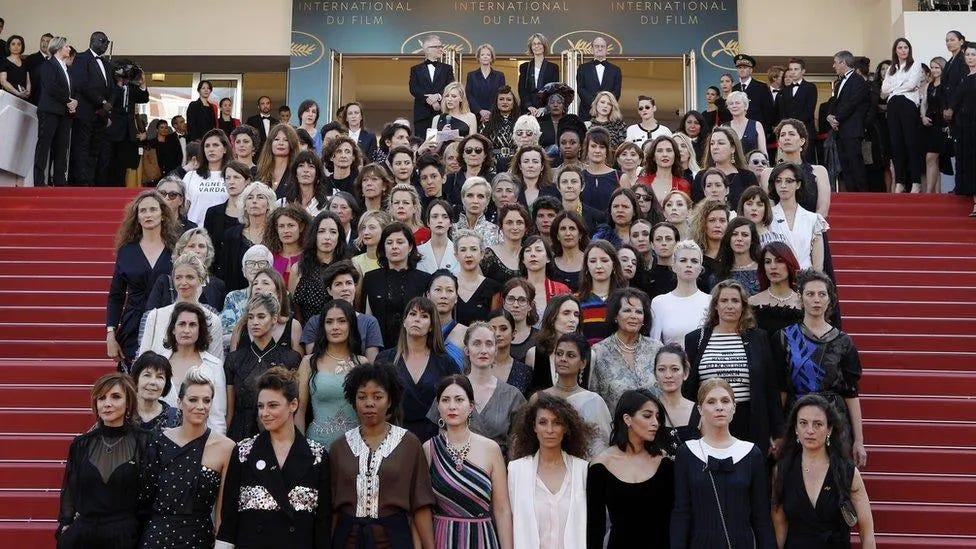
I established in Film Festivals vs. Activists that festivals and nonprofits have been selecting against white men for over a decade.
So shouldn't those resources be reaching the filmmakers who actually lack the runway — disproportionately Native, Hispanic, and the Black descendants of slavery — instead of the most-resourced members of whichever groups clear the racial bar? And once you put it that way, the cleaner answer isn't just discovering a better race formula. It's to stop using race as the proxy and measure the disadvantage we actually care about.
This is the universalist's case, put most sharply by political scientist Adolph Reed Jr., who argues that making "desert on the basis of special injury" the test for benefits is "the opposite of the socialist principle that everyone in the society is entitled to a reasonable and secure standard of living."
Race was always a crude stand-in for disadvantage. Drop the stand-in, put a floor under everyone, and — because injury and poverty overlap so heavily — you still do right by the people history actually harmed, without sorting anyone by ancestry.
On the measures that actually predict access to a film career — household income, parental wealth, educational attainment — the Asian women in this sample look more advantaged than the white women, not less. That’s no knock on anyone’s talent; it’s an indictment of a category that treats ‘nonwhite’ as a synonym for ‘disadvantaged.’
Perhaps the only way to actually help the marginalized — and not merely the most elite members of each marginalized group — is to stop sorting by race at all, and start measuring need.
Until we do we’ll keep funding the comfortable posing as the afflicted.
Wowzer! Another blockbuster enlightening report. Thank you for all the hard work you’re doing here, HG! Onward.
“funding the comfortable posing as the afflicted” is ALL OVER higher education and I’m so fed up with it.