

The Permanent Correction
Sundance has selected women at four to six times their submission rate for twelve years. Submissions have been flat since 2017.

For over a decade, we've been told that women directors face systematic barriers in film. The solution, according to major festivals and institutions, is preferential selection: temporary corrective measures to build a pipeline and level the playing field.
The data tell a different story.
Looking specifically at Sundance's U.S. Dramatic Competition, the festival's most prestigious category, the numbers reveal not modest course correction but extreme, sustained preferential treatment that has persisted long after its stated purpose should have been fulfilled.
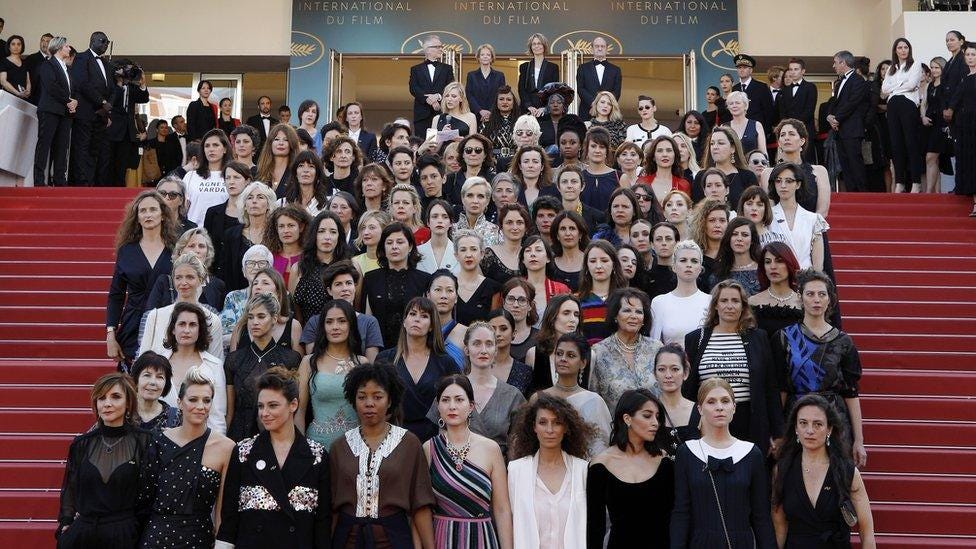
Sundance’s preferential treatment of women led to a schism in the world’s major film festivals, a battle that goes on to this day.
The Methodology Problem
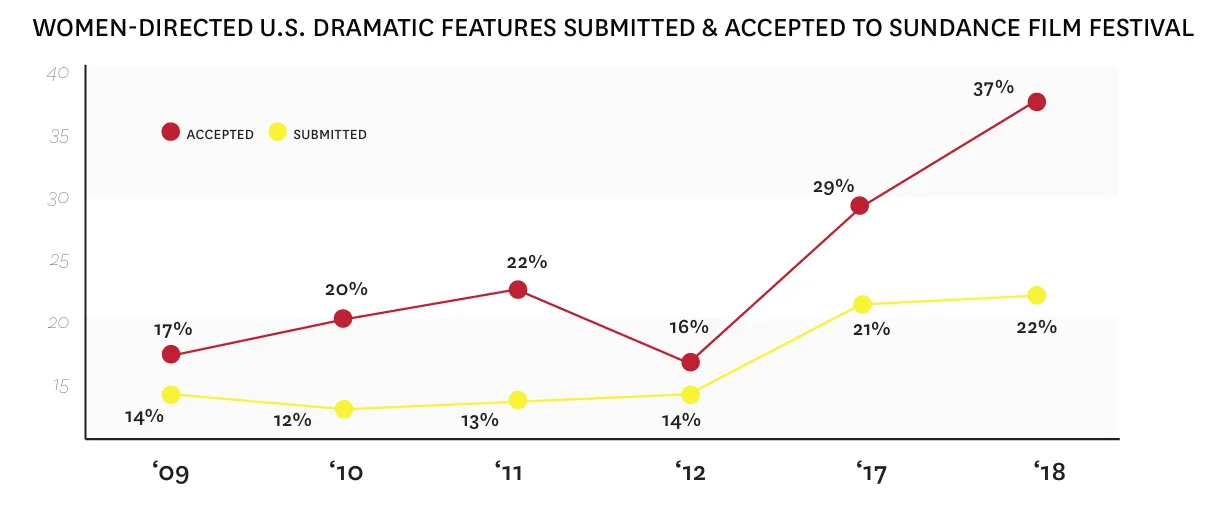
Sundance doesn't break out submissions for the U.S. Dramatic Competition specifically. But Annenberg, in.a 2019 study measured submissions to the broader U.S. Dramatic section directly: 13.6% female in 2012, rising to about 21% by 2017–18.
Documentary submissions ran far higher - 38.3% female over 2017–18 - so women do submit to documentary at nearly twice the dramatic rate. Because the Competition is the most selective slice of the U.S. Dramatic section, and narrative features are so much more expensive to produce, its applicant pool is, if anything, narrower than the section-wide figure. Using the measured section-wide rate as the denominator is therefore conservative.
Quantifying the Disparity
2013: The First Parity Year
Sundance U.S. Dramatic section submissions (measured, 2012): 13.6% female
U.S. Dramatic Competition acceptances: 50% female
A woman’s submission was 6.3x as likely to be accepted as a man’s: women filled half the slots from a 13.6% share of the pool, men filled half from an 86% share. (50/13.6) ÷ (50/86.4) = 6.3.
2023: A Decade Later
U.S. Dramatic section submissions (measured, 2017–18): ~21% female
U.S. Dramatic Competition acceptances: 54.6% female (based on my count).
A woman’s submission was 4.4x as likely to be accepted: (54/21) ÷ (46/79) = 4.4. Even granting a generous 25% female submission rate — above any measured year — the gap is still 3.5x.
If the Competition is now 10 films, and women make up 21% of the applicant pool, then under a merit-neutral selection process the probability of getting 5 or more women out of 10 films in any given year is about 4.0%.
Doing it twelve years in a row without actively overselecting for female filmmakers is basically impossible. The odds of that happening naturally, under a merit-neutral selection model are in the quadrillions.
The Inflection Point: 2014
After celebrating 50% female directors in U.S. Dramatic Competition in 2013, the numbers dropped sharply in 2014. That year's competition featured just 4 women out of 16 directors, returning to 25%.
Annenberg didn't measure dramatic submissions in 2014; interpolating between the measured 2012 (13.6%) and 2017 (20.8%) points puts it in the mid-teens. Even there, four women of sixteen — 25% — still ran ahead of the applicant share.
Even at 25%, women were still being selected at roughly 1.4x their submission rate. But this was the last time the category would dip below 50%.
From 2015 forward, U.S. Dramatic Competition has never fallen below gender parity. What had been framed as a historic breakthrough in 2013 became, after one year of reduced (but still preferential) selection, a permanent mandate. The temporary became permanent, with no announced endpoint and no metric for success beyond maintaining the quota itself.
The Persistent Pattern
Between 2012 and 2018, measured female submissions to the U.S. Dramatic section rose from 13.6% to about 21%, while Competition acceptances held above 50%.
The per-submission gap narrowed from roughly 6.3x to 4.4x — but, this wasn't a natural market correction. It was a conscious choice to continue preferential selection rather than allowing the improved pipeline to organically increase representation.
In other words, Sundance didn't reduce its submission gap as the "pipeline problem" improved. They simply sustained preferential treatment at a slightly lower (but still extraordinary) level.
According to Annenberg data, by 2021-2024, female directors comprised 54.6% of U.S. Dramatic Competition selections. The only directly measured figures available place female directors at roughly 14% of U.S. Dramatic submissions in 2012 and about 21% in 2017-18. Even if the actual Competition applicant pool were materially higher—say 25% to 30% female—the resulting acceptance rates would still substantially exceed the applicant share. What was framed as temporary corrective action to build a pipeline has become permanent policy with no endpoint in sight.
