

The Virtuous, The Assholes, and the Damned
Both sides claim they know if diversity sells. So who’s telling the truth?

The industry these days is at war over diversity, and they’re divided into two camps. The old-school players, call them the assholes, want money and power, and are anti-diversity. The new players, the virtuous, also want money and power, but argue the opposite: diversity is the best path to it.
Raquelle David’s Substack regularly argues the “virtuous” side, like with her recent piece The State of Diversity In Hollywood: And How it Became A Dirty Word.
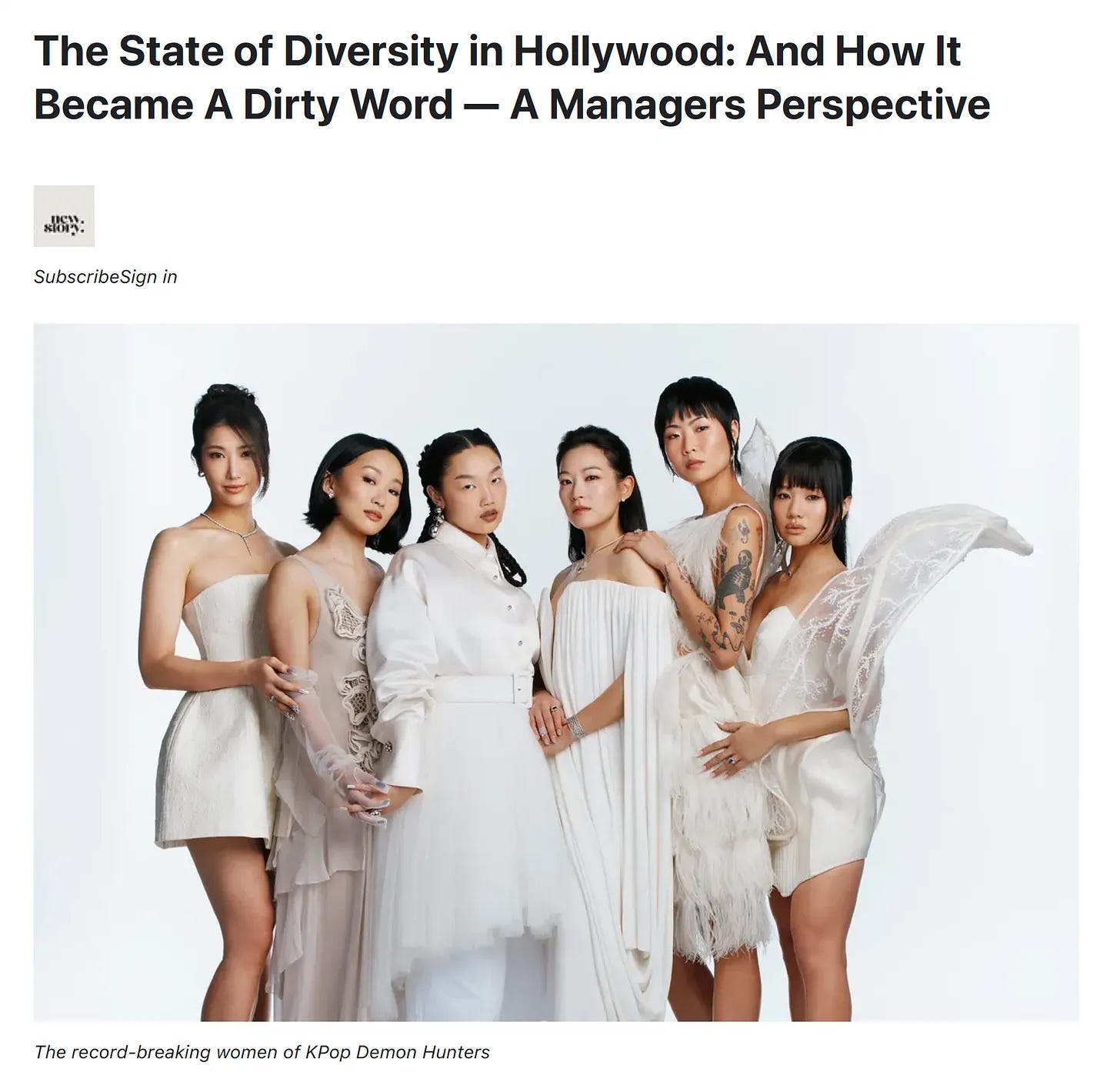
David opens early with this:
I think we need to stop using the word [diversity]. Not because the case got weaker — because the word can’t get in the door anymore, and I’d rather win the argument than keep saying a word that gets turned down, time and time again.
She claims elsewhere that “Black and brown audiences are single-handedly reviving cinema.”
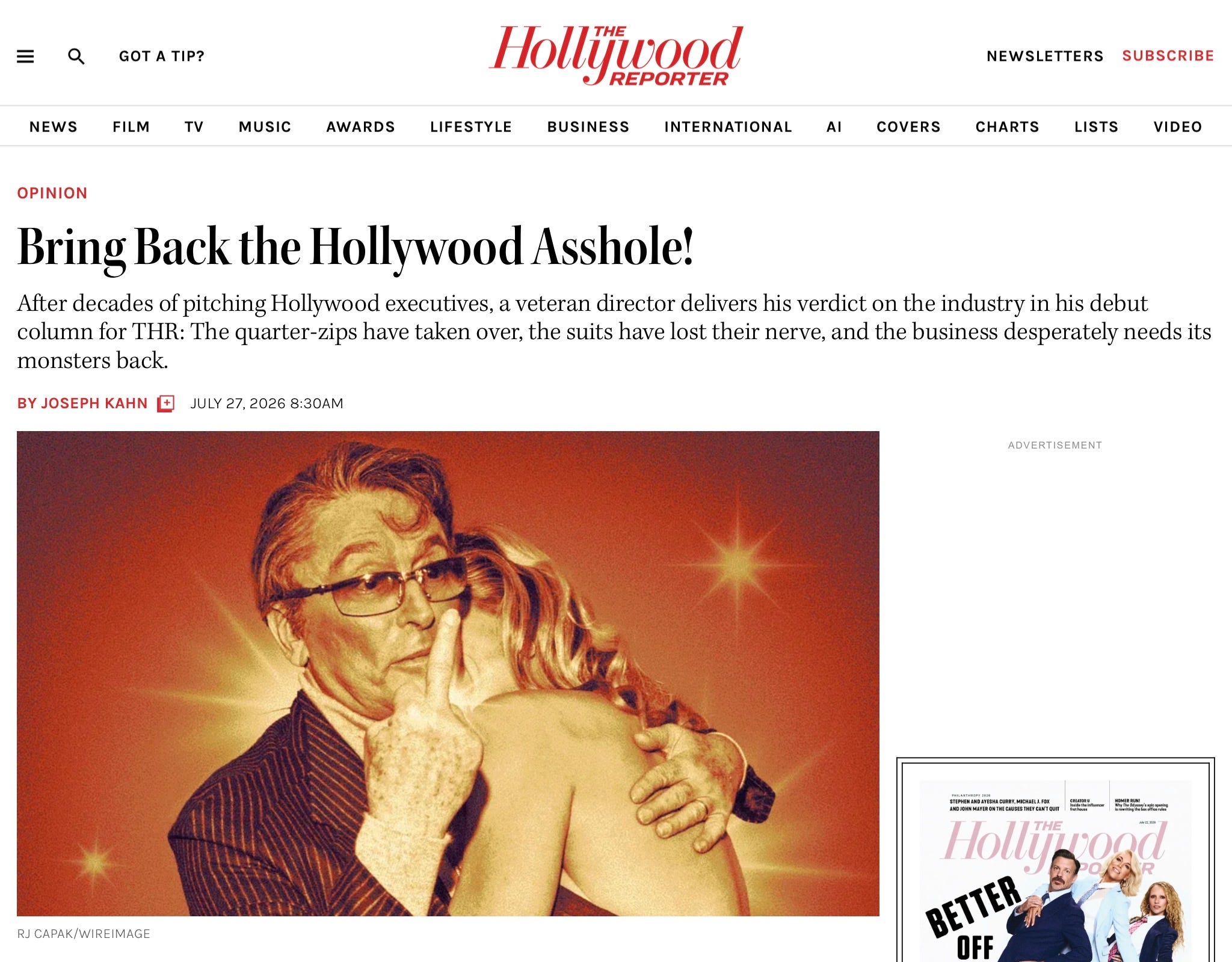
On the opposing side, Joseph Kahn laid out his argument for the assholes in his recent Hollywood Reporter Op-Ed:
Some of you decided to focus on progressive social agendas for the wrong reasons: You actually believe in them.
No. The only reason to replace Iron Man with a Black woman is because you believe a Black Iron Woman will make more money.
Both sides claim to know the path to box office success. So who’s right?
The Virtuous Argument
David’s virtue case relies heavily on UCLA’s Hollywood Diversity Report, which covers both streaming and theatrical. She writes:
Lets start with the one number that should end the argument. In 2025, theatrical films with casts that roughly mirrored the country — 41 to 50 percent actors of color — posted the highest median global box office of any group: 117 million dollars. The least diverse films, the ones under 20 percent BIPOC, were the worst performers on the board across domestic and global audiences.
Here’s UCLA’s headline finding:
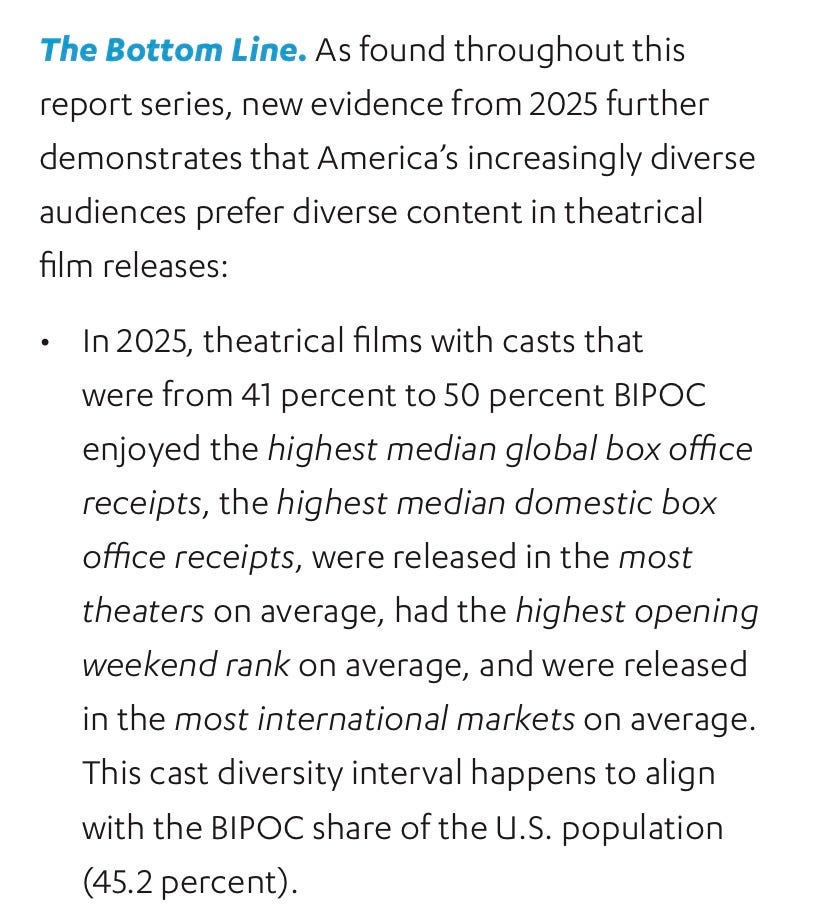
But as my breakdown of UCLA’s highly flawed Hollywood Diversity Report, and Stephen Follows’s exhaustive followup demonstrated, there is no real evidence that diverse audiences prefer diverse casts, or that this contributes to those films’ bottom line.
As Follows put it:
I tested 108 defensible methods across 2,600 films and 26 years. I found that almost all the methods produce no meaningful connection, and the median answer is a 2% dip. No method shows cast diversity meaningfully lifting box office. None shows audiences punishing it either.
So UCLA’s central finding, that 41-50% diverse cast number that “should end the argument” is false.
Even worse, she mis-cites the data. UCLA’s tables put the worst performance in the 11–20% band, not the under under 20% band she claims. The all-white, least diverse films (listed below as 0-11%), significantly outperform the second least diverse films on every metric, including global box office, ROI, and domestic box office.
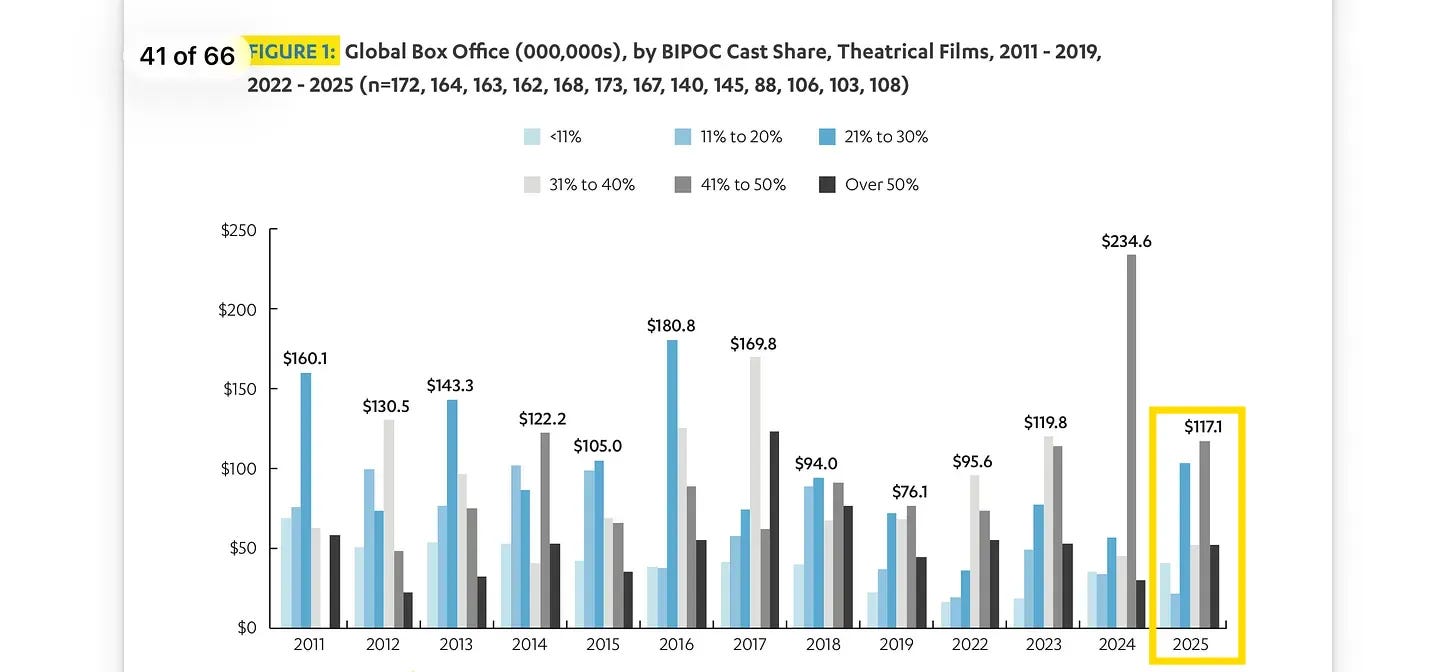
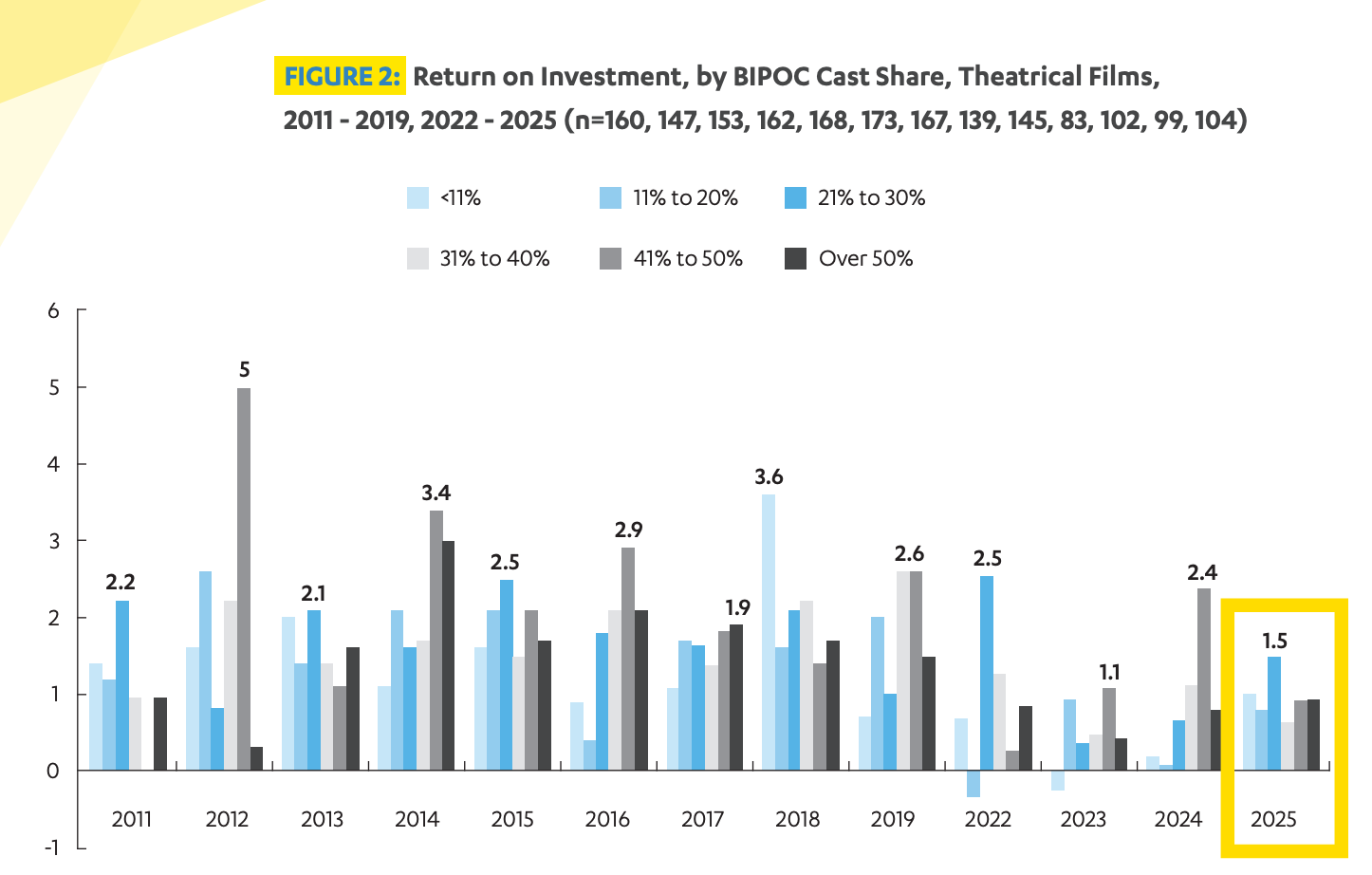
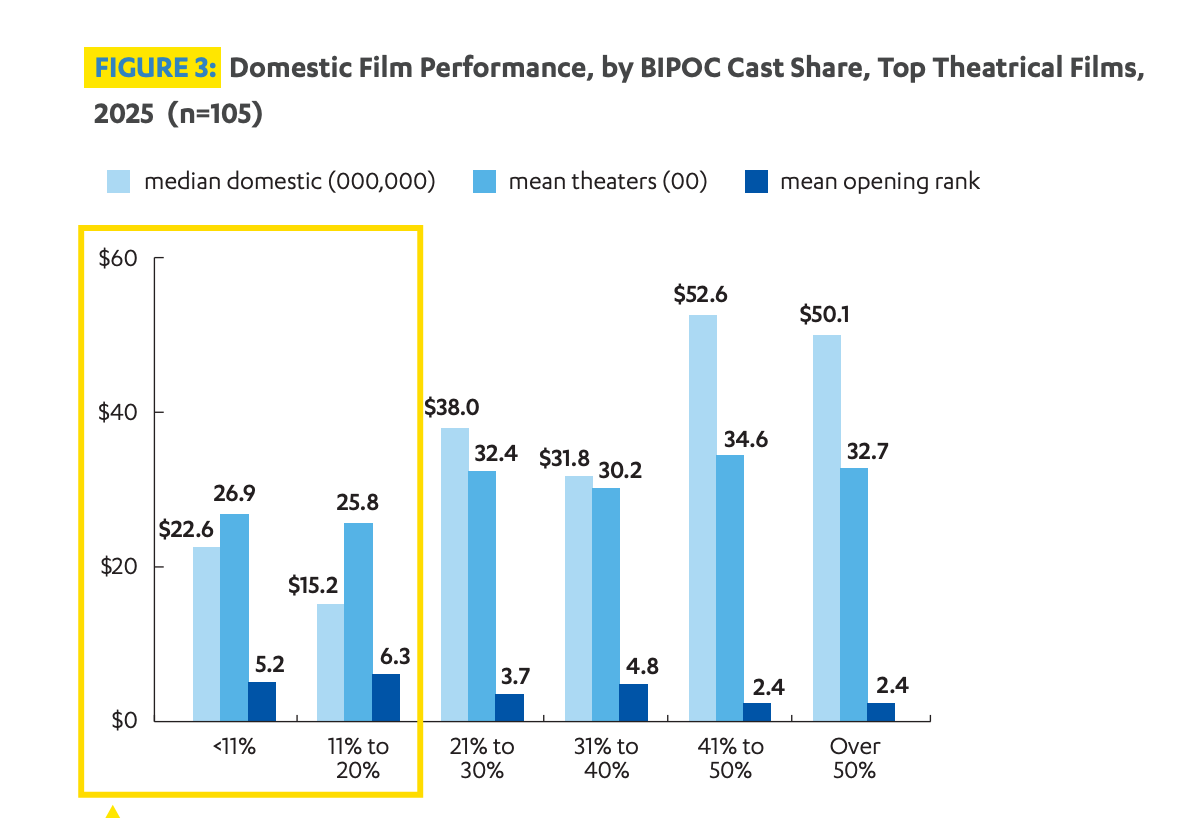
I’m not going to claim that audiences prefer all-white casts, or that they’re more profitable. The honest reading is that none of UCLA’s headline finding is real: it’s statistical noise arbitrarily sorted to match a thesis, one that happened to play into David’s business strategy. As she writes:
If you’re a woman, if you’re Black or brown, if you’re queer — these numbers are your terrain, and they’re steeper than they should be. I manage these careers, and my roster is predominately women, queer and diverse.
Note that UCLA doesn’t even try to make the argument that audiences prefer behind the camera diversity, because general audiences literally have no clue who’s behind the camera. Yougov runs a poll of general American audiences where they ask them if they’ve even heard of a famous director. Not even if they’ve seen a film, just if they’ve heard of the director.
Only 69% of them recognized director number 20, a little indie filmmaker named Stanley Kubrick.

The reality is that genre probably matters a lot more to audiences than any kind of diversity.
The Horror Problem
Following UCLA’s flawed data, David writes:
Audiences show up hardest for the films that actually reflect them — their stories. We see it clearest with horror films. Black and Hispanic moviegoers drove the genre last year—with the massive success of Sinners.
Sinners is one film, and it was a big success, especially with Black audiences, where it was number one.
But it doesn’t prove that those audiences prefer diverse casts, which UCLA’s own data contradicts.
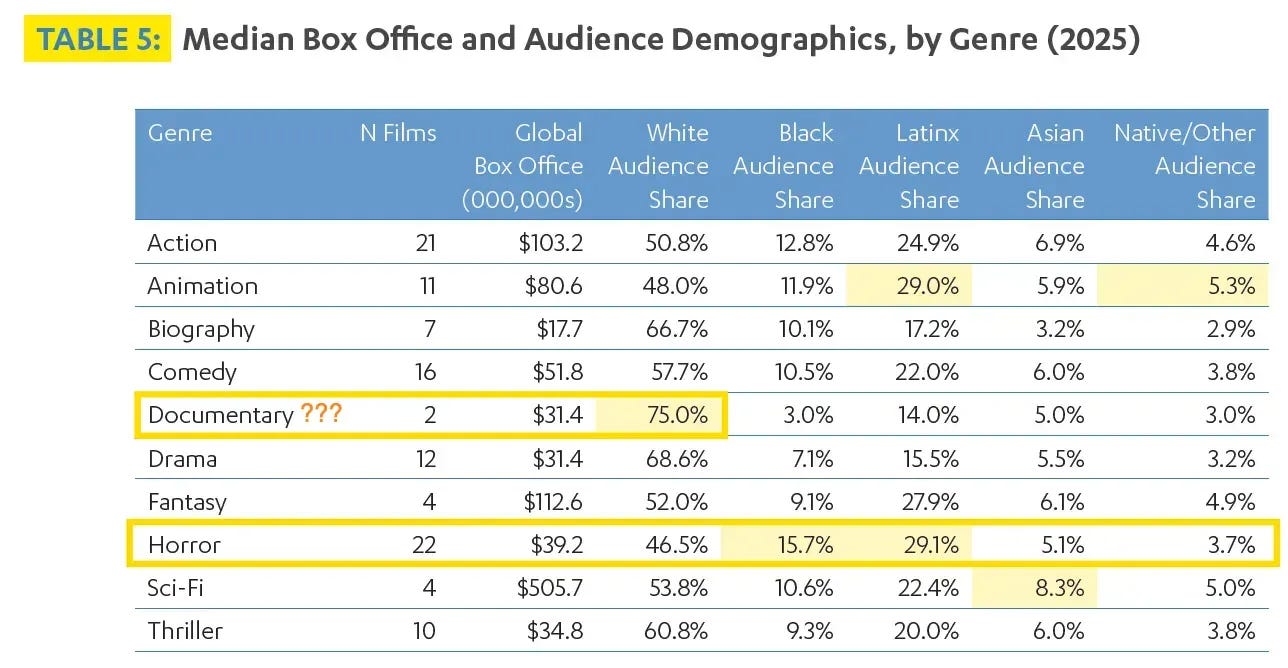
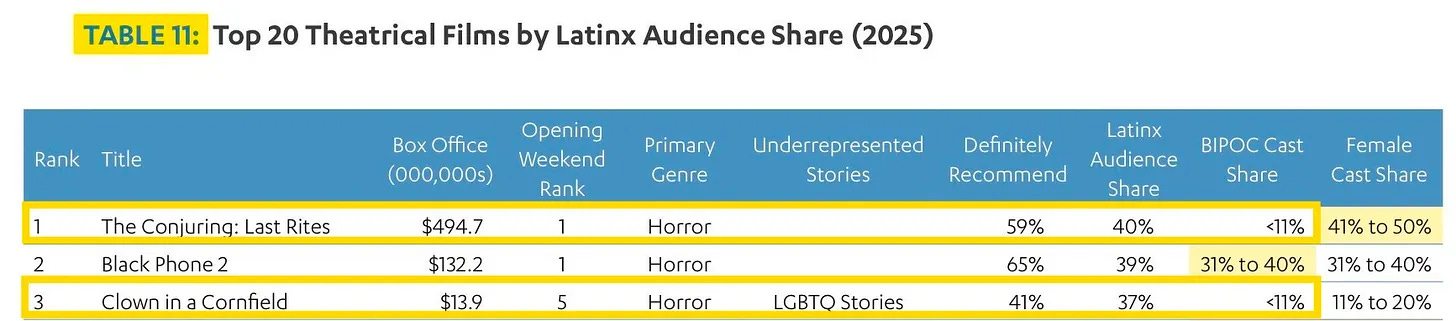
According to UCLA, horror draws the highest Black and Latino audiences, and is also the third least diverse genre, with 63% of films that were 30% or less BIPOC.

And David gets the Latinos wrong again. Sinners isn’t even in the Latino top 20.
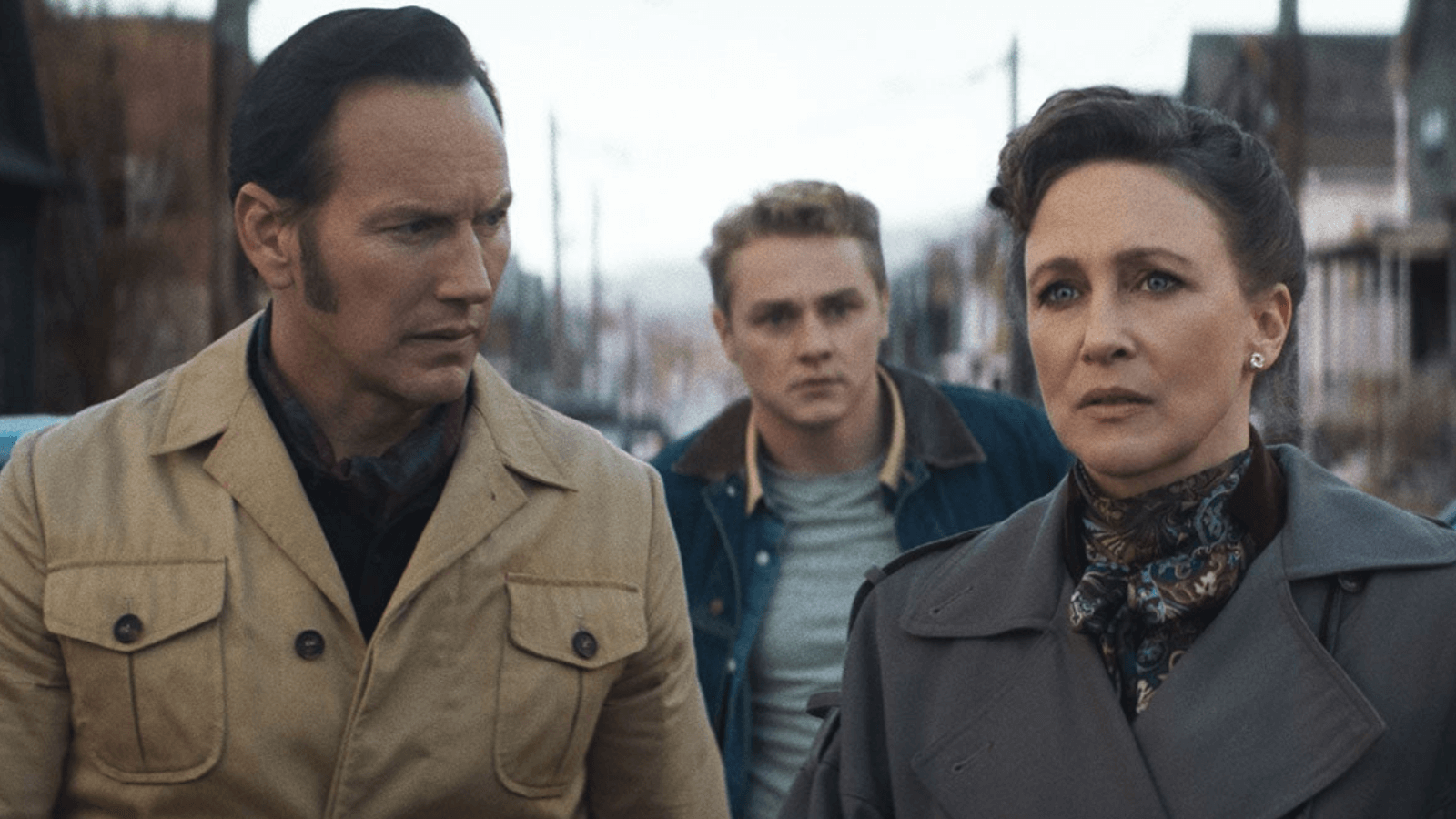
In fact, Latino moviegoers’ number 1 and 3 films from 2025, The Conjuring: Last Rites and Clown In a Cornfield, both had all white casts, further undermining David’s “people show up for diverse casts” argument.
These issues have real world implications.
Let’s consider a hypothetical situation. Imagine you’re a creative trying to reach Black and Latino audiences. UCLA’s framework suggests optimizing cast demographics. But if genre is doing most of the work—as horror appears to suggest—you’ve optimized for the wrong variable.
Bad data + bias = bad business decisions.
Pushback
David argues that Hollywood’s early 2020s commitment to diversity was in bad faith.
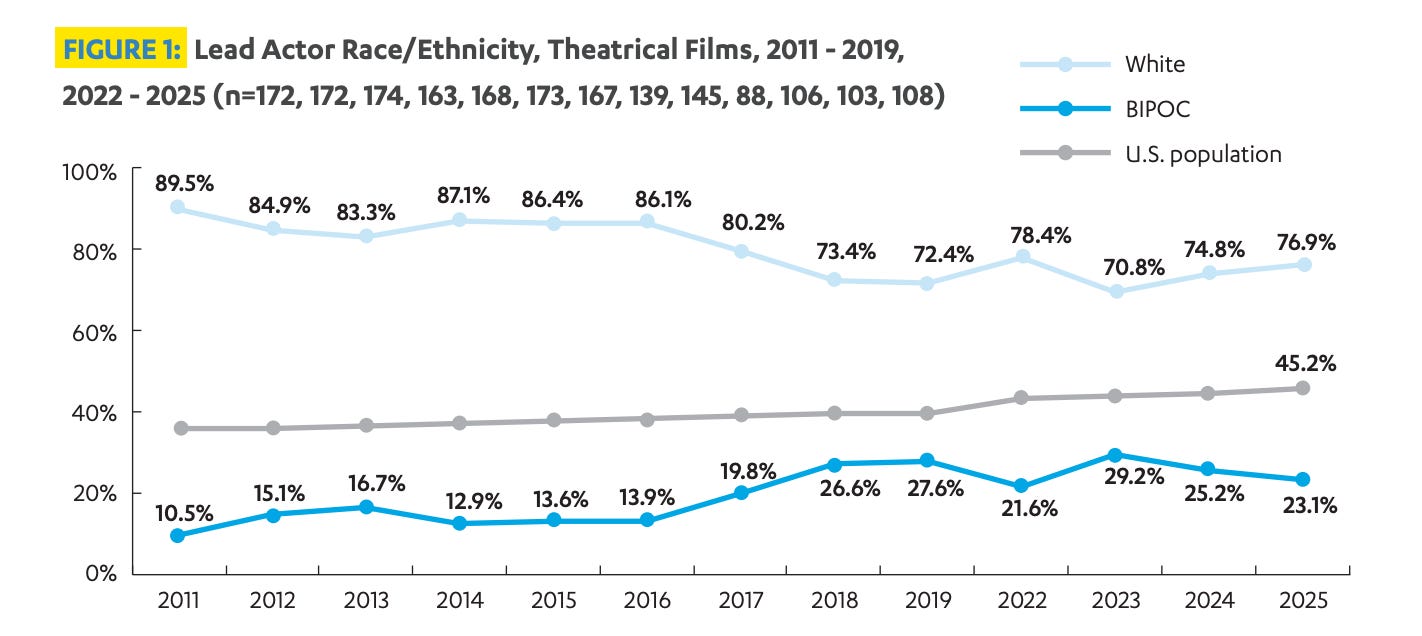
Diversity actually peaked in 2023 and fell in 2024… If Hollywood had a real commitment to diversity it would have pushed back when the pressure came. Instead it folded at the first opportunity, which tells you exactly what it was the whole time: an optically ‘nice-to-have’.
This is the UCLA chart she’s referring to:
Later David says that…
Politics have never made Hollywood misogynistic and risk-averse — it was already both. If you want the single worst number in either report, its that women directed just 10 percent of all top theatrical films last year.
David accuses the industry of folding when the numbers fell, but this data is published a year later, and the films themselves take multiple years to make. It’s difficult to understand how the industry could have reacted in real time to year old statistics.
But beyond that, when the pool size and membership change every year, small moves (2019’s 27.6% → 2022’s 21.6% → 2023’s 29.2%) can't bear the weight of a "Hollywood folded on diversity" narrative. Did they double down on it in 2023 (29.2%), only to pull back suddenly in 2024 (25.2%)?
Did Hollywood also “fold on diversity” in 2022, when a similar drop occurred? How about when it peaked right after in 2023? How strange that those years are right next to each other. A bit noisy, one might say.
The signal behind the noise is this; as UCLA’s own data shows, the number of diverse leads more than doubled from 2011 (10.5%) to 2025 (23.1%).
But even this number is shaky. Look at the top of the chart; UCLA doesn’t even use the same number of films every year like Annenberg. Some years have as few as 88, others as many as 174. This happens because they take the top 200, then subtract non english language films.
With topline numbers swinging this wildly, I don’t see how you can reliably isolate diversity as a factor at all.
All Asian Diversity
David goes on to cite KPop Demon Hunters as evidence of why diverse women outperform. But this is also severely flawed.
First, it’s apples and oranges: Sinners is cited as a box office success, then she shifts over to a streaming release, which has no box office data. You can’t fairly compare the two; one requires audiences to leave their homes, the other doesn’t.
And what kind of diversity is Kpop, really? KPop Demon Hunters is animated, and the cast is virtually all Asian. Is that really diversity?

All 6 of the 2025 top 100 BIPOC female directors were Asian, double the number of white women. It’s sitting right there in Annenberg:

Again, the major diversity studies can't even agree on how to classify someone like Madeline Sharafian, the Armenian-American co-director of Elio — MENA under UCLA, white under USC.
Regardless, there were no Latina, Black, or Native women in the top 100 female directors this year. It’s the BIPOC Problem at work; sometimes it’s “diverse” for a film to be all Asian, other times it means Black and Latino, except when it doesn’t. It’s not only cherry picking the movies, it’s cherry picking within the entire panethnic category.
These problems matter, because the central claim of the virtuous is that diversity sells, but the data shows no actual positive effect.
The Assholes Strike Back
This week Joseph Kahn published an anti-diversity op-ed in the Hollywood Reporter, in which he called for bringing back the Hollywood Asshole. His point is pretty bluntly stated:
Hollywood had already seen plenty of virtue-signaling reboots explode into culture-war bonfires. But instead of learning that audiences hate being assigned homework with their popcorn, the town doubled down… It was no longer only about the best story, the biggest star, the sharpest commercial instinct. It was about who or what checked the right boxes.
Kahn's argument is that the people preaching diversity have no real commercial instinct — the opposite of what David claims.
So if David is wrong, maybe Kahn’s right?
But Kahn is Also Cherry Picking
While David uses KPop Demon Hunters and Sinners as her holy grails of diverse success, Kahn uses The Marvels as his holy grail of diverse failure:
The Executive Artist fell into the same trap as the mere artist: believing you are more interesting and important than the audience. Believing they would marvel at your Marvels.
They did not (2023, $237 million net loss).
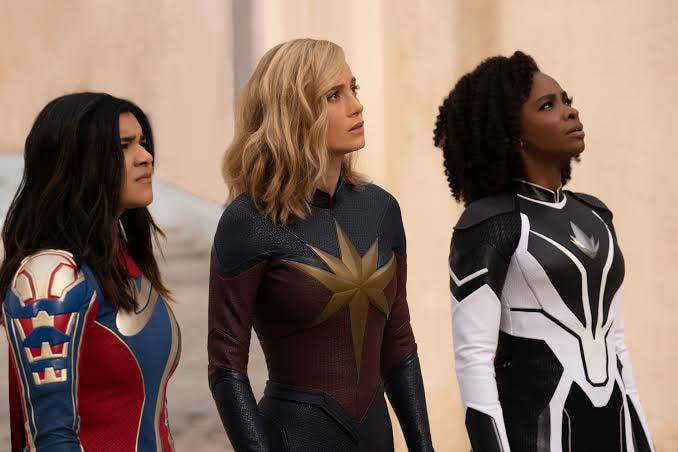
But can we really trace The Marvels’ failure to cast diversity? Didn’t Black Panther make buckets of money with a very diverse cast? Didn’t the original Captain Marvel gross over a billion dollars with the same character?
In a post on X, Kahn lists more examples:
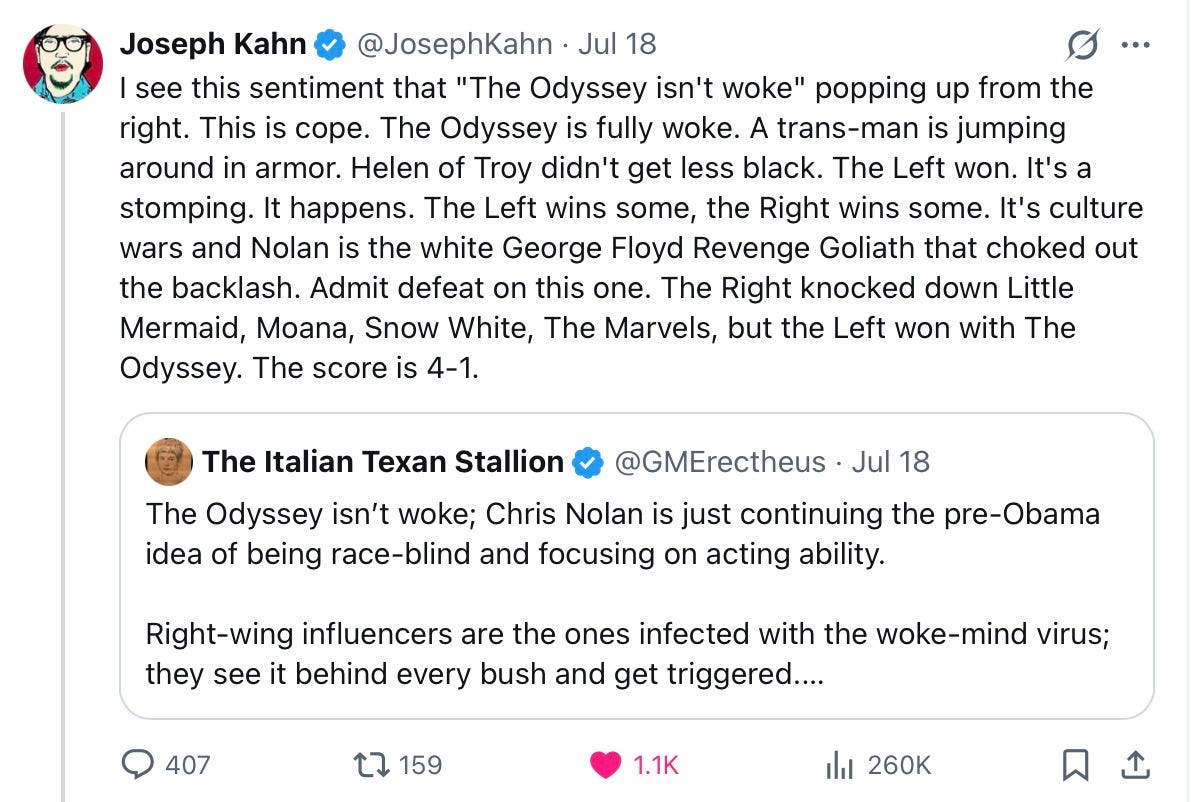
It’s also odd to say that the right was responsible for those films’ failures, but hey.
The Diversity Microwave
I share Kahn’s frustration with Hollywood’s endless reboots, but I honestly think he’s missing the forest for the trees.
It’s annoying how Hollywood tried to use diverse casting as a microwave to reheat frozen IP instead of taking a risk on new material.
Then when the microwave IP bombed, they got to blame the audience and call them racist/sexist/whatever trolls.
Sure, some of the audience were racist trolls, but it’s ridiculous to think that applies to the entire global audience. Aren’t they the same audience that made hits out of Wonder Woman, Black Panther and the first Captain Marvel?
“The audience is evil” seemed to become a sort of preemptive PR strike when test screenings went bad. The strategy that was perfected by the time Supergirl came around:
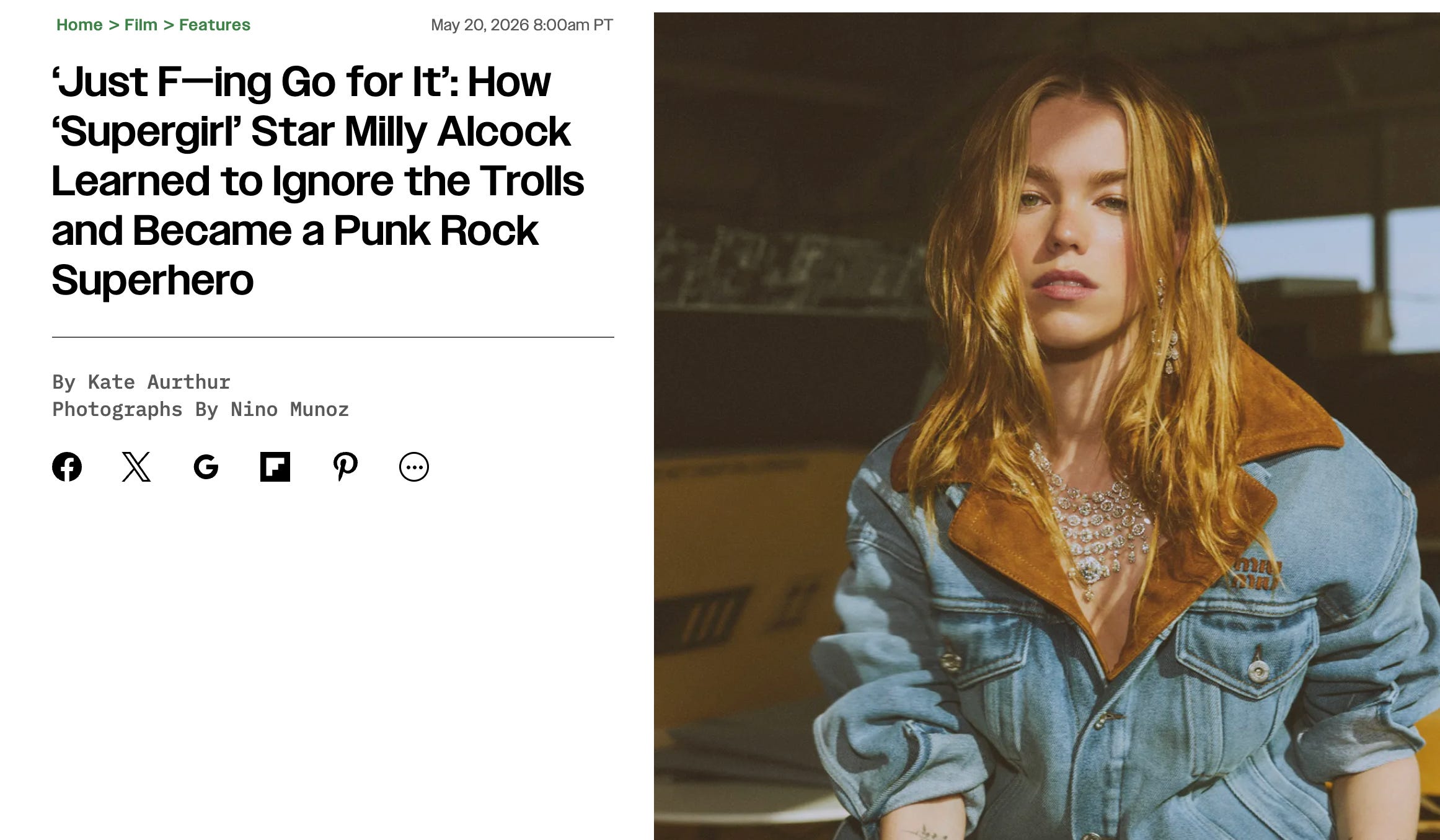
The movie flopped, not because of trolls, but because it was microwave IP with, to quote Owen Gleiberman, “a terrible script” and corporate “punk rock” sprinkles on top.
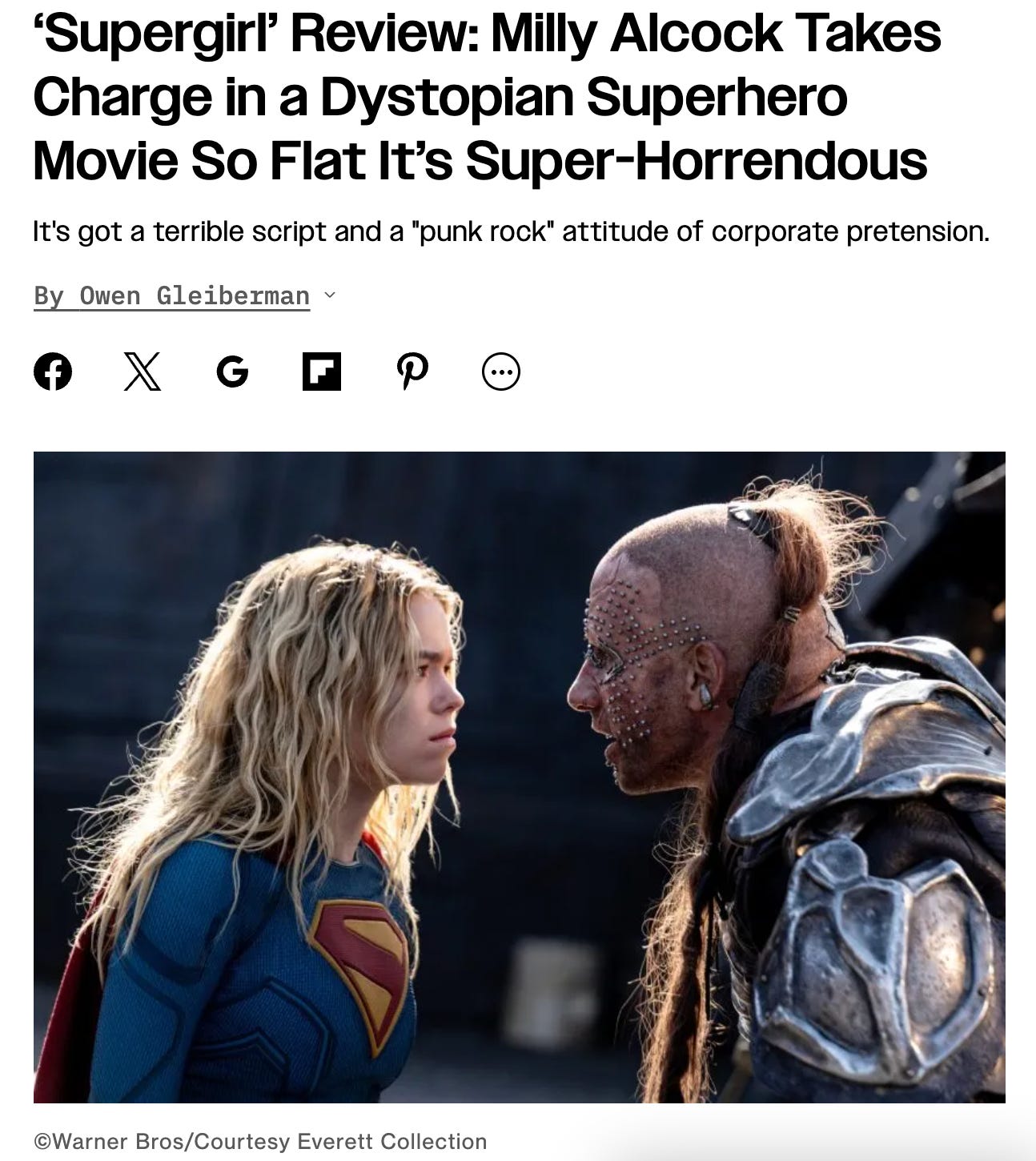
Alcock’s social justice interviews, like Brie Larson’s before her, were a publicity strategy, one that likely alienated even more of Supergirl’s audience, which in the end was 59% male.
The sociologist Musa al Gharbi perfectly articulates the social justice publicity strategy:
The symbolic professions […] tend to be brutally competitive, to the point where social justice advocacy itself becomes another front in aggressive struggles over status, resources and opportunities.
So let’s revisit Kahn’s negative examples: Little Mermaid, Snow White, and Moana, all of them Disney microwave IP duds. But again, some of the live action Disney movies were genuine hits: The Lion King, Lilo & Stitch, Aladdin and Beauty and the Beast all crossed the $1bn mark. And Lilo and Aladdin had (animated) leads of color.
It’s tempting to blame the diversity for the failures, but it has very little to do with it. The movies were bad and lazy. And that’s a real problem, because for many people, especially on the right, diversity has come to be associated with that laziness and predictability, as I examined elsehwere.
The reality is that for every Supergirl there is a Wonder Woman. For every The Marvels there is a Black Panther, for every Snow White there is a Lilo & Stitch. Because remember Stephen Follows’s conclusion after crunching a shit-ton of data:
No method shows cast diversity meaningfully lifting box office. None shows audiences punishing it either.
Raquelle David and Joseph Kahn are thus two sides of the same cherry picking coin. David picks the diverse hits and forgets The Marvels. Kahn points out the diverse bombs and has never heard of Black Panther.
Look at the whole thing honestly and cast identity becomes noise, not signal — exactly what Stephen Follows found across 2,600 films.
All That’s Left is Quality
When we take away both sides, all we have left to fall back on is the quasi-religious question of whether the movie is any good. And that sucks, because why something is good is very hard to define.
Quality drives word of mouth in a way paid marketing can’t, like it did with Obsession. As I wrote in that piece:
Marketing front-loads an opening weekend. What it cannot manufacture is a positive second-weekend swing. That's word of mouth - audiences telling other audiences to go. The films with the most money behind them are the most front-loaded, not the least: as Comscore's Paul Dergarabedian puts it, the biggest openers tend to drop hardest - “the bigger they are, the harder they fall.” A second-weekend gain, let alone a third one, is the one thing a marketing budget can't buy, and hasn’t since 1982 [when E.T. grossed more its second weekend than its first].
But “good things sell” is a damned dull argument to sell subscriptions off of.
The Damned
So we have our two groups: the old school assholes, the unmasked ones who just admit they want money and power. Then there are the new school ones wearing a virtue mask, who tell you they want to save the world and make it a better, more fair place.
But what do the virtuous need to accomplish that noble mission?
The same money and power the old school assholes want.
The only difference, really, is transparency. So here’s how I feel at this point:
I want the money and power only audiences can give me. And so does everybody else.
But I reject both camps. Diversity is a storytelling tool. It’s execution-based like any other; when it’s done well, with good scripts and performances, that both subvert and fulfill genre expectations, audiences respond. When it’s done poorly, or used as a lame substitute for quality, audiences reject it. (As Follows also found here).
I guess that makes me one of the damned, the people who realize that neither side has a secret answer, and that the real secret sauce is in the alchemy of the creative process.
It’s fucking hard to write a really good story, get it made, and get it seen in the right way by the right people. Some of my favorite movies, including iconic films like The Big Lebowski and Fight Club, bombed in theaters before becoming cult classics.
That’s the god’s honest truth; there’s no secret formula for or against diversity.
The best shot we have is making something of quality, which, like the famous definition of pornography, everyone understands the definition of, but is immensely difficult to pin down in words.
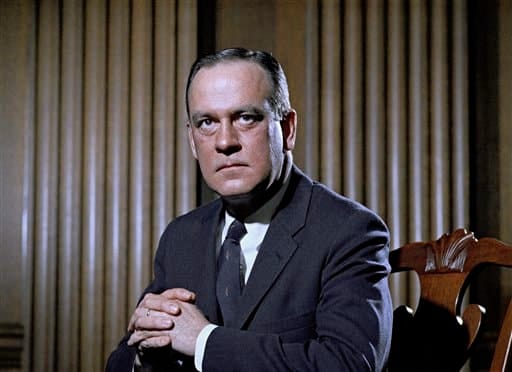
Supreme Court Justice Potter Stewart defined pornography in a landmark 1964 obscenity case the same way audiences ultimately define quality:
I know it when I see it.
A Social Justice Shot with an Expensive Chaser
Just as Stephen Follows tried to disentangle science from activism, it’s worth disentangling activism from business strategy. Kahn is selling ideas, so what’s David selling?
David presents herself as an advocate, but the advice she’s selling, that would actually help those diverse writers—how to get a manager, why your query goes unanswered—is largely locked behind a $20-a-month paywall, with even more expensive consultations and six-week intensives stacked above it.
The advocacy is free. The practical advice is not. The former is a funnel to the latter.
Gharbi again:
“The pursuit of social justice seems to be subordinate to the pursuit of affluence and influence—with the latter often subverting the former.”
Traditional managers earn around 10% of what their clients make. They only eat when the client eats.
Subscription businesses work differently: they get paid upfront, whether subscribers break in or not. David’s management business may run on the normal commission—but the advice business runs the other way.
David’s craft and business advice is often good. But the intellectual edifice on which the advocacy funnel stands — diverse audiences reward diverse casts — is the one thing her own data doesn’t support.
Diversity sells advice, consulting, and subscriptions. It just doesn't sell tickets.
Anti-diversity doesn’t either.
It’s only quality, that mystical, porn-like feeling audiences crave so desperately, that can save us.
Well said! Well written! Another banger of an essay from Hollywood Gadfly. Keep up the good work (and Thank you!).
Great article as always. You perfectly expressed what audiences actually want from entertainment: quality, regardless if it's diverse or not. I do think, though, that in the case of the Disney live action remakes that were box office hits, they were successful purely because of nostalgia: The Lion King and Beauty and the Beast were poorly received even during their release, to say nothing of the discourse surrounding the ending of the Lilo and Stitch remake. This highlights another nuance to the conversation: that box office success does not automatically equate to objectively good movies, and there are plenty of examples at this point (especially in recent years) to support this. Of course, you were arguing purely from a financial standpoint, and you did bring up some of your favorite cult films that were box office bombs, but I felt that wasn't addressed when you mentioned the Disney live action remakes. Just my two cents, really.