


I’m a fan of the podcast What Went Wrong which, on good days, explores big historical Hollywood failures. I was thus surprised to see them wade into activism with their new episode with Raina Deerwater, GLAAD’s Associate Director of Entertainment Research & Analysis, where they discussed GLAAD’s recently published study Where We Are in Film: Analyzing LGBTQ inclusion from top film distributors.
The WWW hosts were quite laudatory. Lizzie opens by saying…
Chris and I got a chance to read, I believe, an early copy of the report, and boy, is it eye-opening. I love seeing the stories that data can tell, and you’ve done such a fantastic job here.
I was curious to read it after listening to the episode and, as you probably expected, I found some pretty serious issues.
I should state my intentions clearly: the pursuit of truth has to supersede that of social justice. You cannot invent claims to serve noble intentions, and doing so will always backfire eventually.
I’m getting very frustrated with how easy it is to hack progressives’ critical thinking skills by simply mentioning discrimination and identity issues. The average Hollywood liberal would never take this study at face value if it argued, for example, that movies with white, heterosexual leads make more money.
They should be equally skeptical of a study claiming that queer films make more money, especially from an organization that specifically advocates for, and fundraises off of the same claim.
We simply need a lot more accountability. I started this substack in part to investigate the claims activists have been making for decades in the film industry. To try and find the limits of truth.
And one truth that’s emerging is that activists are really bad at science.
Part 1: The Study
Introduction
The GLAAD Media Institute’s 2026 report opens with letters by Sarah Kate Ellis, GLAAD’s President and CEO, and Megan Townsend, their Senior Director of Entertainment Research & Analysis.
Afterwards we receive an executive summary of findings, recommendations, and a judgment of the individual major studios on the basis of their queer representation.
As I’ve said with other diversity studies, some of the findings are genuinely helpful, in particular that there were no transgender characters in the major films released in 2025.
The GLAAD study has been around since 2013. Until last year it was called the Studio Responsibility Index. That earlier iteration gave literal grades to the LGBTQ representation of the top distributors until 2024.
Their most recent scale included poor, fair, insufficient, good, and excellent.
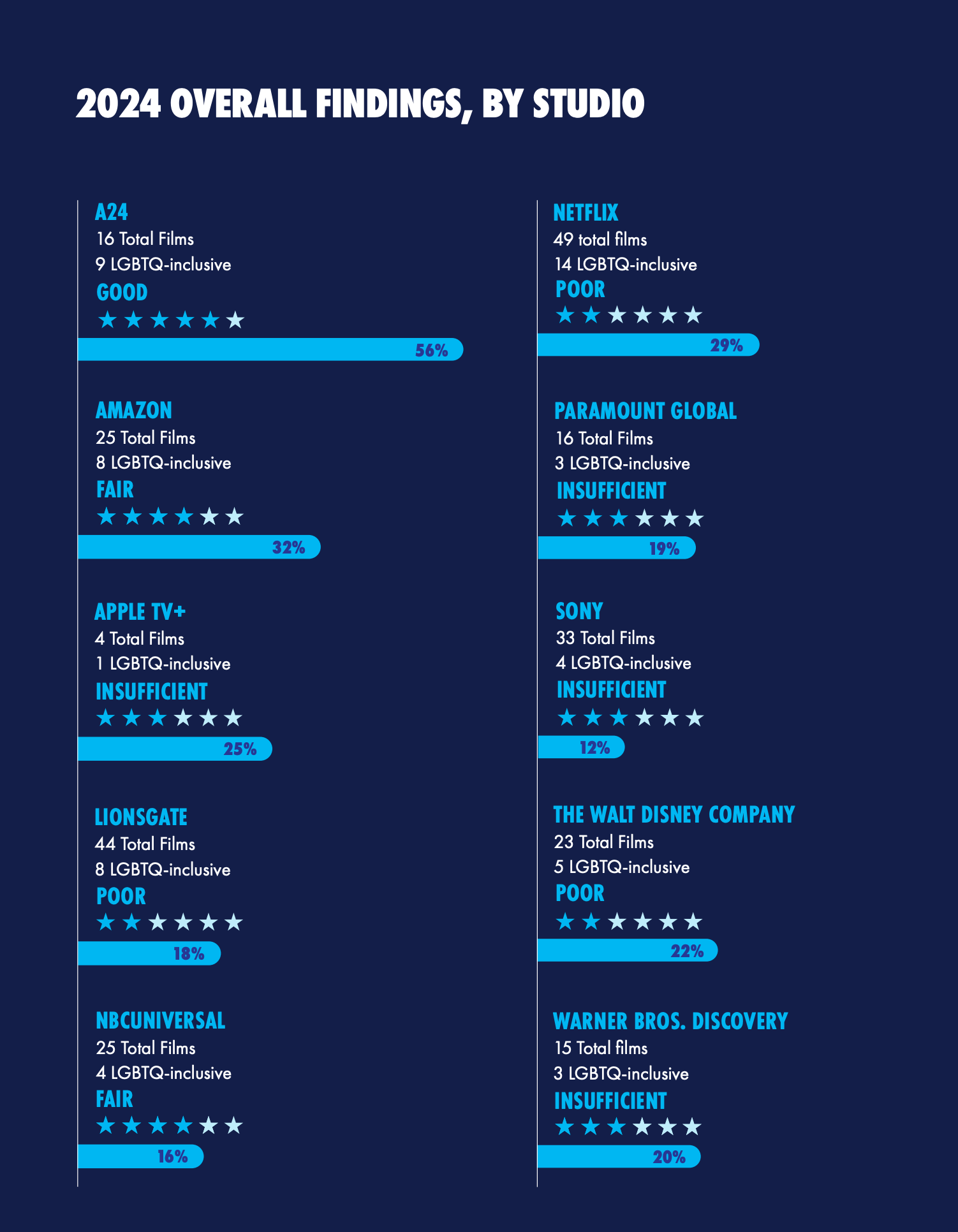
While these rankings look scientific, with percentages and stars beneath them, they’re not.
If you look closely, you can see that Netflix has 29% LGBTQ-inclusive films, but gets a worse grade than Sony, which only has 12%. This is because of a “quality” metric they call the Vito Russo test, after the eponymous activist and film historian.
As we’ll see, the Vito Russo test is not only untransparent, but highly arbitrary.
In 2025 GLAAD also made some significant changes to the coding system they had in place. First, they started hand-coding films, instead of using overall screen time, which is a far more objective metric.
Second, they stopped their longstanding practice of assigning grades to the individual distributors.
What’s fascinating is that on GLAAD’s scale, not a single distributor in 11 years ever received an “excellent” mark, the study’s top ranking. In that time, out of 65 ratings, the study also only handed out eight “goods.”
As we can see above, even with 56% LGBTQ inclusive films in 2024, A24 still only got a “good.” Would they have needed 100% LGBTQ inclusive films to get an excellent? Would 90% be enough? We don’t know, because they never define their scale.
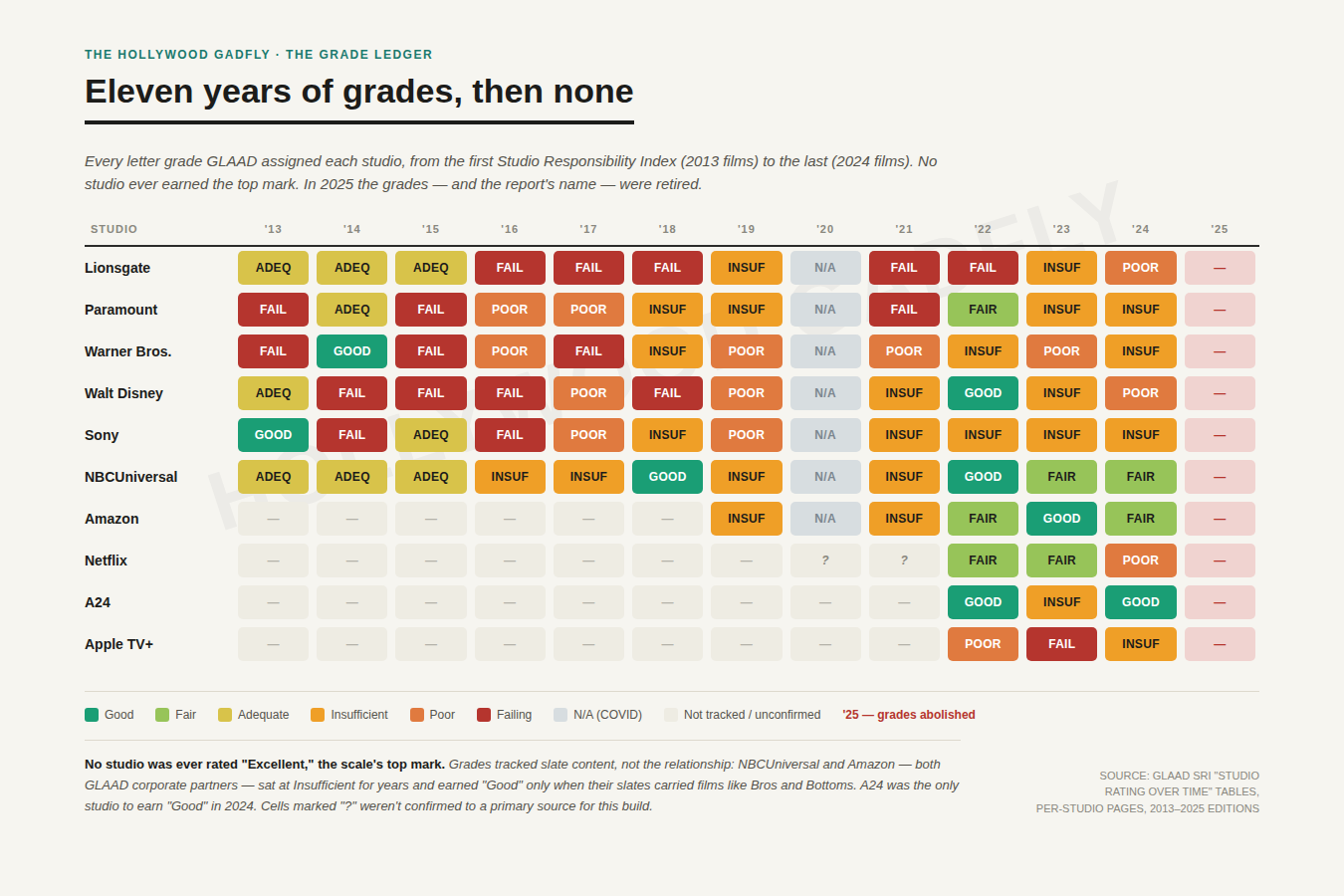
As you can see they’re pretty harsh. These studios also pay to attend the GLAAD Media Awards, and are listed among their corporate sponsors. If they ever got an “excellent,” perhaps they wouldn’t need GLAAD’s services anymore.
And maybe they shouldn’t, because…
They Present No Evidence For Their Headline Statement
Nota Bene: The terms “study” and “report” are used interchangeably by GLAAD when referring to this document. I will also use the terms LGBTQ and Queer interchangeably.
This is the first thing you see when you open the “study.”

This implies a rigorous financial argument for why films that center the LGBTQ community are more financially successful. The intro also includes this highlighted quote from CEO Sarah Kate Ellis’s opening letter:
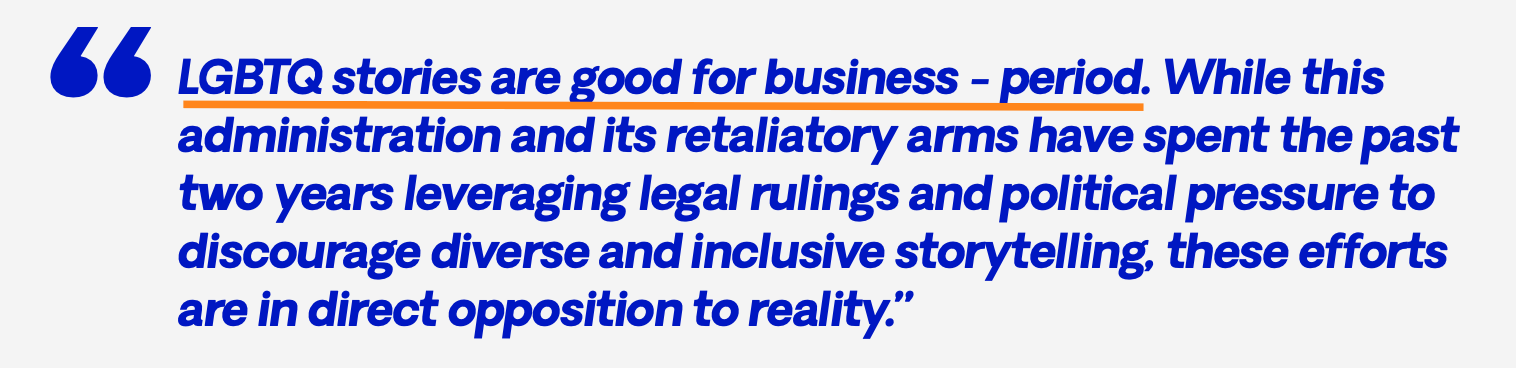
But this “study” presents no evidence at all for its headline argument that LGBTQ stories are good for business. There are no box office figures or ROI reports on queer-led films, no control study for non-LGBTQ movies, nothing.
They literally just say “LGBTQ films make money” and expect us to believe them.
They don’t even clearly define what an LGBTQ film is. Is it an LGBTQ lead? Even if it’s one they would call “problematic”? We have no idea.
It’s almost like they just plagiarized the beginning of the UCLA Study, which tried and failed to prove that diverse casts increase box office.
The letter even mimics UCLA’s finding and format:
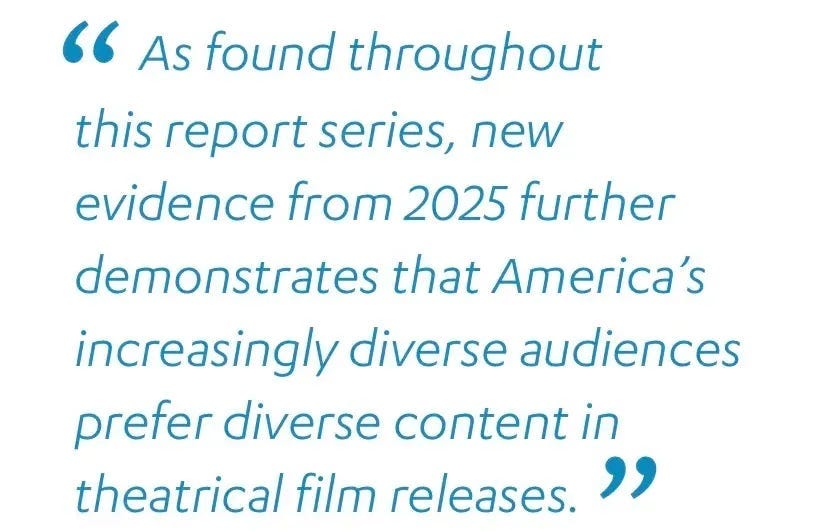
At least UCLA developed an elaborate, failed methodology to prove its central claim, that diverse casts lead to more box office and ROI performance. GLAAD does no such thing; it just says the films make more money at the beginning, then drops even trying to prove it.
Ellis’s letter goes on to say that the Trump administration is responsible for hurting LGBTQ stories. This is obviously a bit premature, as it’s only been two years, and we haven’t yet seen the films that were likely greenlit a minimum of three years ago.
Yes, Trump has signed several executive orders specifically going after trans people, including most recently trying to block access to gender-affirming care through Medicaid.
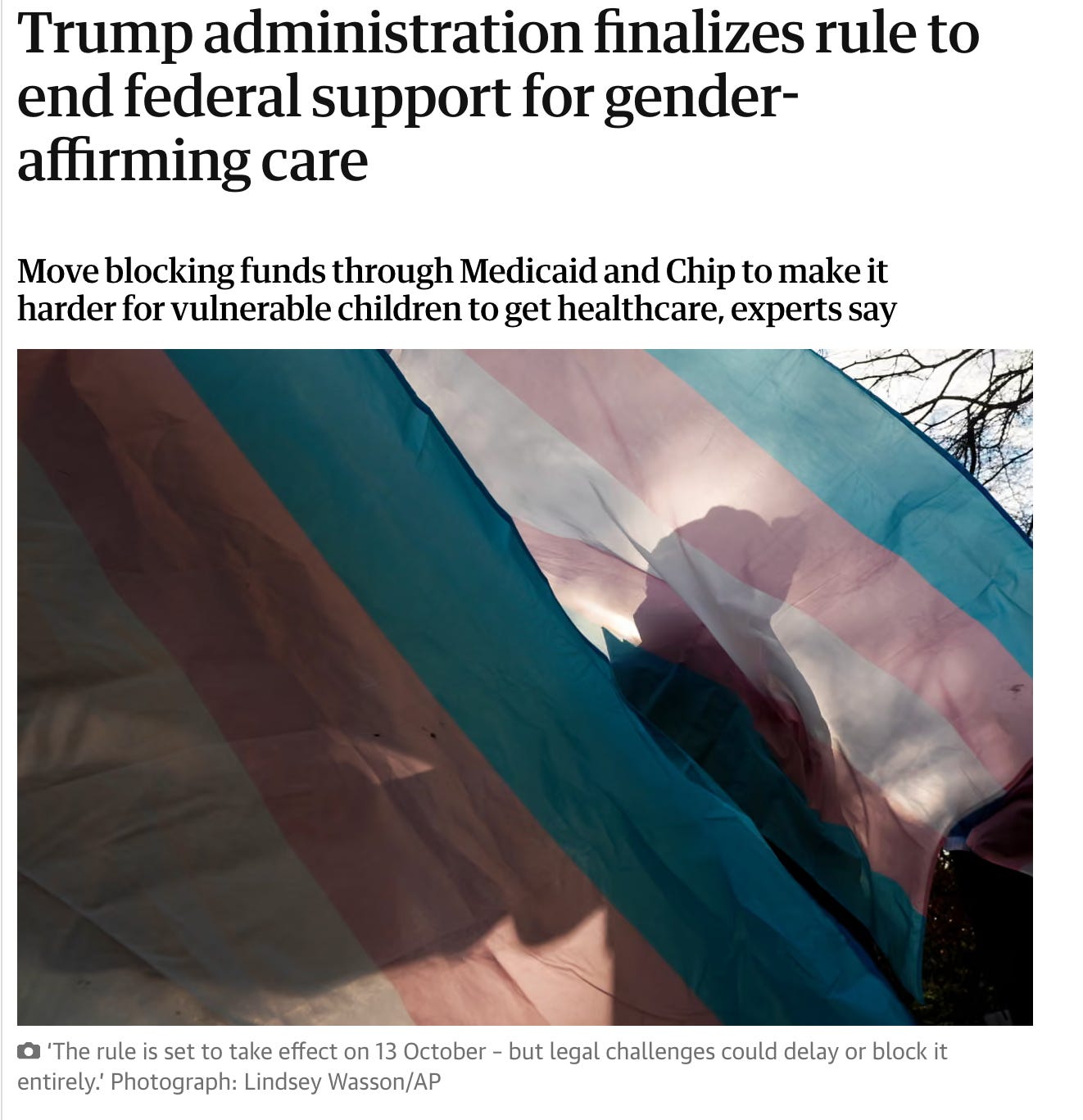
But we likely won’t really see how Trump really impacted Hollywood until next year. Remember, it generally takes a minimum of three years to make a movie, so the movies we’re seeing in this study, which covers 2025, would have been greenlit in 2022, years before we even knew Trump was going to be reelected.
Even worse, it blames politics for a decline its own numbers explain far better. The total films GLAAD tracked fell over the last several years from 350 → 256 → 250 → 225. The number of inclusive films thus fell alongside everything else, and the mid-budget tier they cite also collapsed amid industry-wide strikes and a popped streaming bubble. More on this soon.
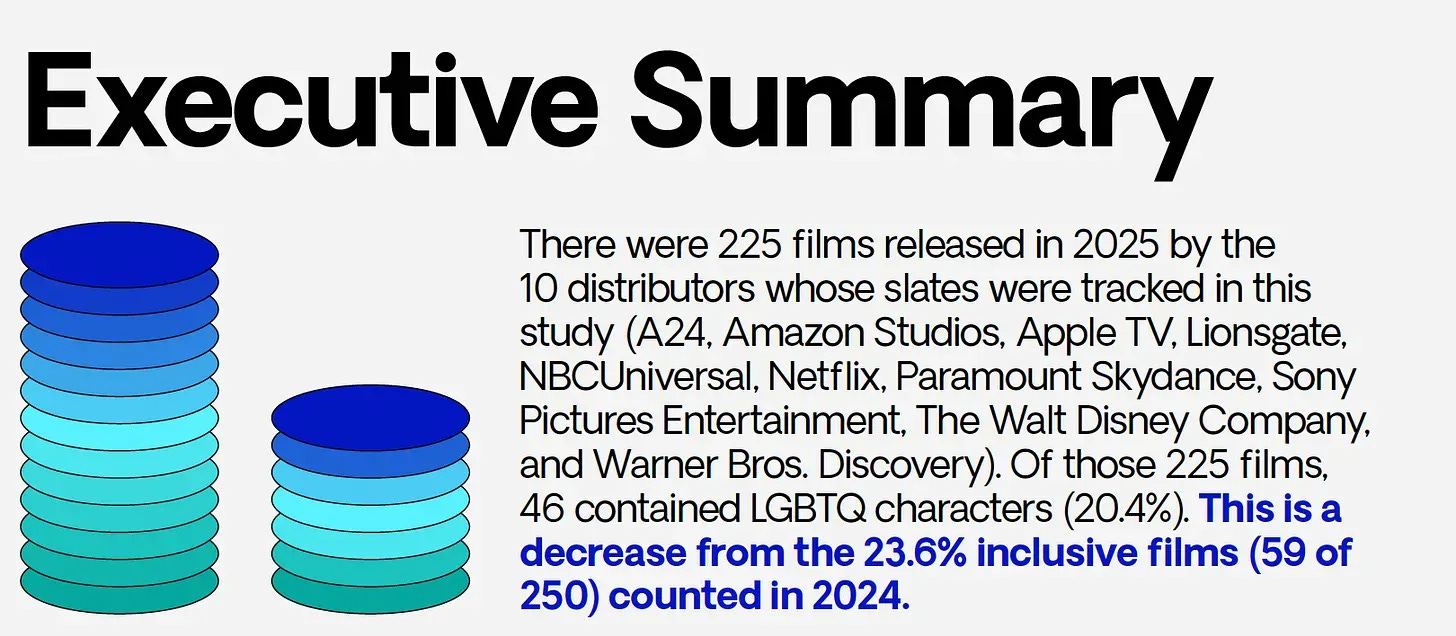
Like the UCLA study, GLAAD scolds the distributors over and over again for ignoring LGBTQ characters, but again, they don’t even present convincing evidence that LGBTQ audiences prefer seeing themselves on screen.
We have to remember that if you’re making a business argument, and Hollywood is theoretically a business, you have to prove it.
Megan Townsend, writer of the second introduction letter, is a little less brazen in her claims. The first line states that…
“Companies that wish to successfully grow need to win LGBTQ audiences’ eyes and dollars.”

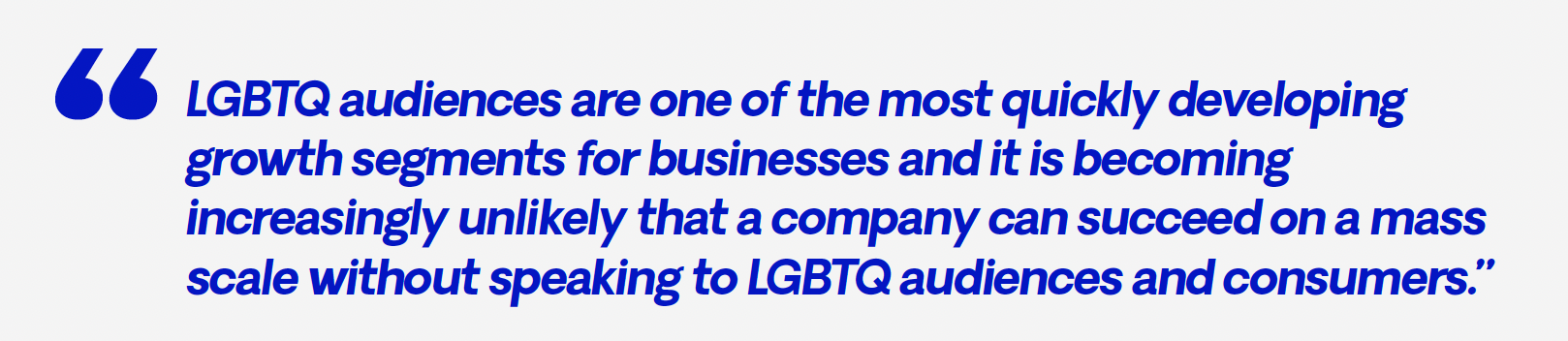
Townsend cites two real stats — Gen Z is 39% of moviegoers (Comscore PosTrak) and 23% of under-30 Americans are LGBTQ (Gallup) — then leaves the reader to connect them into 'therefore queer Gen Z is driving queer film attendance.'
But the letter never actually shows that connection: no Comscore or PosTrak breakdown of queer-audience turnout for specifically queer films.
Theoretically, we would need proof of this connection. As we saw in the UCLA Study, Latino audiences seemed much more driven by genre than the racial makeup of the cast. What’s to say this isn’t happening with queer audiences as well?
There Is An Inherent Sloppiness To The Report
Even its own headline counting contradicts itself. The Executive Summary, describing 2025’s LGBTQ characters, says “59 (53%) are women, 46 (41%) are men.”
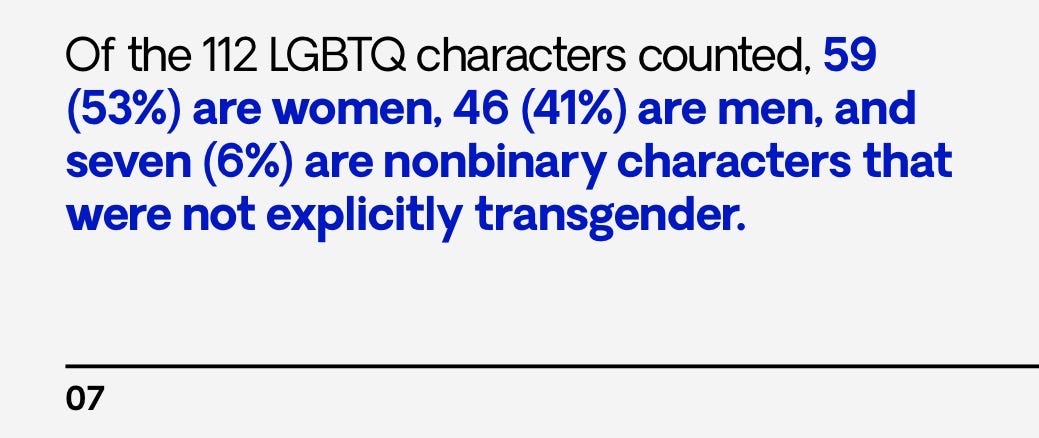
But then just a few pages later their own orientation table contradicts the summary, stating the opposite: 59 men and 46 women.
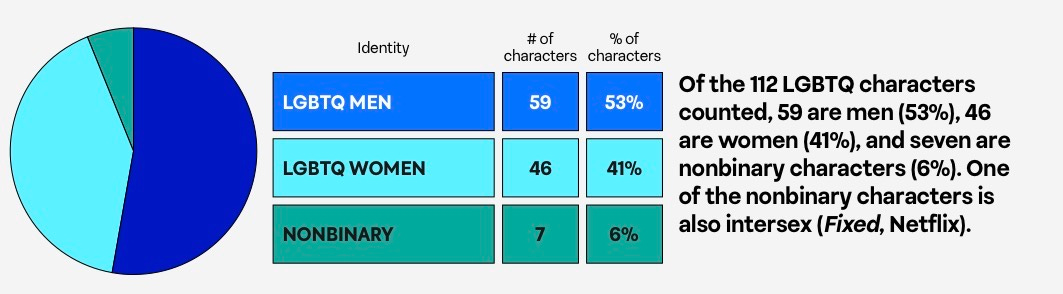
So if the headline gender split is provably wrong in at least one prominent place, why trust any of the other figures? It’s unbelievably sloppy.
They also never report the number that would matter most. They count 112 LGBTQ characters but never count total characters — so “are LGBTQ people under-represented on screen relative to 9% of the population?” is unanswerable.
The animated/family “0%” reading contradicts the thesis. GLAAD frames the lack of queer representation in family films as studios “rejecting reality.” The more likely driver is that family tentpoles are built for global release into markets that legally restrict LGBTQ content.
You can’t argue “inclusion is always good business, period” and simultaneously write off the lack of queer representation in family films as discrimination.
The Conveniently Missing Scorecard
I mentioned that the GLAAD study used to grade the studios.
But this year they got rid of the grading system, in what turned out to be the worst year, by their own standards, since 2019.
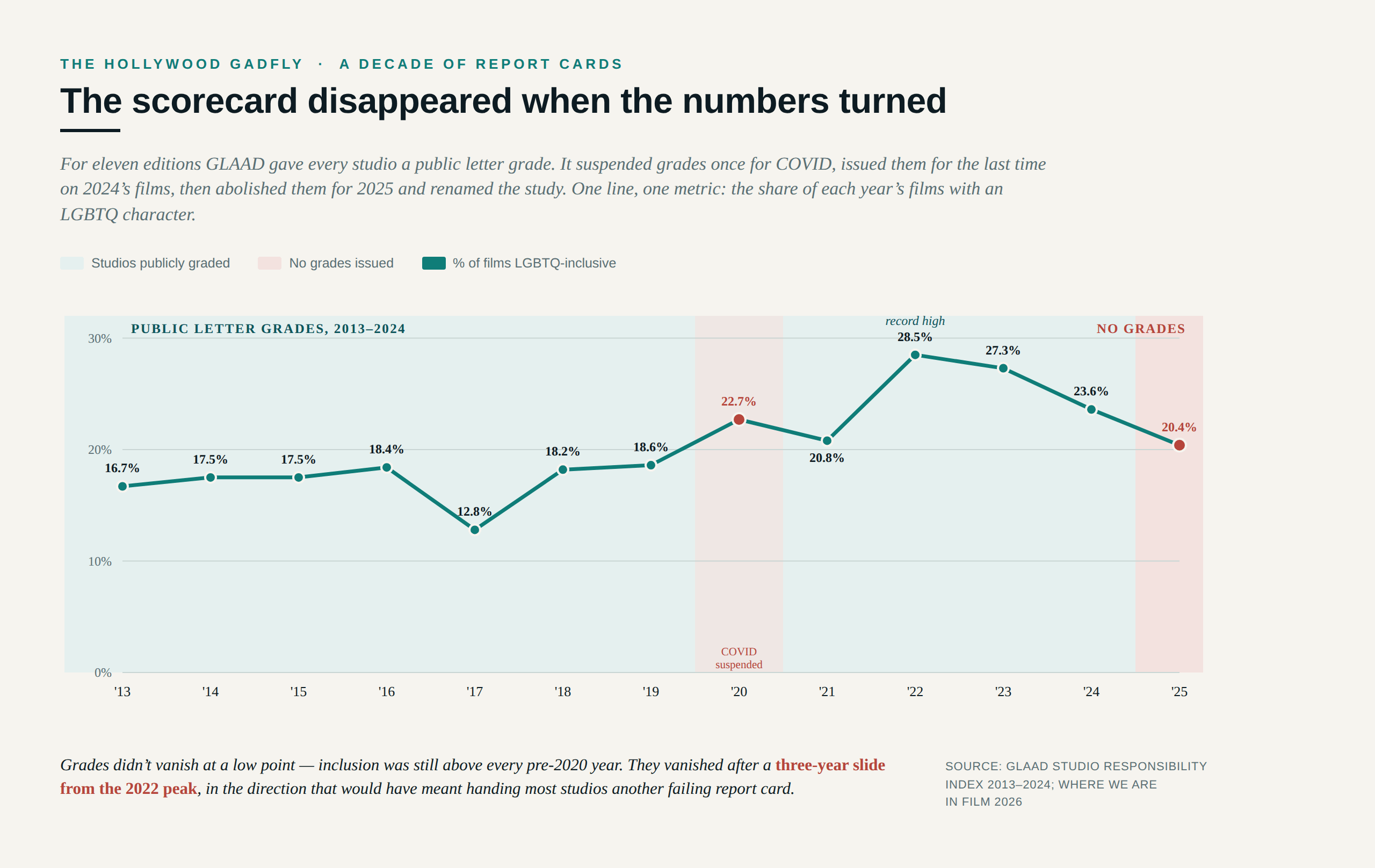
This would have meant giving the studios three failing report cards in a row, for the first time in its history, a job which GLAAD seemed to have abandoned. Why? They never tell us.
Even worse, they changed the flagship character metric in a down year, then continued calling things a trend as if they were measuring the same thing the same way. The shift in methodology would likely result in massive differences, but they never comment on this.
This year they swapped the far more objective “screentime” for the more subjective “narrative significance.” For over a decade the Studio Responsibility Index measured representation by tallying how many minutes a character spent on screen, with over 10 minutes serving as a stand-in for “leading” or “significant.”
Starting with the 2026 report, researchers now watch each film and sort every LGBTQ character into one of four tiers — Lead, Significant Supporting, Supporting, or Background — based on the character’s actual role in the story rather than raw runtime.
This does make some sense, and a combination of the two might have yielded the best possible outcome; then you could compare actual screentime to the non queer characters. You could also set the floor for a “lead” at a certain amount of screentime, using the non queer characters as a baseline to compare.
Measuring screentime is very onerous, but a 2024 study from UC Berkeley, published in the journal Proceedings of the National Academy of Sciences, has proven that we’re already able to do this with AI. Working with what they called “computer vision,” which scanned movies with facial recognition software, they were able to accurately count the actors’ screentime in 2,300 Hollywood films. Their dataset is public, and there’s no reason a similar study couldn’t be done for queer characters, with humans helping code before the machines took over.
This system would significantly reduce the effort involved, reduce errors, and potentially increase transparency by allowing all organizations to use the same, public dataset.
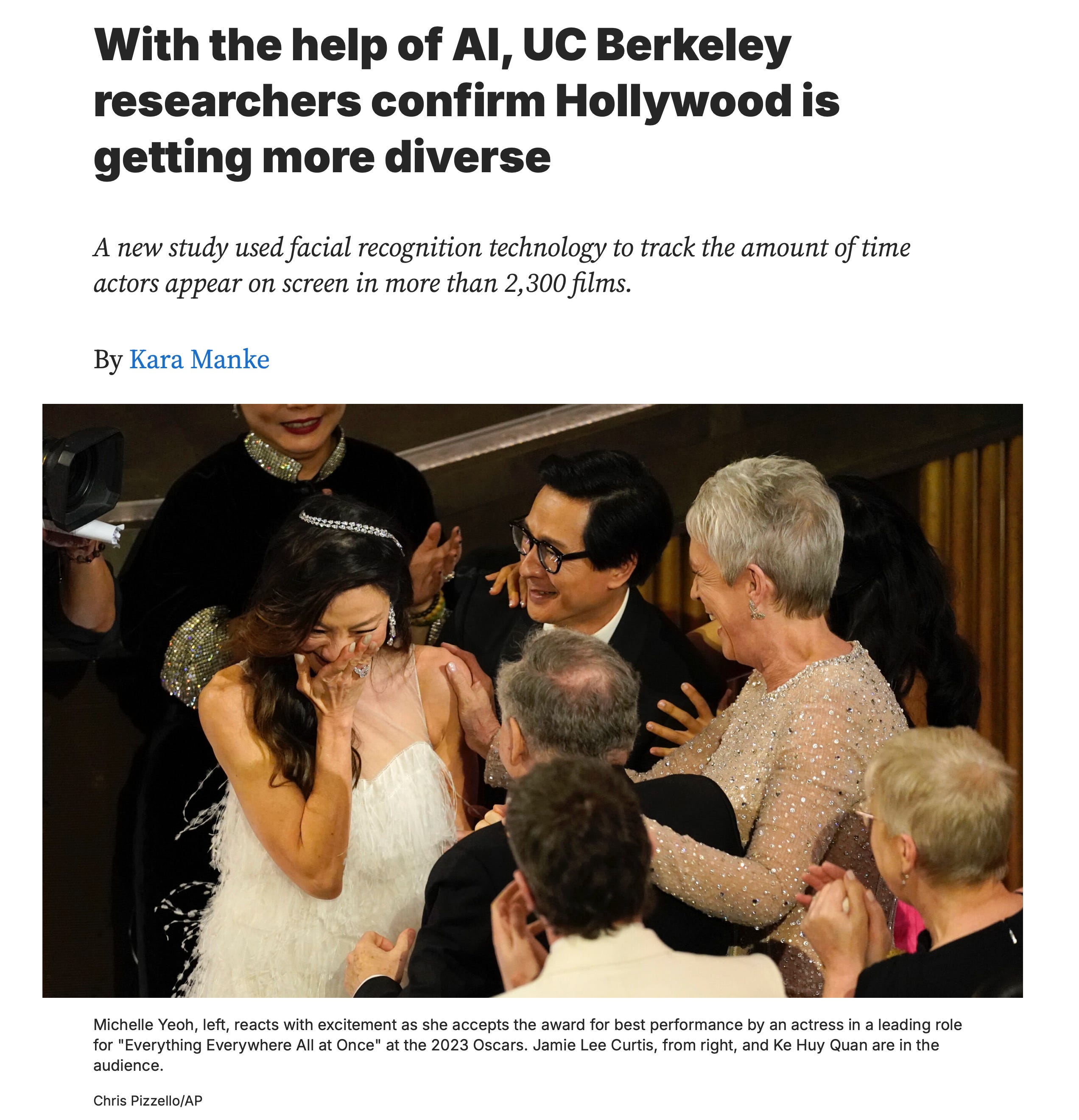
The study was also highly positive, showing that films were getting significantly more diverse:
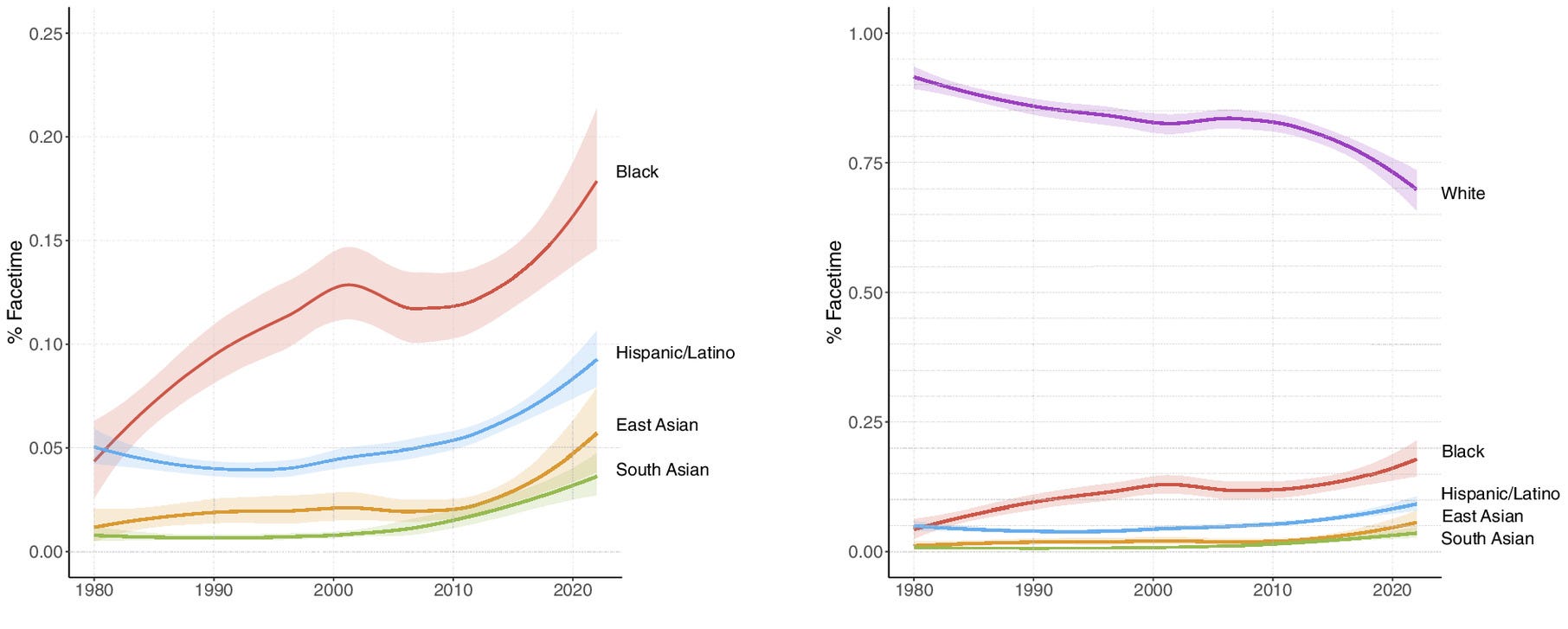
The numbers above are truly objective: we have an overall measurement of the exact amount of screentime each character has. I can’t imagine how helpful this methodology would be for GLAAD’s work, just as an overall metric of what’s happening.
Compare that rigor to GLAAD’s own methodology:
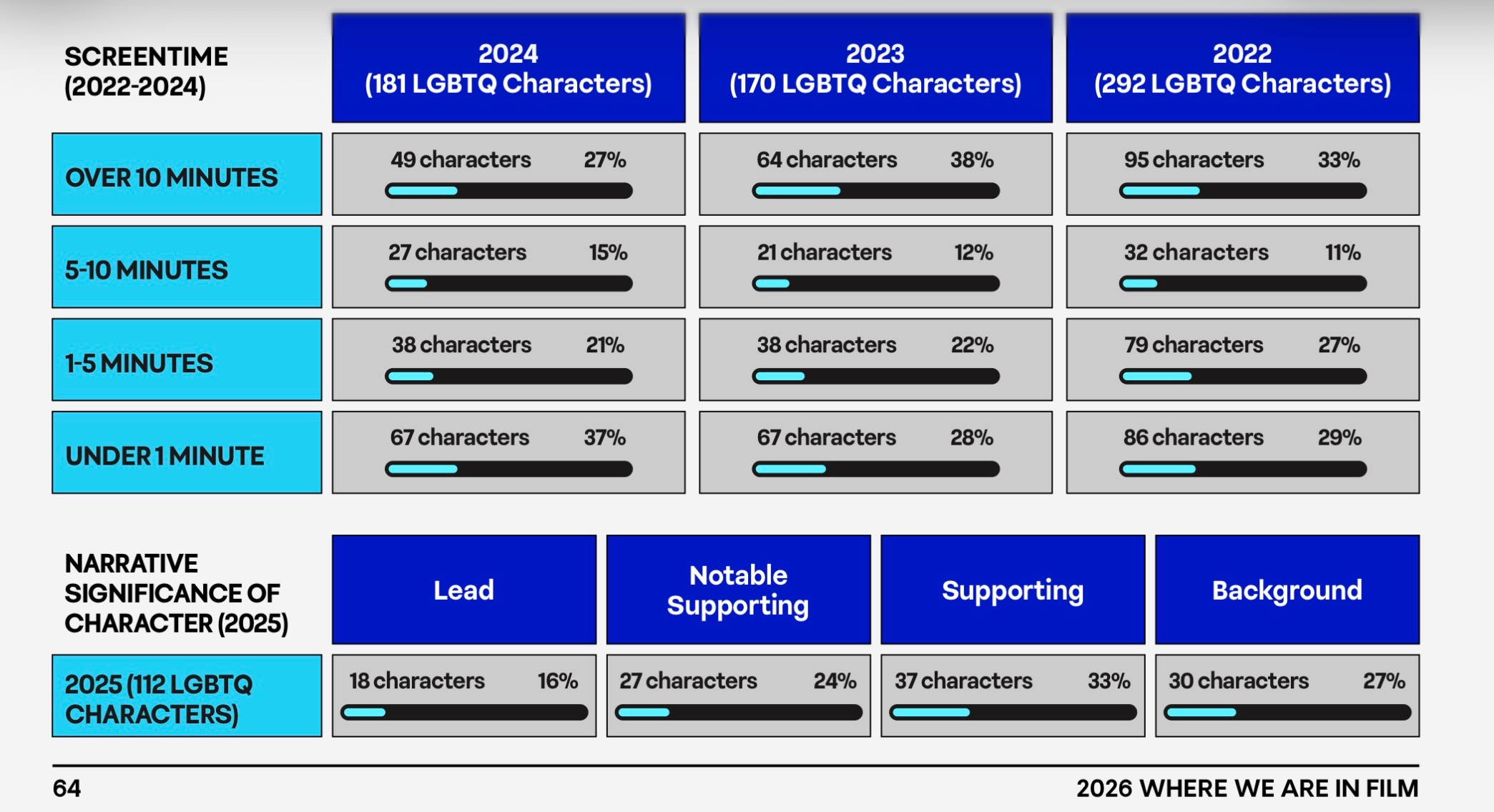
The year-over-year appendix shows screentime for 2022–24 and narrative significance for 2025. Again, nowhere do they comment on the fact that they may actually just be tracking a decline in the number of films, not just queer characters.
Because of the shift in methodology, this is incredibly difficult to do. Perhaps they could have gone back and recategorized the earlier films so we could measure them on the same level. That might have taken a lot more rigor. It’s extremely difficult to parse which “over 10 minutes” characters would qualify as “leads” in the new coding system.
The shortest performance to win a supporting actor Oscar was Beatrice Straight, who appeared for five minutes and two seconds in Network. But the vast majority of supporting actors appear for over ten minutes. The splitting of “10 minutes” into “lead and notable supporting” thus already makes things look worse.
Imagine a recategorization: combine lead and notable supporting into one category. Now we have 40% LGBTQ characters in the top slot. Suddenly the numbers actually improve. Again, without the baseline of the Oscars or anything else, we can fuss with the numbers to make them look however we want.
And honestly, this may have been why they recategorized as well, because their old methods would have potentially shown an improvement in queer leads. Hard to say, because we don’t have any of their data.
All we have is their confident claim that LGBTQ characters are being “pushed into smaller roles” over time. If a character is recategorized from “above 10m of screen time” to “clear lead,” of course they’re going to be “pushed into smaller roles,” by the study’s own methodology, not Hollywood.
And if you run the math, it runs against what they’re saying.
The total number of LGBTQ characters fell from 292 in 2022 to 112 in 2025 — but if the 2022 rate had simply held steady, 2025's smaller slate of 225 films would still have produced about 188 characters, not 112.
That means roughly 58% of the decline is just fewer films getting made, and the remaining 42%, about 76 characters, reflects an actual drop in queer-character density.
Run the same test on just the "Over 10 Minutes" tier across 2022–2024 (95 → 49 characters) and you get almost the identical split: 59% fewer films, 41% falling rate.
So there is a decline in queer leads, but the majority of it can be attributed to the decline in films overall.
And that’s not even the beginning of the problems with this study.
The Vito Russo Test is Whatever They Want it to Be
The study bases much of its methodology on what they call the Vito Russo Test. Here’s GLAAD’s definition:
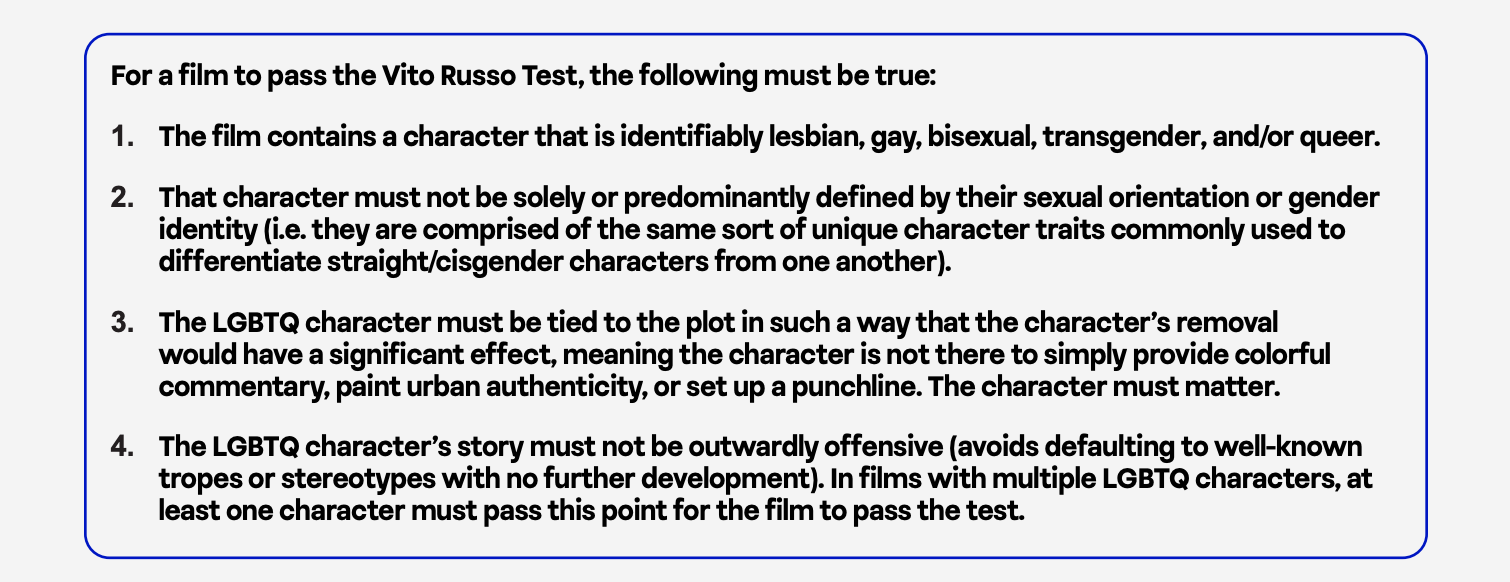
This already creates several challenges, two larger ones being:
What if a film is made for children and thus not focused on the characters’ sexuality at all? Does it count as a “straight film” if the sexuality is not identifiable?
Isn’t a bit contradictory that a character has to both be identifiably lgbtq but not defined by it?
How do they define “outwardly offensive?”
The latter becomes particularly challenging, because as we move into the studio grades, a curious thing happens; the study only cites positive examples.
We know that those bad, outwardly offensive characters exist, but we never receive a single lengthy example, like we do with the positive ones. There are no boxes with “FAIL,” only those with “PASS.”
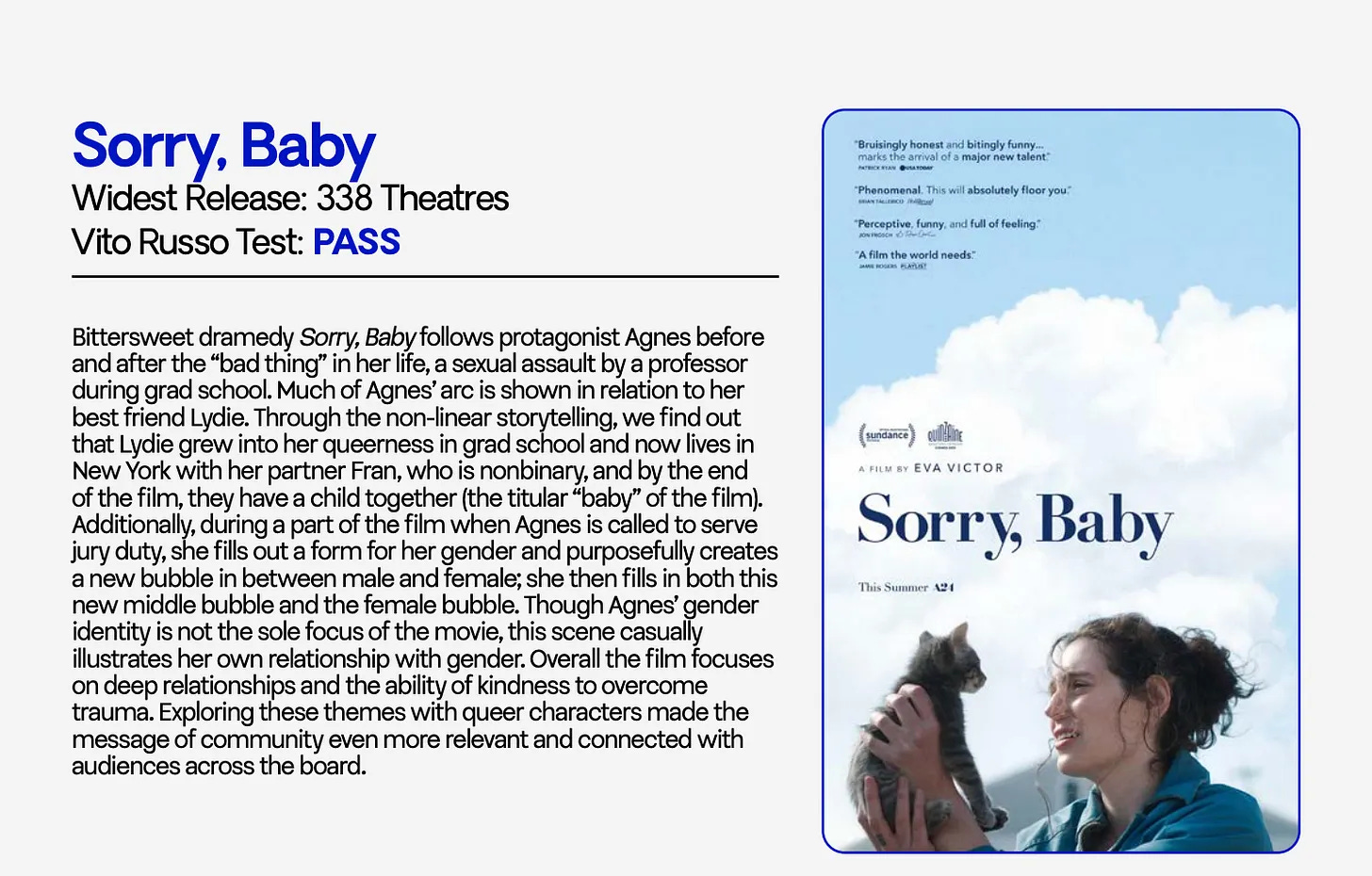
This creates a set of interlocking issues:
Their test is unfalsifiable-by-omission. A reader can’t check a single judgment call to go “that makes sense to me.” It also conveniently protects named films (and named studios, who all sponsor GLAAD) from an explicit FAIL.
The test contradicts the report’s own stated purpose. The Vito Russo section explicitly says the test exists to flag films that include queer characters but fail them.
The report calls out films like Another Simple Favor (where a character’s gay identity is revealed only at death), Play Dirty (both gay men die early), Fixed (where a character is “reduced to their genitalia”), and The Hand That Rocks the Cradle (manipulative bisexuals). Yet several of those they decline to score at all, or score as passes, and none carries a visible, fully broken-out FAIL.
And again, many of these “failing traits” are essentially just having queer antagonists, who by their nature are duplicitous, immoral, etc.
GLAAD is expressly creating a narrow “good” moral range for the queer characters to exist in. On What Went Wrong the GLAAD representative sighed over the death of the gay characters in Weapons. But they were the only truly happy onscreen couple, in a horror film.
This is part of the endlessly frustrating part of reading these studies: the writers are neither storytellers nor researchers; they’re activists failing at both.


GLAAD describes our Weapons couple as having “problematic issues,” because one brutally kills the other. But how else are we also going to fulfill their qualification that the characters be overtly gay and in a horror film? The only option seems to be to make them the leads.
And again, the report itself calls out Weapons elsewhere as a bright spot for queer horror, probably because it made a lot of money.
Deerwater herself has choice words for Weapons on the What Went Wrong podcast:
“That’s also a really interesting thing to look at with a film like Weapons, where a lot of people died. And it just happened to be that the gay characters were killed a little more brutally than the other characters.
And I think that was an innocent mistake of just like, let’s make this character gay or whenever that happened in the process. I can’t say, but it’s just so funny that it’s like, if there was just one queer person who’s like, hey, maybe let’s just not have this be the most brutal murder. I think that would have helped a lot.
But again, we’re not scolding where we want to educate.”
But they are scolding, and if this film bothered them in particular, maybe they shouldn’t have included it in their inclusive films? But that would hurt their business case, so Weapons becomes a tick in the success box, even though the leads are straight, and the gay couple is brutally murdered in what they call the “Bury your Gays” trope.
Throughout the study, a number of additional queerphobic tropes are identified, many of which are extremely subjective or even, dare I say, just basic storytelling:
Predatory bisexual.
Inaccurate intersex tropes.
Inauthentic casting (?).
Minimizing, or shrinking established queer roles in sequels (?).
Queer characters existing only to prop up straight leads.
And so on. But the presence of these evil tropes in films don’t even seem to prevent GLAAD from counting those characters and films as “inclusive.”
Here’s a complete list of tropes I was able to find that they identified, and whether they still qualified as inclusive or not.
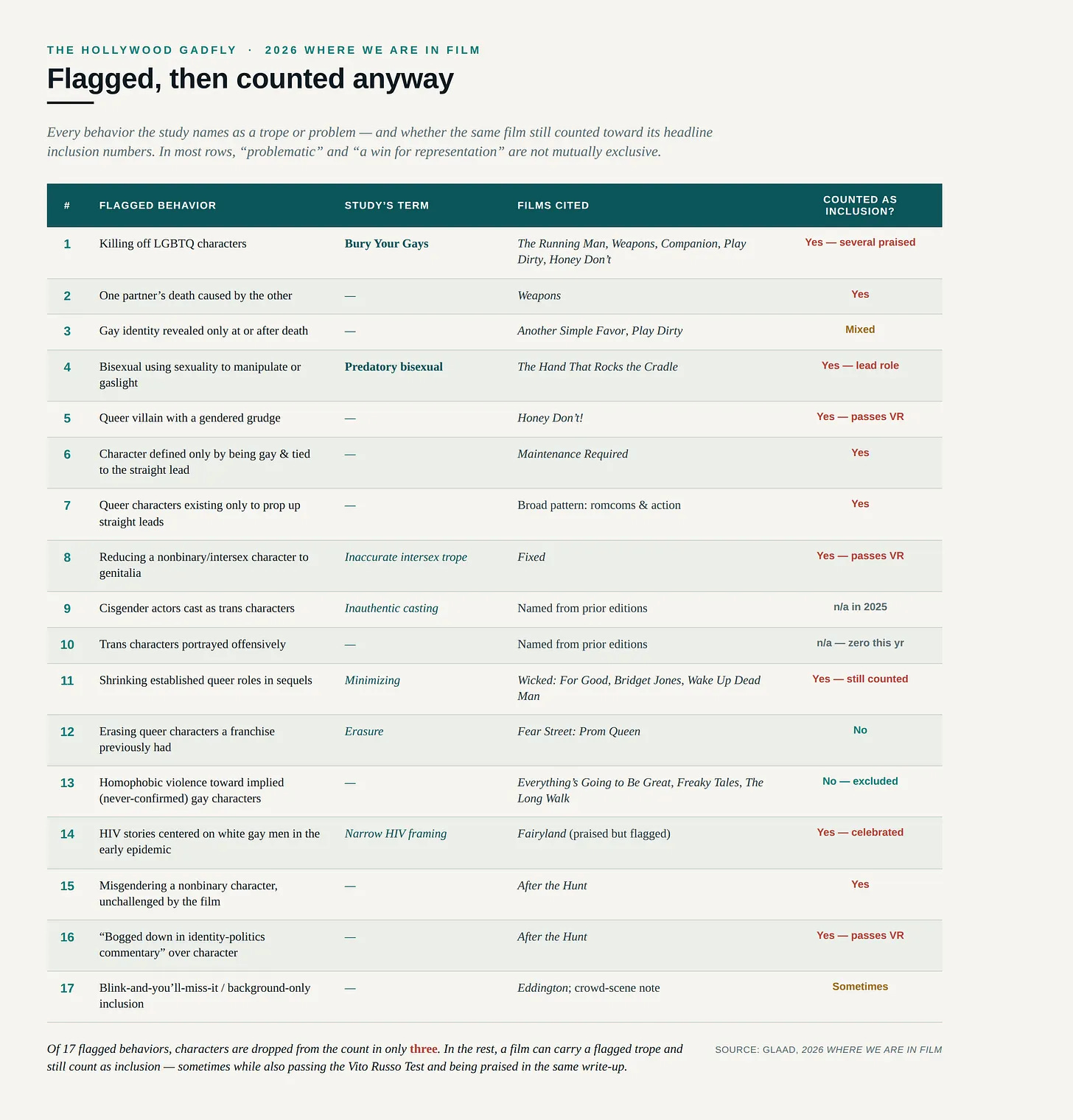
As you can see, over half of them still qualify, which essentially means the study is cherry picking, perhaps in a callback to their unproven “queer films make money” theory.
And there are even more issues with their coding process: Benoit Blanc from Wake Up, Dead Man: A Knives Out Mystery is counted as an LGBTQ lead even though the film “excluded his personal life entirely.” It does so because we know he’s queer from an earlier film, while human characters that read as queer-coded (Les in Everything’s Going to Be Great) are excluded for being only implied.

Meanwhile Frankie, the nonbinary intersex cartoon dog in Fixed, as well as Companion’s robots, both count toward the representation percentages. Each ruling is individually defensible; combined they mean the “count” is far more human than it seems.
The Vito Russo count is also flawed on a mathematical basis.

If you look at just the Vito Russo numbers, this very well may be a large decline, even if it’s subjectively coded.
But if you run the math on the pass rate — 77 in 2022, 36 in 2025, against 350 and 225 total films — holding the 2022 rate steady would predict about 49.5 passing films in 2025, not 36, meaning roughly two-thirds of the drop is just fewer films getting made and one-third is a real decline in the pass rate.
So again, the numbers aren’t great, but not nearly as bad as they seem.
GLAAD’S Entire Business Case Has No Control Group
We can’t verify that “queerness” pays because we have no baseline of heterosexual films to compare them to.
A real study would look at movies in similar budgets, release sizes, and genres, then compare the performance of the heterosexual and queer-led films. That would be a basic level of rigor this study comes nowhere near to reaching.
There is similar sloppiness throughout the report: they claim at one point that “mid budget films made back over three times their budget.” But that’s a claim about all midbudget films, not just the queer-led or even featuring ones. The success is about the budget range, not queerness.
They also conflate general surveys with audience behavior. They assume that because “more than one in five” American adults under thirty are LGBTQ, that those groups also want to see queer films.
Even within that acronym there are multiple disparate subgroups, most prominently:
Gay men
Lesbians
Bisexuals
Trans people
Queer people
Where is the evidence that these people all behave as a monolithic block when choosing which movies to watch? Does the fifty year old gay man really watch the same kind of movies as the twenty year old trans woman?
We have no idea, and they present no evidence to explain this.
They Bury Their One Positive Finding
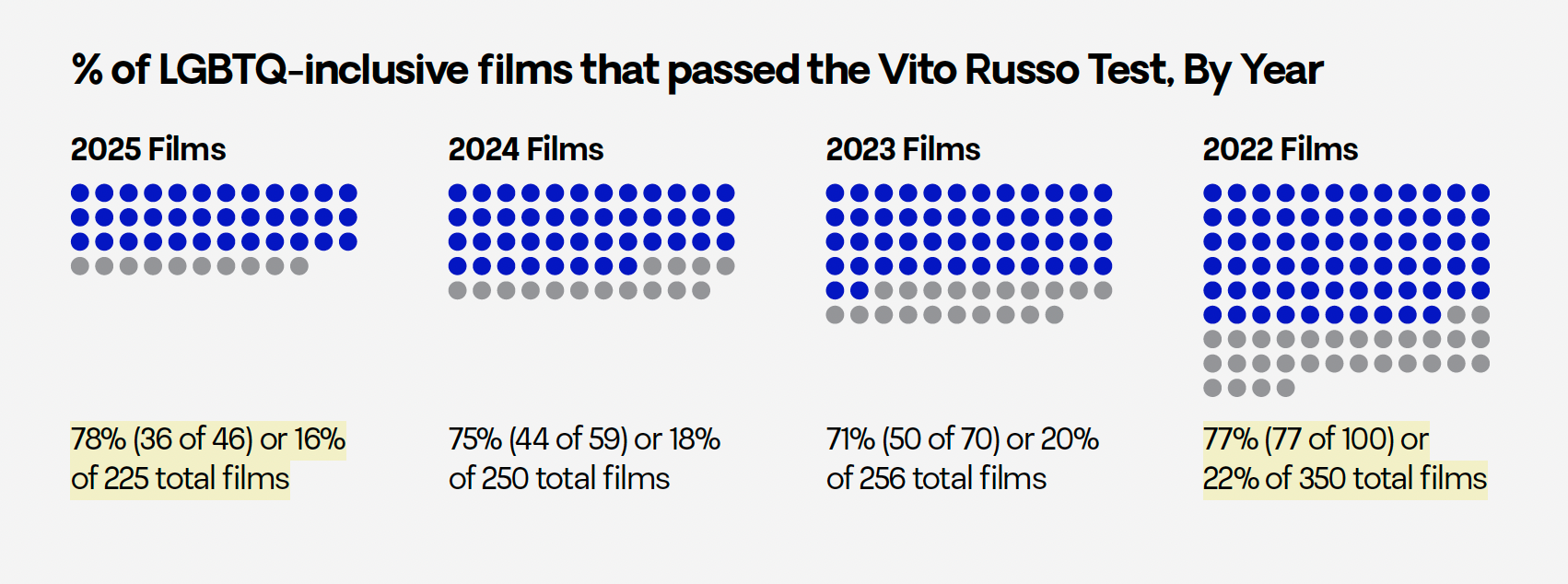
As we saw with USC’s Annenberg Inclusion Study, which buried the slow but steady progress of women and diverse filmmakers into the ranks of the top 100 directors, GLAAD buries its own happy finding:
The Vito Russo pass rate among inclusive films hit an all time high in 2025 of 78%. This of course contradicts the report’s doom and gloom finding that quality is eroding; their main quality measure says inclusive films are better than ever.
But again, you can’t sell fundraisers and consulting services on good news, which might obviate your own reason for existing. So it’s not featured on the headline page.
And this is all crazymaking, because of…
The GLAAD Money Machine
Let’s have a look at GLAAD’s finances.
Corruption Accusations
I honestly hadn’t thought much about GLAAD since this 2024 New York Times exposé:
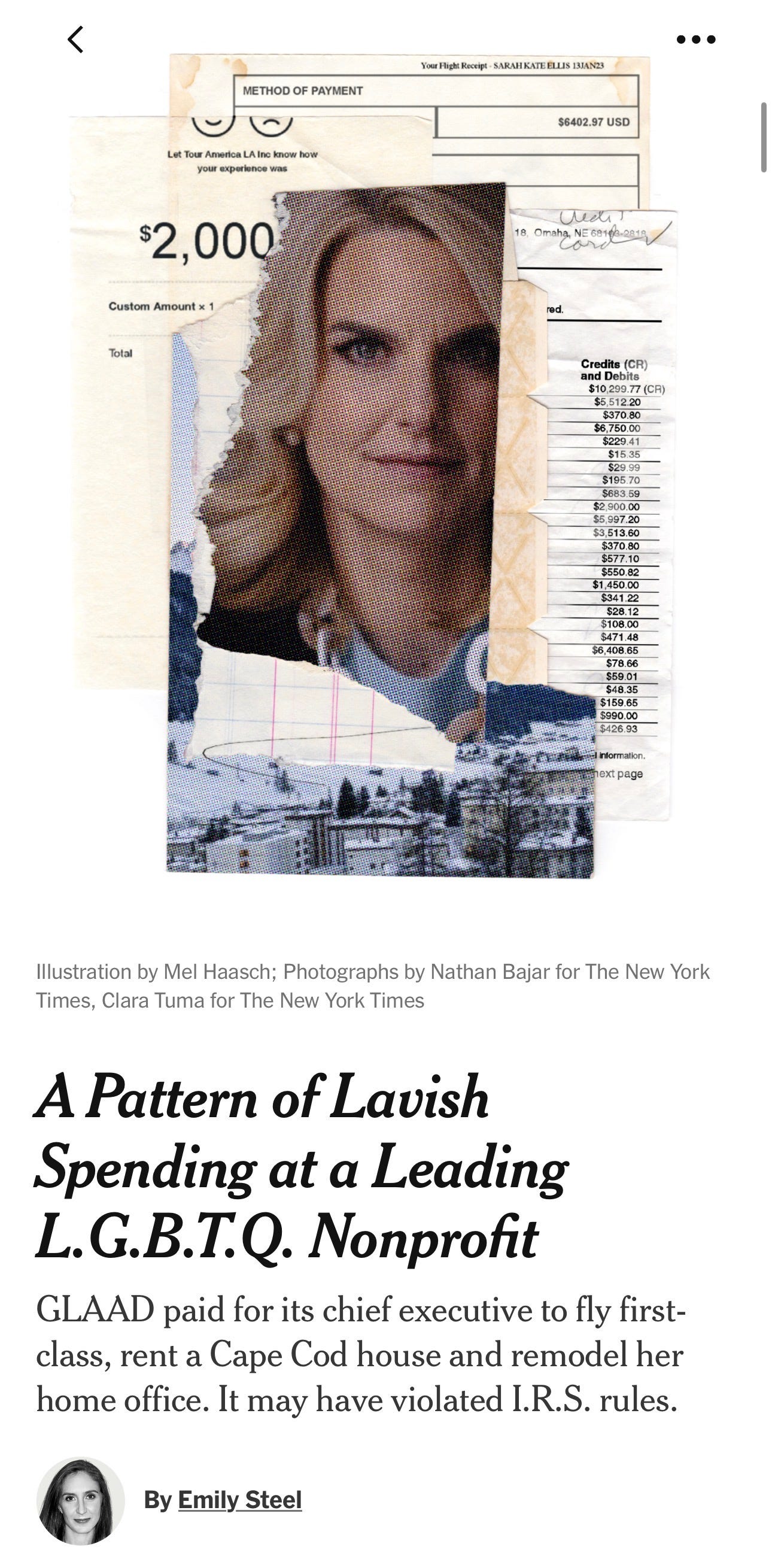
The story opens with chief executive Sarah Kate Ellis going from Delta’s most exclusive cabin, to a waiting Mercedes, to the Tivoli Lodge, a half million dollar a week chalet in the Swiss Alps. She was on her way to Davos, the stomping ground of the ultra elite, and had the digs to prove it.
Back then the New York Times reported that CEO Sarah Kate Ellis’s compensation ran between roughly $700,000 to as much as $1.3 million, depending on fundraising bonus targets. This included a $25,000 Cape Cod housing allowance and $20,000 for a home-office renovation, an amount of money one charity lawyer called “a potentially abusive use of charitable funds.”
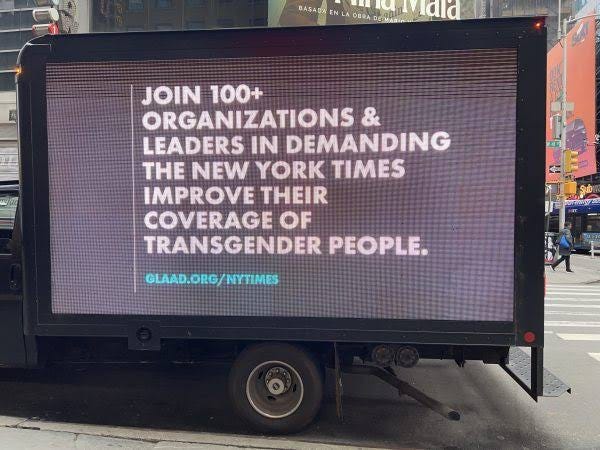
You see, GLAAD and the NYTimes had been at war over the paper’s transgender coverage, which GLAAD claimed was biased. They printed lengthy responses to the Times’s coverage of trans issues, and soon rented a van to protest outside the paper.
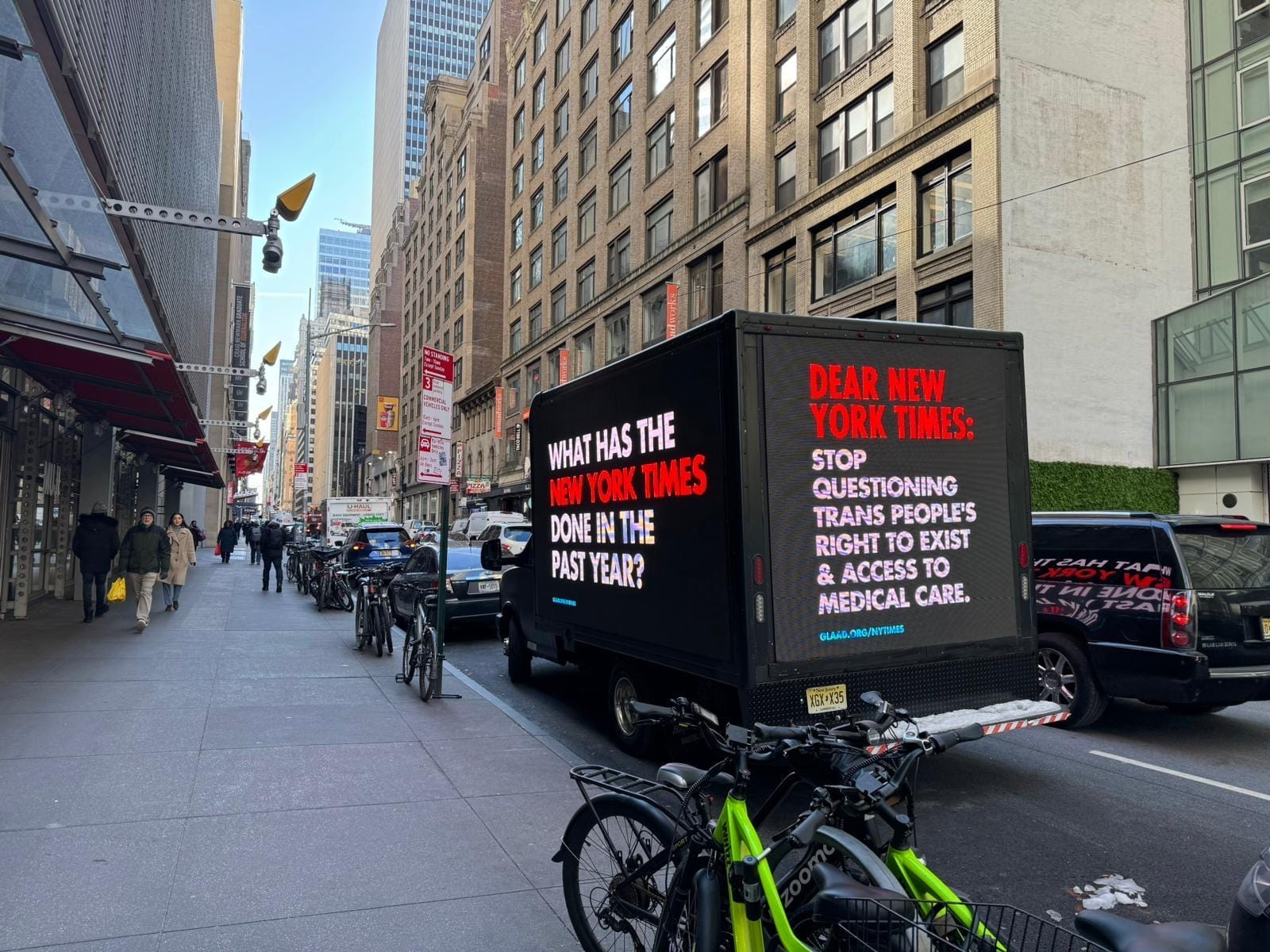
Honestly, after reading the article back when it was published, I was amazed to see that Ellis survived the scandal, and is still writing the introduction to the report:
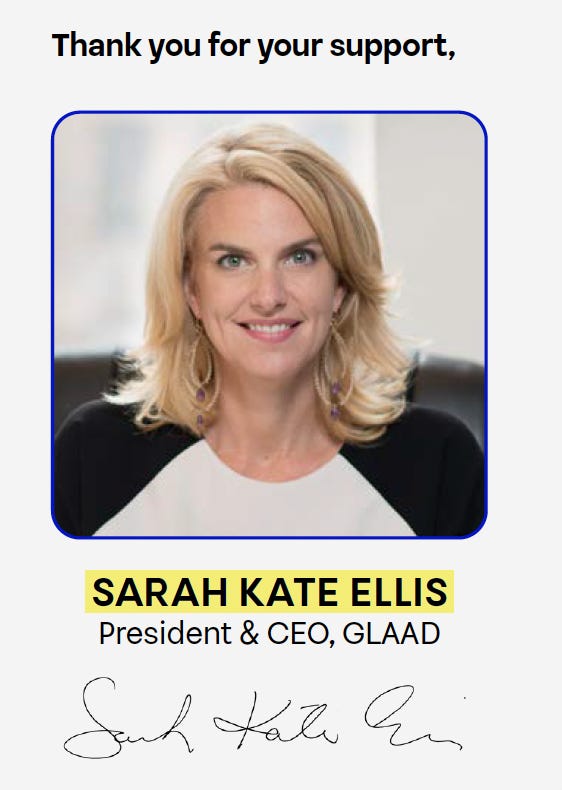
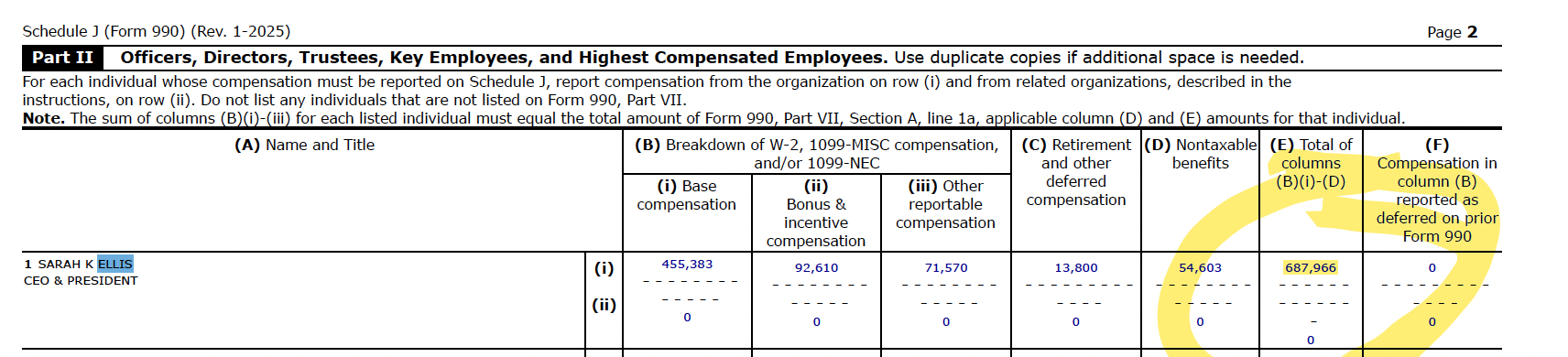
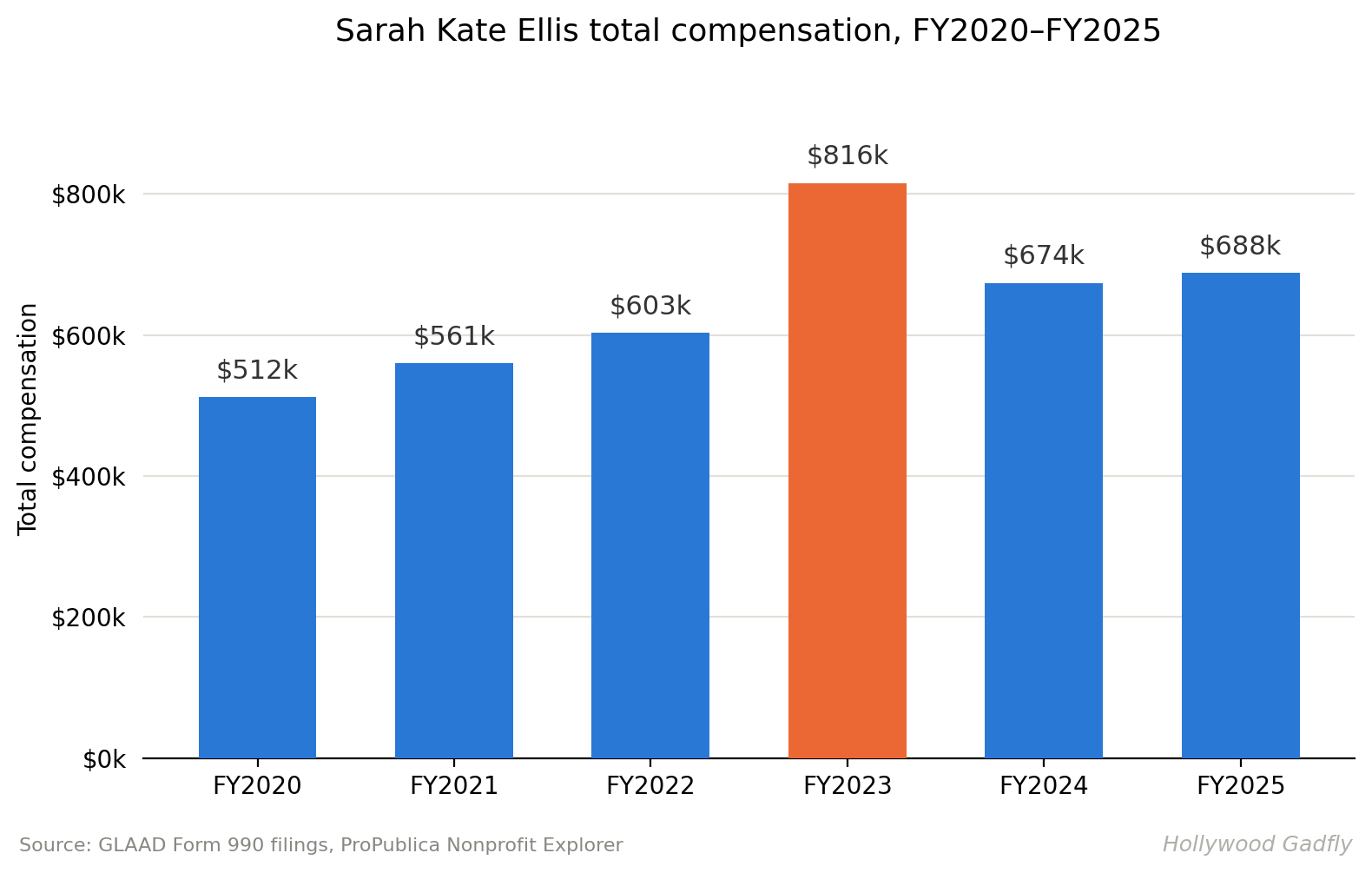
According to GLAAD’s own 990 filings, Ellis made $687,966 in 2025, the most recent year on record. In her most recent 2022 contract, she also received:
$150,000 signing bonus (2022, already paid)
Up to $300,000/year tied to fundraising performance
A discretionary annual bonus of up to 40% of base salary
A $225,000 “farewell appreciation bonus” — payable in 2027, only if she’s still at GLAAD when the contract ends.
Here’s a breakdown of her salary:
Here are their total revenues over the last 5 years.
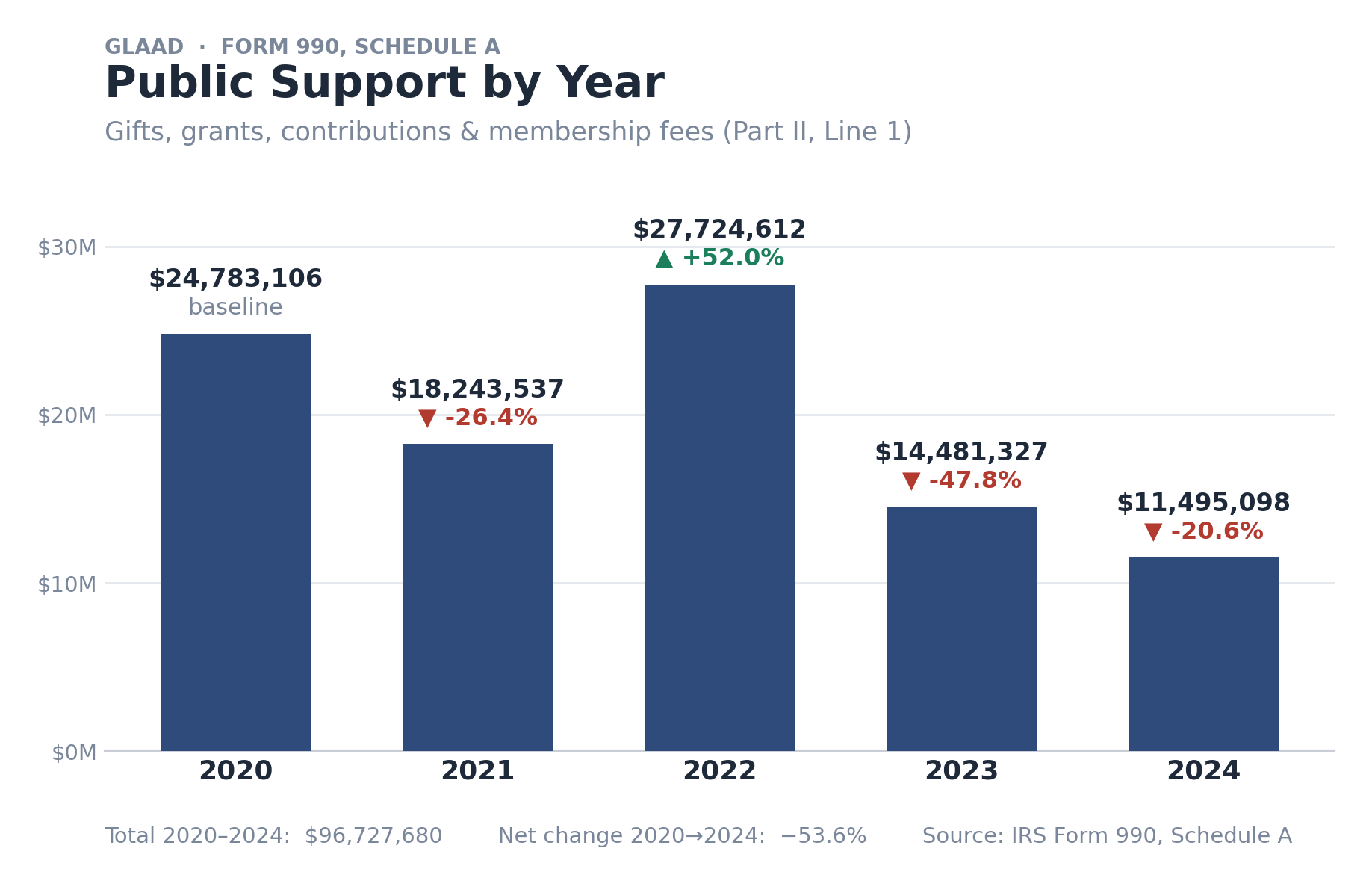
As you can see, GLAAD’s donations peaked in 2022, and have declined precipitously since, perhaps tracking the fallout from the increasingly brutal trans culture wars.
Even worse for GLAAD, they ran an $8M deficit last year.
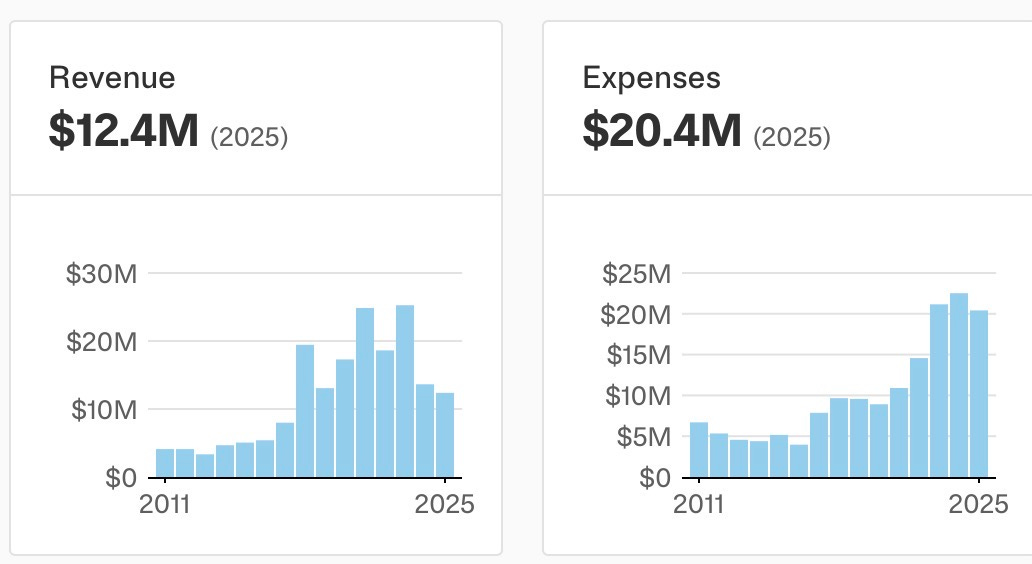
Net assets also dropped from $42.68M to $35.5M (down ~17%) in a single year.
This is important, because it likely makes them even more dependent on the studios they police to make up for the lost money. One major source of funding for GLAAD is its many corporate sponsors:
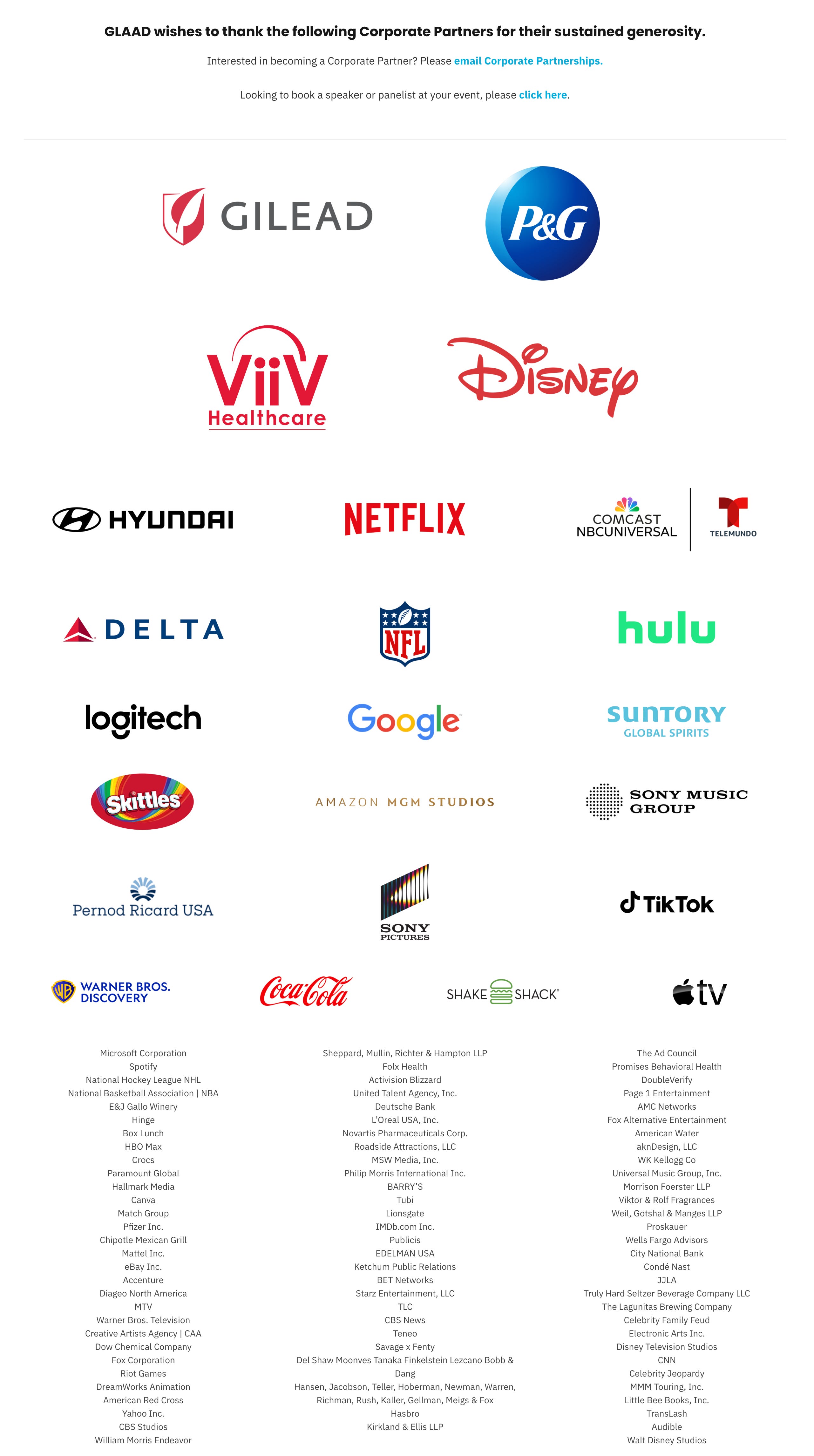
Here we can see represented virtually every major American entertainment and news company. This is problematic, especially among the news organizations, because the public depends on those organizations to report on controversial issues in a fair, fact-based manner.
We’ve seen what happens to news organizations who don’t report the way GLAAD wants.
A Highly Lucrative Feedback Loop
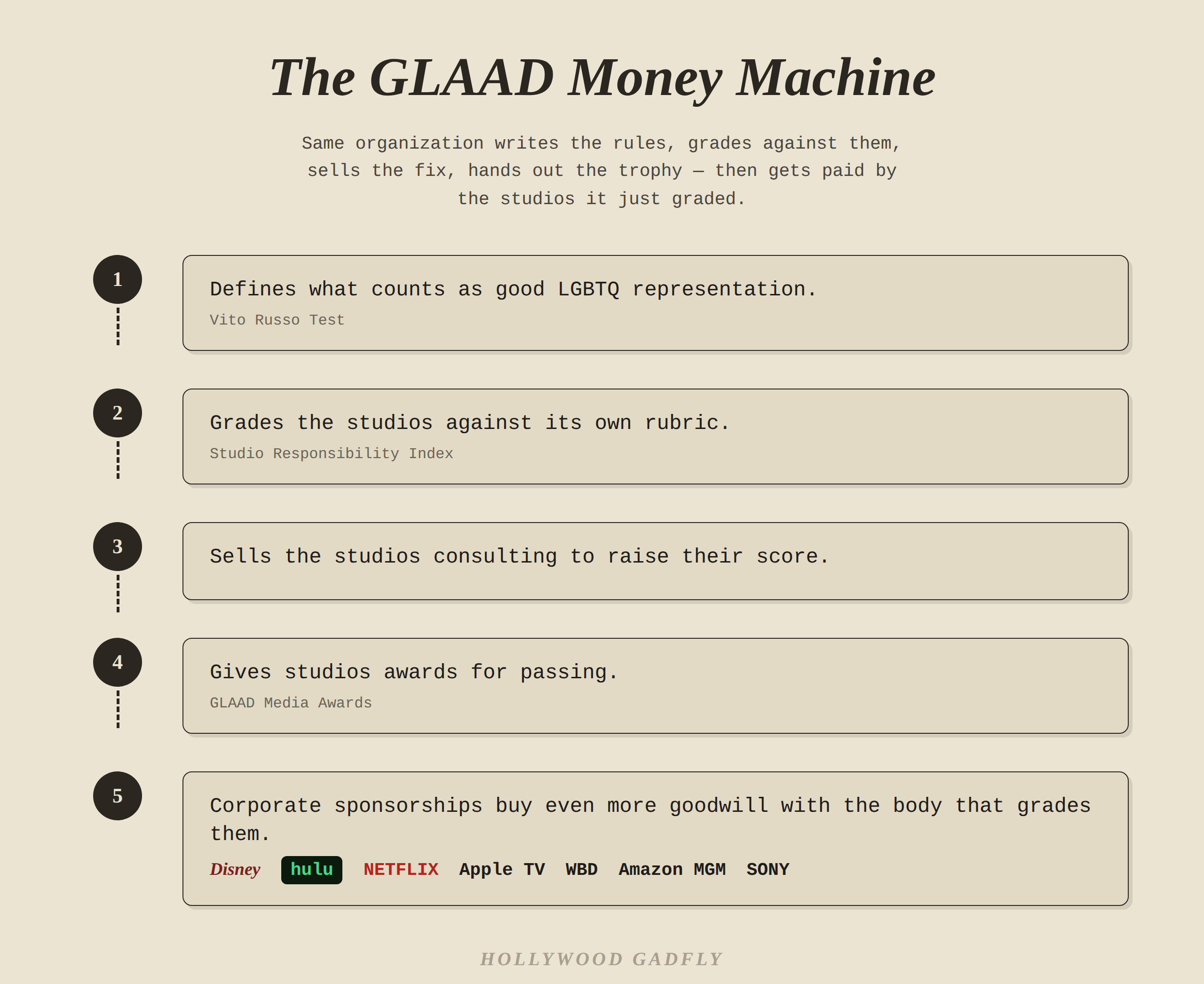
In spite of their recent financial troubles, GLAAD has built a highly lucrative machine. The same organization:
Defines what counts as good LGBTQ representation (via the study),
Grades the studios against it (the report),
Sells the studios consulting to improve their score,
Awards the studios who pass by charging them to attend their ceremony (the Media Awards). Submissions are $350 for the regular deadline and $500 for the late deadline, making it more expensive than even the most elite festivals. Finally, GLAAD…
Continues to take money year round from several of those same studios through funding and partnerships.
This is a perfect circle of fundraising; every step contributes to the one after it.
The GLAAD Media Awards is their biggest fundraiser of the year, and particularly lucrative. The 2024 GMAs raised over $5 million to support GLAAD’s year-round advocacy efforts.
This is the culmination of a cycle that begins with the media report, where the studios are criticized, then pitched consulting.
GLAAD is acutely aware of the report’s fundraising function. They state it explicitly in a recent job posting:
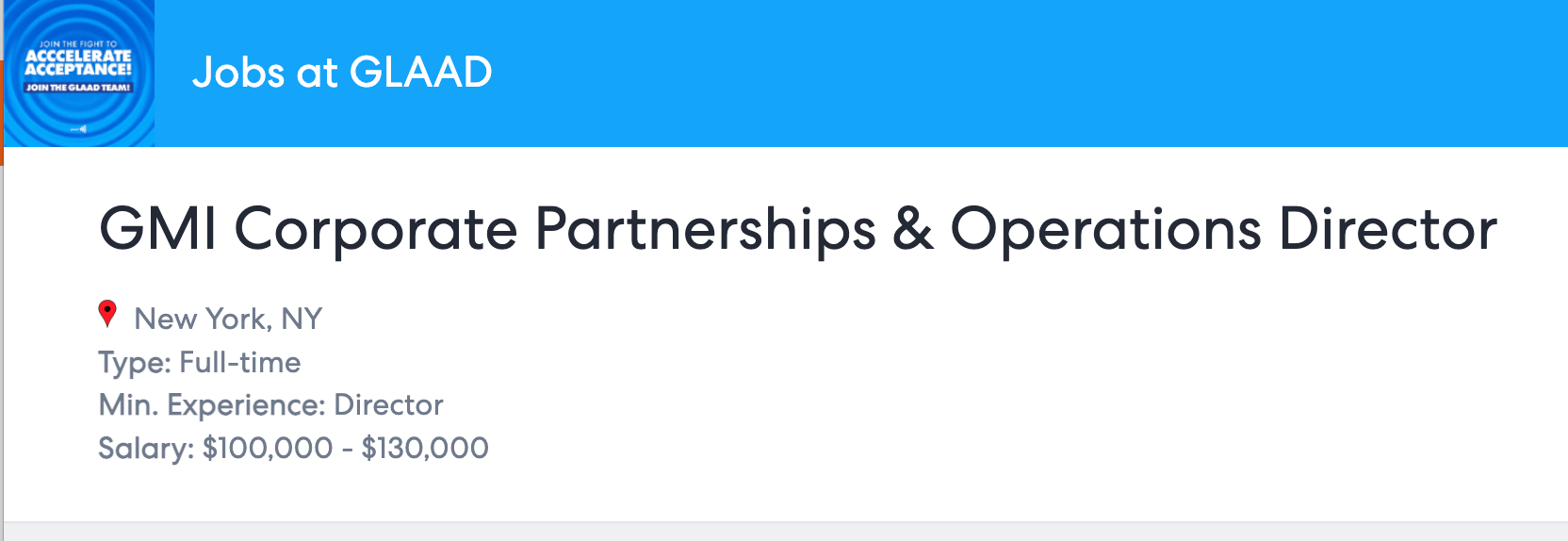
If you look at the job responsibilities, one of them is painfully clear:

They’re literally using these studies, which they define elsewhere as “carefully-designed” and “involving meticulous data evaluation,” to reach out to corporate partners for paid consulting.

That’s GLAAD, where the research and paid-consulting arms come together to form a single commercial pitch aimed at corporate partners.
They’re Also Selling Consulting Services

In Ellis’s opening letter, she cites that “GLAAD consulting increases watch times by 68%”. This is a sales pitch, and a bizarre one.
As we saw above, GLAAD scores the studios on representation, sells them story consulting, and then cites its own paid service as causing “68% increase”. But can we tease apart that it was the story consulting that caused the increase? Or was it something else, like a movie being big enough to afford the consulting?
GLAAD's own public disclosure practices, which do name specific TV/game clients, do not name a single wide-release film client, despite the 68% stat resting entirely on unnamed films in exactly that category.
So we don’t even know which movies they’re referring to, and can’t verify it.
The Real World: Trying to Fit GLAAD’s Ideal
Let’s find a movie that would fit GLAAD’s ideal requirements, which I will summarize here:
A main character explicitly and identifiably queer, but not solely defined by it.
Central to the plot (not removable).
Sympathetic rather than morally complicated.
None of the flagged tropes, played by an actor who’s “the right kind of queer,” i.e. a trans person playing a trans person.
Ideally directed by someone who’s “also the right kind of queer.”
Backed by someone powerful enough to get it made.
Released by a major studio with real marketing muscle.
And avoids every trope on the list.
We have a great example in Bros!
Billy Eichner (openly gay) was the lead and co-writer, it had a largely queer cast, no bury-your-gays deaths, no predatory-bisexual trope. It was also backed by Judd Apatow and released wide by Universal with a real ad campaign — this is about as close to “checks every GLAAD box” as a studio comedy has come.
And GLAAD loved it. They singled it out twice in their 2023 SRI Report:
Universal’s romantic comedy Bros boasted a central gay love story and a multitude of LGBTQ characters in the larger ensemble
This year, GLAAD Media Award-winning romantic comedies Bros and Fire Island both not only featured gay romance, but diverse friend groups and chosen families of queer people.
So how did the film do at the box office?
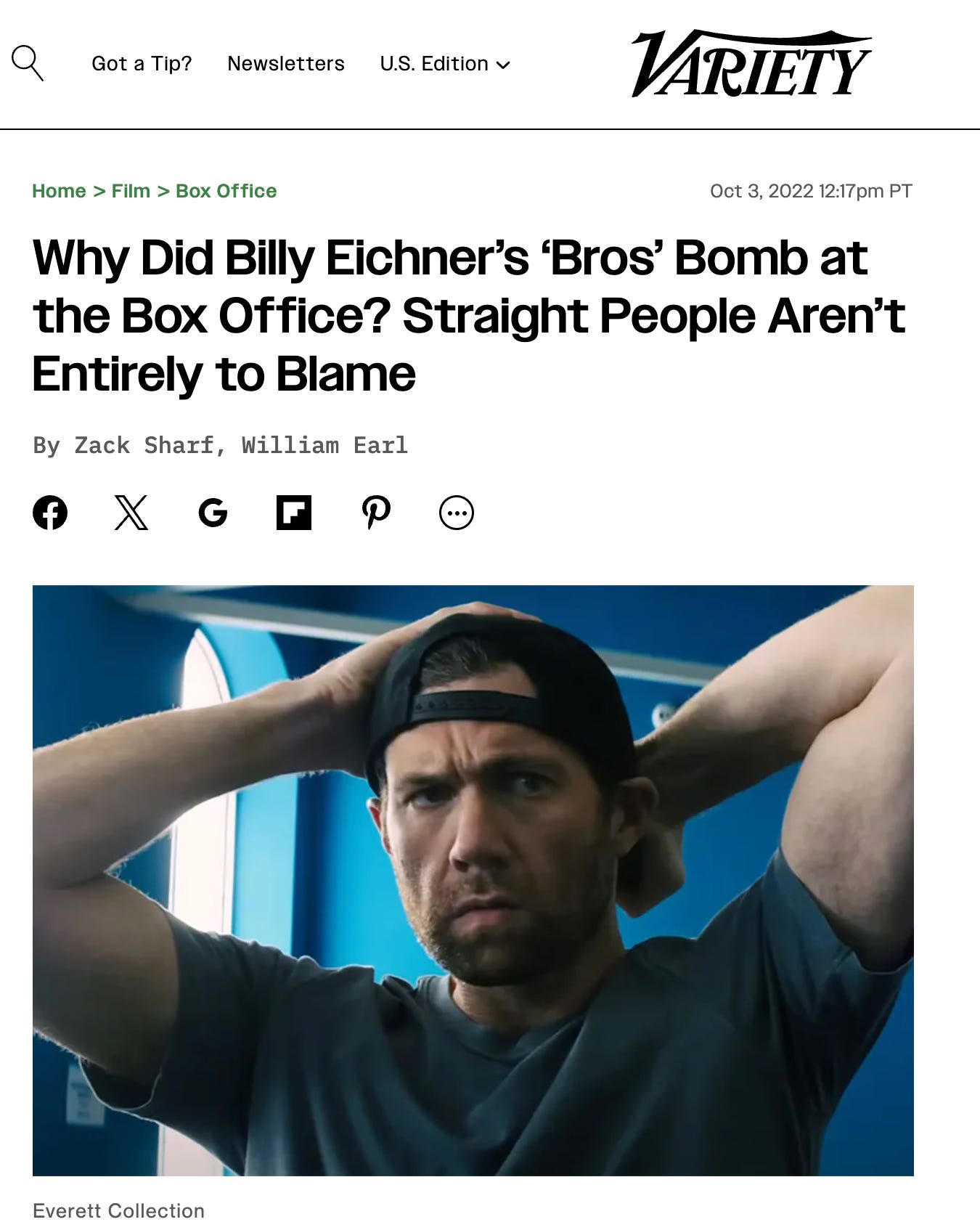
Bros bombed hard, earning just $15m against a $22m production budget. The film underperformed so badly that it became its own industry news cycle.
Eichner, for one, blamed homophobia in the Hollywood Reporter:
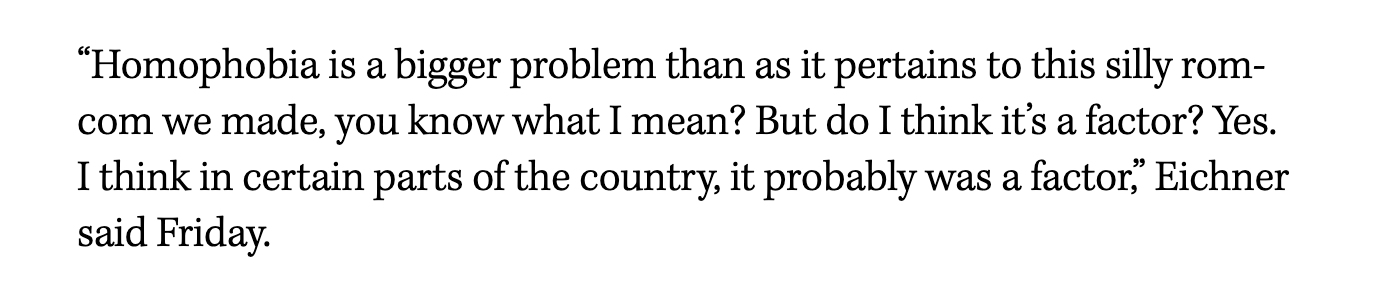
Eichner’s own tweets also blamed straight audiences:
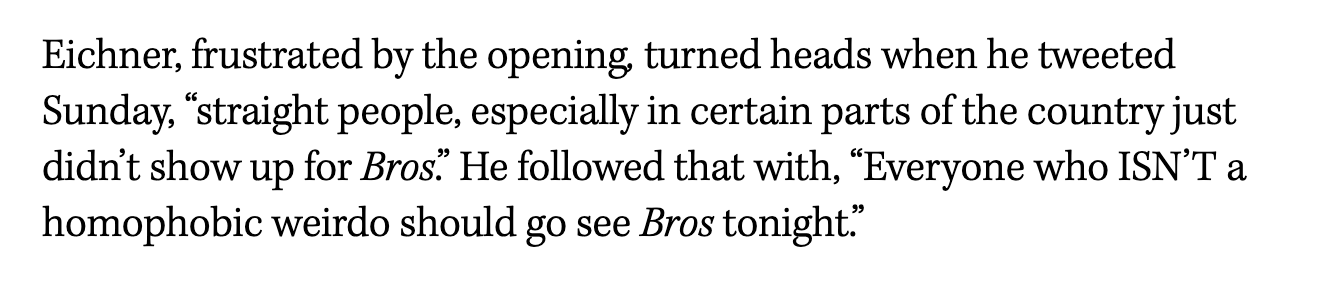
The countervailing argument was that original R-rated comedies of any kind were struggling that year. So how do we measure this accurately?
The GLAAD Award Winners
I thought it would be an interesting thought experiment to investigate the box office of all of the GLAAD Award’s wide theatrical release winners, to see if they outperformed financially.
These were obviously one of the only categories that could be fairly measured as such, as several other categories were either low budget, with limited releases, or had no box office to measure.
So does winning GLAAD’s most prestigious award mark a financial success?
I looked at all thirty eight winners of GLAAD’s Wide Theatrical Release Prize to see if there was any outperformance. Keeping with the methodology I developed with my piece Bomb Shelter, I used the metric of 3.5x production budget for global box office to determine a hit, which accounts for both exhibitor cut and marketing spend (2.5x as a rough heuristic for recoupment).
I also used the acquisition price for the two acquired titles My Old Ass and Go Fish to better represent what distributors paid for them. 2021’s winner Happiest Season did not have a proper theatrical release because of the pandemic, so it is not included below.
Sources are from Box Office Mojo, Forbes and The Numbers.
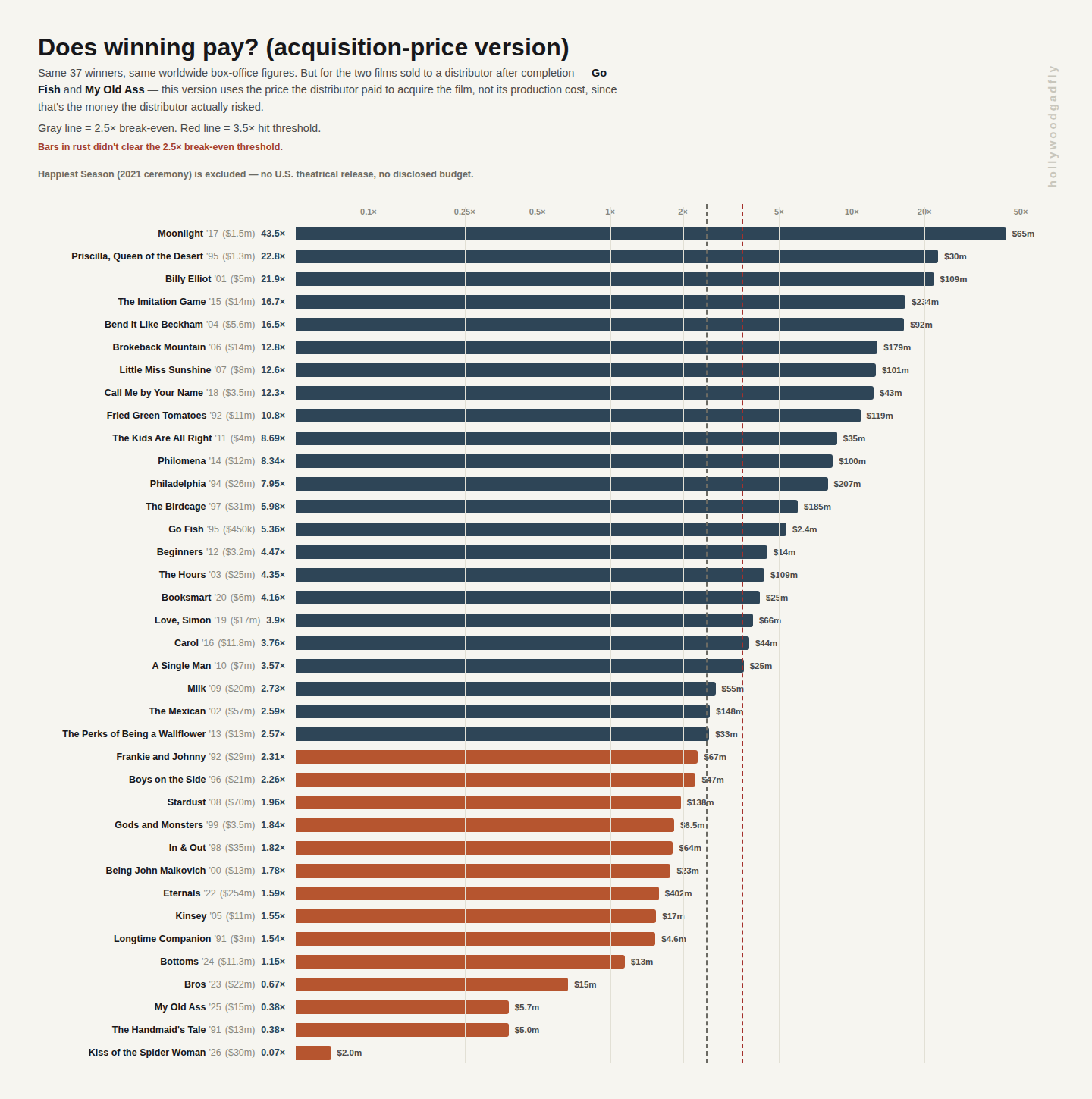
And you know what? Happily, a lot of these movies did pretty well. There are some tremendously profitable queer films.
It’s worth remembering that these movies were already winners when GLAAD chose them. They didn’t make the films successful, they picked them.
But if you look at it, nearly all the films clustering at the bottom are from the 2020s, the worst decade for the GLAAD Awards winners.
Let’s look at them in the money earned vs spent chart:
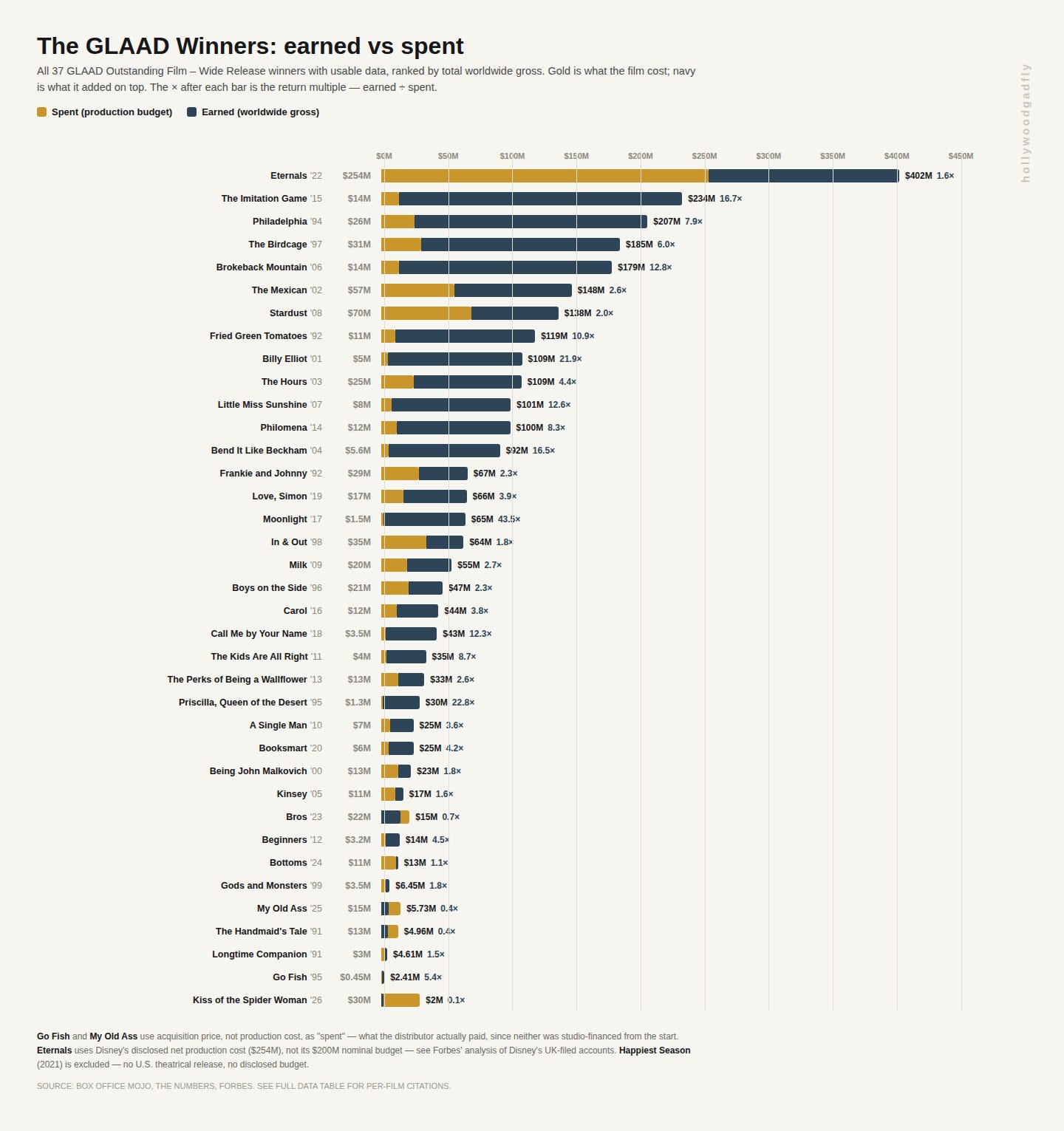
The 2000s and 2010s appear to have been a golden age for mainstream queer cinema, with a decline running into the 2020s where, even with fewer films, significantly more money has been spent than the decade prior (this is partly due to the outsized influence of Eternals).
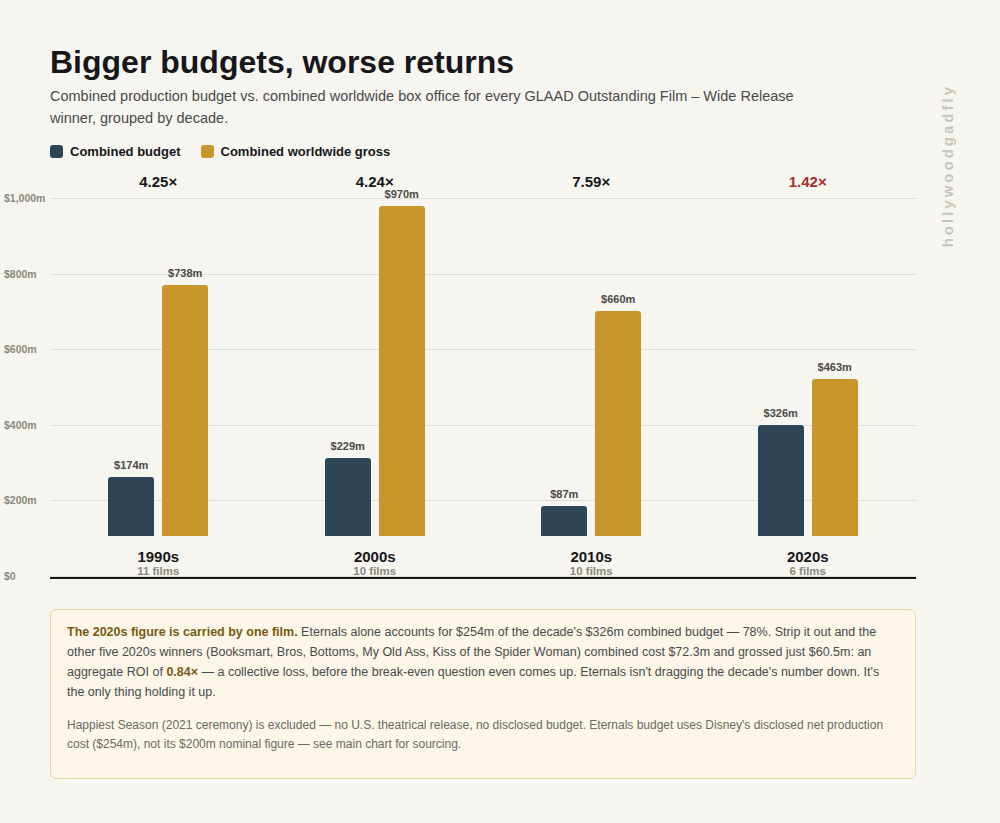
GLAAD seems to have switched from awarding the most financially successful movies to awarding other qualities. And if you break out the gender of the winners, the 2020s, just like with the Oscars, has the highest percentage of female-directed winners by far, more than all the other decades combined.
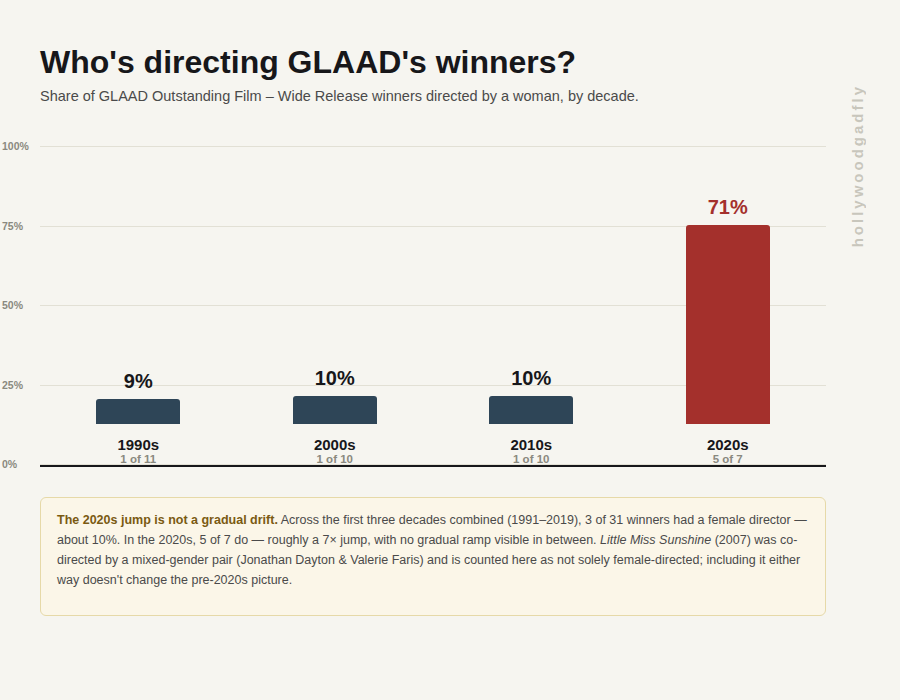
The awards seem to have shifted toward female-directed films in this decade, alongside a real decline in winner profitability. It’s worth noting that the two male-directed winners, Bros and Kiss of the Spider Woman, were genuine bombs, especially the latter, the worst performing GLAAD winner of all time.
In the last few years, GLAAD seems to have been remarkably bad at awarding films that make money, which is one of the only clear data points I can find for their CEO’s “Studios Are Leaving Money on the Table” claim we opened with.
If we are going by GLAAD’s own voting preferences, they are currently very bad at identifying and praising those queer films that actually make money. They haven’t awarded a film that cleared our break-even threshold since 2020’s Booksmart.
After pondering it at length, there’s one more serious issue I have with these studies.
These Studies May Actually Narrow Queer Representation
This goes back to my theory of why progressive ideology and dramaturgy are incompatible. Imagine having a GLAAD person consulting on your erotic thriller, a genre fueled by femme fatales and betrayals.
The safest way to avoid criticism is to have the queer characters be sympathetic main characters, a choice which is also likely “problematic” if you aren’t queer yourself.
Because GLAAD’s requirements that characters be explicitly queer and ideally main characters inevitably starts to make the film a queer film, which may or may not appeal to mainstream heterosexual audiences. In fact, it would be interesting to find that out from a study like GLAAD.

Imagine, for example, the Rosamund Pike character in Gone Girl updated for a queer audience. This would almost certainly trigger flags for the GLAAD team: the character is genuinely psychotic. How about Fatal Attraction? We already know they weren’t happy with two bisexual leads in the remake of The Hand that Rocks the Cradle, another thriller, which they accused of using “outdated tropes”:

So we know from activists that it’s best to write a script with sympathetic queer leads, and ideally non-queer antagonists, or at least not trope-y ones, then hand them to a suitable director, one who is ideally also the right kind of queer, who wants to do your script, and is powerful enough to get it made.
It’s a tall order.
This is, I suspect, part of why there might be a decline in inclusion; activists give filmmakers a lot of impossible conditions to fulfill. More than a handful of colleagues have run the gauntlet of trying to get a film made with a lead of an identity group that they themselves do not belong to.
I have seen several colleagues strike out with beautiful scripts, often their best, because they feature main characters not in their exact sexual, gender and racial identity groups. This no doubt happens routinely, in an industry where audiences, ironically, are highly unlikely to even be aware of the director’s identity.
As I wrote in my piece The Virtuous, the Assholes and the Damned:
General audiences literally have no clue who’s behind the camera. YouGov runs a poll of general American audiences where they ask them if they’ve even heard of a famous director. Not even if they’ve seen a film, just if they’ve heard of the director.
Only 69% of them recognized director number 20, a little indie filmmaker named Stanley Kubrick.
So if activists were calmer about people directing outside their identity lane, there would of course be more representation. They could always firebomb the shitty representations after the films were actually made, as they should.
But as it stands, I have seen several filmmakers simply choose to avoid writing these characters, because why expose yourself to a wave of criticism with almost no potential payoff?
These organizations are actually increasing the risk of making projects that feature the people they claim to champion in an already impossibly risky business, and people who want to sell things and get them made obviously take notice.
Several working writers have described to me, on condition of anonymity, absurd identity discussions where, by the time all the executives have mitigated the perceived risks of representing a queer character, the world no longer resembles the one we actually live in.
These conversations often consume an entire week. I have experienced it myself with the non mainstream identity characters; the executives endlessly obsess over them, often ignoring far larger characters or story issues in the process.
These organizations and their reports have helped create our Kafkaesque world, where it’s safer to distort reality than to represent it.
Only Crazy People Try To Please Activists
But no smart person makes movies for activists. My real concern is that all this seems to have the net effect of creating a lot less interesting, challenging roles for diverse leads.
Because the only place where the right people are always morally good and avoid harmful tropes in ways activists approve of is called propaganda, not art.
I honestly think now that these organizations woukd be far more helpful if they started funding the kind of films they want to see.
I understand why diverse actors would intuitively view these studies and activist organizations as a net gain, but if the real goal is increasing overall roles and work, they likely do the opposite. If a brilliant role is created by the wrong person, shouldn’t an actor still have the opportunity to choose to play it?
But there are several, even more uncomfortable reasons for the extremely small number of specifically trans roles, which yield a paradox that might well go a long way towards explaining their severe underrepresentation among theatrical leads.
Stay tuned for my next essay, which will discuss this issue in depth.
Holy moly, you're doing great work here, HG! Just upgraded to paid.
I agree with 99% of your essay. GLAAD is powerful and I shudder to think what they'd do with my script that features a queer boy exploring who he is with skirts and tiaras, etc. IRL teens explore who they are.
I fear that GLAAD would push this character way out of balance -- no gray at all, 100% trans -- which would destroy the film. I hope the aggressive extremism of that side has calmed some over recent years. Militancy like that can kill a movie.
As to the 1% that I disagree with: your quote that activists are "...the most joyless audience members on earth."
As a one-time activist, I think I'm pretty joyful. I laugh. I smile. I joy.
Brilliant piece with all the receipts needed...to call out that the (Gay, Latino, Black, Asian, et all) Emperor's ( COMPLAINTS) have no clothes ( aka merit).
Tell a great story in a great way, and people will come and see - regardless of the segmentation and demographic "represented". How about we make films and TV- instead of propaganda?